
Custom Food Trailers in Tacoma: Why Local Entrepreneurs Choose Golden State Trailers
Custom Food Trailers in Tacoma

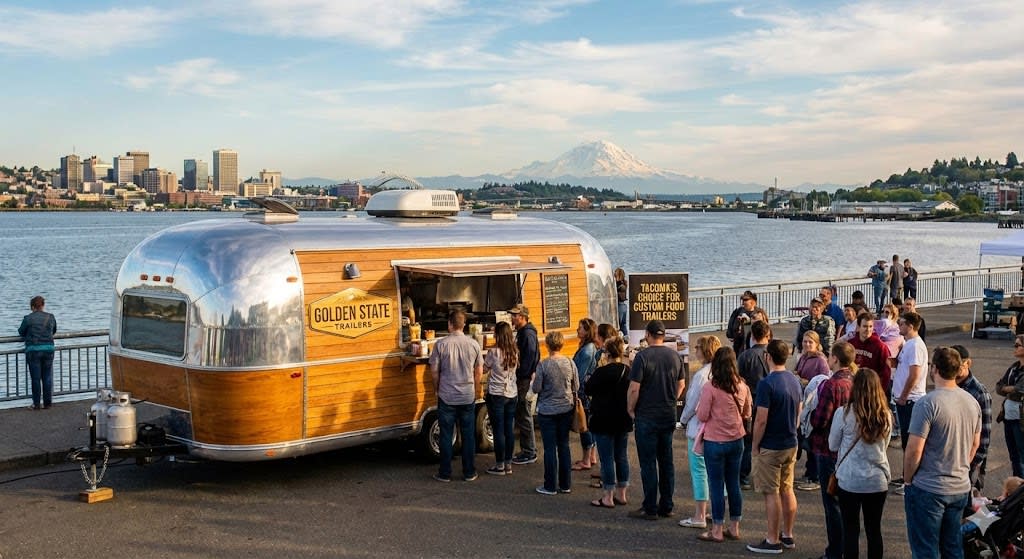
Starting a mobile food business in Tacoma, Washington involves far more than a strong menu idea and entrepreneurial drive. The city operates under Washington State’s strict mobile food regulations, making trailer design, safety systems, and inspection readiness critical factors for success. For many local entrepreneurs, understanding these requirements early can prevent costly delays and operational setbacks.
As interest in mobile food concepts grows across the Pacific Northwest, Tacoma has emerged as a competitive and regulation-heavy market. Entrepreneurs searching for food trailers quickly learn that not all units are built to meet Washington Labor & Industries (L&I) standards. Electrical systems, ventilation, plumbing, and fire safety measures must meet precise guidelines before a trailer can legally operate.
Understanding Washington’s Mobile Food Regulations
Washington State maintains one of the most detailed inspection frameworks for mobile food units in the country. L&I inspections focus heavily on electrical compliance, proper ventilation, fire suppression readiness, potable water systems, and structural safety. Even minor oversights can lead to inspection failures, redesign costs, or long approval delays.
Because of this, many Tacoma operators prioritize trailers that are designed with regulatory compliance in mind rather than adapting generic or out-of-state builds. A trailer designed specifically for Washington conditions reduces the risk of costly modifications later in the process.
Why Custom Design Matters for Tacoma Food Trailers
Tacoma’s food scene is diverse, ranging from coffee and dessert trailers to full-service kitchens and seafood concepts. Each business type has unique workflow, equipment, and space requirements. A custom-built trailer allows operators to design a layout that supports efficiency, safety, and daily high-volume service.
Custom design typically focuses on:
- Practical kitchen workflow to reduce congestion
- Proper spacing between cooking equipment
- Ventilation aligned with local fire codes
- Utility placement that supports faster service
- Exterior design that reflects the brand without violating local guidelines
These factors directly affect daily operations and long-term sustainability.
Climate Considerations in Trailer Construction
Tacoma’s coastal climate brings frequent rain, cooler temperatures, and high humidity. Over time, trailers built with lower-grade materials may experience corrosion, electrical issues, or insulation failures. For this reason, many local operators emphasize durability, weather resistance, and reinforced structural components when evaluating trailer options.
Commercial-grade materials, sealed surfaces, and properly insulated systems help ensure consistent performance year-round, even during peak service hours in less predictable weather conditions.
The Role of Planning Tools in Trailer Design
Some trailer manufacturers now offer online planning tools that allow operators to visualize layouts before construction begins. These tools can help entrepreneurs:
Choose appropriate trailer sizes
- Select equipment compatible with local regulations
- Plan service window placement
- Optimize kitchen workflow
- Align aesthetics with functional needs
When aligned with Washington State codes, these planning systems help reduce errors and support smoother inspection processes.
Supporting a Wide Range of Food Concepts
Tacoma’s mobile food market supports a variety of business models. Successful trailers are often adapted for:
- Coffee and espresso service
- Street food and taco operations
- BBQ and smoker-based menus
- Seafood preparation
- Dessert and pastry concepts
- Full-service mobile kitchens
Each concept requires specific equipment configurations and safety considerations, reinforcing the importance of thoughtful design and compliance-focused engineering.
Reducing Risk Before Opening Day
One of the most common challenges faced by mobile food operators is inspection failure due to non-compliant builds. Redesigns, retrofits, and system corrections can delay launch timelines and significantly increase startup costs.
Trailers designed around Washington’s regulatory framework help minimize these risks by:
- Streamlining inspection approvals
- Reducing post-build modifications
- Supporting smoother health department reviews
- Allowing operators to focus on operations rather than compliance fixes
This preparation often results in a more predictable and financially stable launch.
Why Experience With Local Regulations Matters
Tacoma entrepreneurs often seek builders who understand Pierce County inspections and Washington-specific requirements. Familiarity with local expectations can make the difference between a smooth approval process and repeated inspection setbacks.
Rather than prioritizing appearance alone, experienced builders focus on functionality, safety, and long-term reliability. This approach aligns with the needs of serious operators planning sustainable mobile food businesses in the region.
Final Perspective
Launching a food trailer in Tacoma is both an opportunity and a regulatory challenge. Success depends not only on culinary creativity but also on thoughtful planning, compliance awareness, and durable construction. Entrepreneurs who understand Washington’s standards early and choose solutions built for local conditions are better positioned for long-term stability.
A well-designed food trailer becomes more than a mobile kitchen — it becomes the foundation for growth in one of the Pacific Northwest’s most dynamic food markets.
About the Creator
Abbasi Publisher
Khurram Abbasi is a professional content strategist and writer, founder of Abbasi Publisher, specializing in guest posting, high-authority backlinks, and media placements to elevate brands and digital presence.
Keep reading
More stories from Abbasi Publisher and writers in Writers and other communities.
The Language of Luxury in Women’s Handbags
In fashion, handbags exist beyond function. They are cultural objects: carriers of identity, taste, and personal philosophy. Long before they hold essentials, they communicate restraint or boldness, heritage or modernity, intention or instinct. In luxury fashion, this language is spoken quietly, through form, material, and detail rather than excess.
By Abbasi Publisherabout 12 hours ago in Writers
The Comeback Generation: Why Starting Over After 30, 40, or 50 Is Becoming the New Path to Success
For decades, society told a simple story about success: figure out your life early, build your career fast, and lock in your future before you get “too old.” The message was subtle but powerful — if you didn’t make it in your twenties, you were somehow behind. Today, that story is breaking apart. Across the world, people in their thirties, forties, and fifties are walking away from careers, routines, and identities that no longer fit. They are starting businesses, learning new skills, moving to new cities, and chasing dreams they once believed were no longer allowed. This shift is being driven by more than just dissatisfaction. It’s being driven by clarity. With age often comes a deeper understanding of what truly matters. Many people spend their younger years chasing external approval — money, titles, or social status. But after years of experience, they begin to ask different questions. Do I enjoy my daily life? Does my work reflect my values? Am I proud of how I spend my time? For some, the answers lead to a powerful realization: staying the same feels riskier than starting over. Technology has made this kind of reinvention more possible than ever. Online courses allow people to learn new careers from their living rooms. Remote work opens doors to opportunities that were once limited by geography. Social platforms give individuals the ability to build personal brands, launch creative projects, or start businesses without massive upfront costs. What once required permission from companies, investors, or institutions can now begin with a laptop and an internet connection. But the comeback generation isn’t just about opportunity. It’s about mindset. One of the biggest barriers to starting over is fear — fear of failure, judgment, and wasted time. Many people worry that changing direction means admitting they made a mistake. But a growing number of voices are reframing that idea. They see their past not as a failure, but as training. Every job, relationship, and challenge becomes part of a skillset. Communication, resilience, problem-solving, and emotional intelligence don’t disappear when someone switches careers or goals. They carry forward, often making older beginners stronger than younger ones. There is also a quiet confidence that comes with experience. Younger people often feel pressure to prove themselves. Older beginners tend to care less about appearances and more about meaning. This shift in focus can lead to deeper commitment and greater satisfaction. Of course, starting over is not easy. It can involve financial uncertainty, uncomfortable learning curves, and moments of self-doubt. Watching younger people succeed in the same space can trigger insecurity. The question “Am I too late?” can echo loudly in the mind. But many in the comeback generation are discovering a powerful truth: there is no universal timeline for a meaningful life. Some of the most successful entrepreneurs, artists, and leaders didn’t find their true path until later years. What they often share is not youthful speed, but persistence. They kept moving forward, even when progress was slow and the outcome uncertain. There is also a cultural shift happening. Communities are becoming more supportive of non-linear life paths. Changing careers, taking breaks, and exploring new identities are becoming more accepted. The idea of having “one job for life” is being replaced by the idea of having many chapters. In this new story, life is not a straight road — it’s a landscape. Sometimes you climb. Sometimes you wander. Sometimes you stop and choose a completely new direction. And that choice, made at any age, can be an act of courage. The comeback generation isn’t trying to turn back time. They are using it — using what they’ve learned, what they’ve survived, and what they now understand about themselves. Because success is no longer being defined by how early you start. It’s being defined by how boldly you choose to continue.
By Hazrat Usman Usman2 days ago in Writers
Smart phones, Humans and Aliens.
WARNING. I will be tapping into one of your favorite creative tensions: The absurdity of humans worshipping their glowing rectangles as if they were tiny oracles. There’s something deliciously poetic about that contradiction, and it lends itself beautifully to an instructive proviso.
By Novel Allen5 days ago in Poets




Comments
There are no comments for this story
Be the first to respond and start the conversation.