
Creative Challenges and Prompy
The Science Behind Constraints and Why Limitations Actually Fuel Innovation

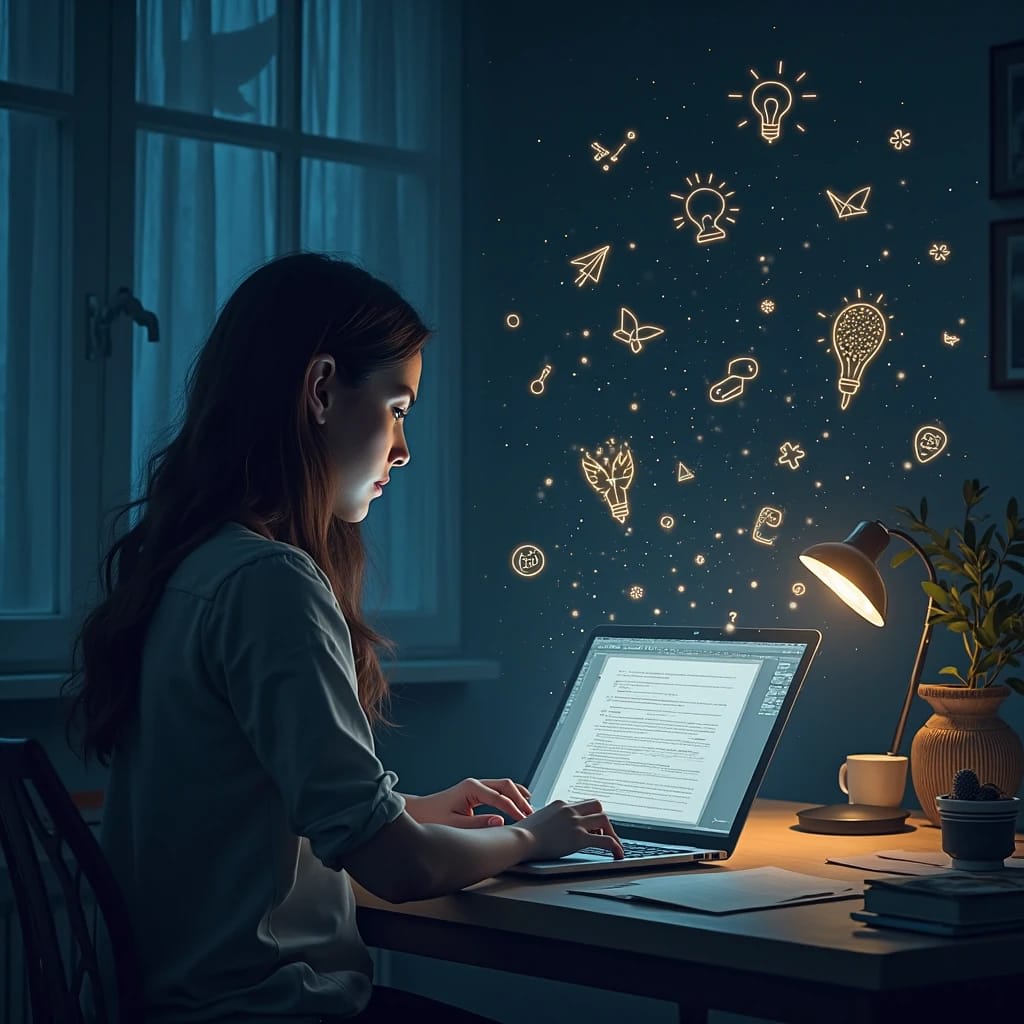
At 3 AM on a Tuesday, Maria sat staring at her laptop screen, cursor blinking mockingly at the beginning of an empty document. She had all the freedom in the world—write anything, about anything, in any style she wanted. Yet somehow, that infinite possibility felt more paralyzing than liberating. Then she remembered the writing challenge her friend had sent her: "Write a complete story using only questions. 500 words. You have one hour." Suddenly, her fingers began to move, and by 4 AM, she had crafted one of the most compelling pieces she'd ever written.
Maria's experience illustrates a paradox that creative professionals have long recognized: sometimes the best way to unleash creativity is to cage it first. Creative challenges and prompts don't limit our imagination—they give it direction, focus, and surprisingly, freedom.
The Psychology of Creative Constraints
Why Limitations Liberate the Mind
The human brain, for all its remarkable capabilities, can become overwhelmed by too many choices—a phenomenon psychologists call "choice paralysis." When faced with unlimited creative possibilities, our minds often shut down rather than explore. This isn't a flaw; it's actually an evolutionary feature designed to help us make decisions efficiently in a world full of options.
Creative constraints work by eliminating the paralysis of infinite choice and forcing our brains to work within specific parameters. This focused limitation activates what researchers call "associative thinking"—the process by which our minds make unexpected connections between seemingly unrelated concepts. When we can't rely on obvious solutions, our brains begin to explore more creative pathways.
Dr. Patricia Stokes, author of "Creativity from Constraints," found that constraints actually promote originality by preventing us from falling back on familiar solutions. When we're forced to work within specific limits—whether it's writing a story in exactly 55 words or creating art using only three colors—we discover creative possibilities we never would have explored otherwise.
The key lies in what psychologists term "functional fixedness"—our tendency to think about objects and concepts only in their traditional contexts. Creative constraints break this fixedness by forcing us to approach familiar problems from entirely new angles. A writer challenged to tell a story through text messages discovers new ways to convey emotion. An artist limited to drawing with their non-dominant hand stumbles upon techniques they never would have attempted otherwise.
The Goldilocks Zone of Challenge
Not all constraints are created equal. The most effective creative challenges exist in what researchers call the "Goldilocks Zone"—not too easy, not impossibly difficult, but just right. Challenges that are too simple fail to push us beyond our comfort zones, while those that are too complex can recreate the paralysis we're trying to avoid.
The sweet spot involves constraints that are specific enough to provide direction but flexible enough to allow for personal interpretation and style. A challenge to "write about love" might be too broad, while "write a love story between two competing food truck vendors in exactly 247 words using only dialogue" provides the perfect balance of specificity and creative freedom.
Successful creative challenges also incorporate time limits, which serve multiple psychological functions. Deadlines prevent perfectionism—the creativity killer that keeps us endlessly revising instead of creating. They also trigger a mild stress response that can actually enhance creative thinking by increasing focus and reducing self-censorship.
The Anatomy of Effective Creative Prompts
Elements That Spark Innovation
The most powerful creative prompts share several key characteristics that maximize their ability to generate original work. First, they often contain an element of surprise or contradiction that forces creators to think beyond conventional approaches. "Write a horror story set in a flower shop" or "Create a sculpture that makes people laugh" combine familiar elements in unexpected ways.
Effective prompts also leverage the power of specificity. Instead of asking someone to "draw a person," a more engaging prompt might be "draw someone who has just discovered something they lost twenty years ago." The specific scenario provides emotional context and narrative hooks that generic prompts lack.
Multi-sensory prompts tend to produce particularly rich creative work because they engage different areas of the brain simultaneously. "Create something inspired by the sound of rain on a tin roof" or "Write a story that captures the feeling of velvet" force creators to translate sensory experiences across different media, often resulting in surprisingly innovative approaches.
The best prompts also contain implicit questions that creators must answer through their work. "Show what courage looks like when no one is watching" requires the creator to define courage, consider its private expressions, and find ways to communicate abstract concepts through their chosen medium.
The Power of Random Elements
Some of the most effective creative challenges incorporate elements of chance or randomness that push creators into truly unexplored territory. Drawing three random words from a hat and creating a story that connects them, or using a random number generator to determine the structure of a poem, forces our brains to make connections we never would have attempted otherwise.
This randomness serves multiple functions: it eliminates the burden of choice (reducing decision fatigue), introduces elements we wouldn't naturally gravitate toward, and often results in combinations so unusual that they spark genuine originality. Many professional writers and artists regularly use random prompt generators specifically because they lead to work they never would have created through intentional planning.
Random elements also help creators overcome creative blocks by bypassing the critical mind that often stops us before we begin. When we're working with randomly generated constraints, we can't second-guess whether our ideas are "good enough" because the parameters themselves are arbitrary. This permission to experiment often leads to breakthrough moments.
From Individual Practice to Community Building
The Social Dimension of Creative Challenges
While creative challenges can be powerful tools for individual growth, they become exponentially more engaging when shared with others. Online writing communities, art challenge hashtags, and creative prompt groups have exploded in popularity because they combine the motivation of constraints with the energy of community participation.
Participating in group challenges provides accountability that solo practice often lacks. When others are expecting to see your daily sketch or weekly story, the social pressure helps maintain consistency even when motivation flags. This external accountability is particularly valuable for developing creative habits and pushing through resistance.
Community challenges also offer the unique opportunity to see how different creators interpret identical prompts. Witnessing twenty different artists respond to the same challenge demonstrates the infinite possibilities within any constraint and often inspires new approaches to future work. This exposure to diverse creative solutions expands our own toolkit of techniques and approaches.
The feedback and encouragement that emerge from creative communities can be transformative for developing artists and writers. Constructive responses to challenge submissions provide learning opportunities that isolated practice cannot match, while positive reinforcement builds confidence and encourages continued experimentation.
Building Your Own Challenge Practice
Creating a sustainable creative challenge practice requires thoughtful planning and realistic expectations. Start small—committing to a daily 5-minute writing exercise is more valuable than attempting hour-long sessions that you'll abandon after a week. Consistency matters more than duration when building creative habits.
Variety keeps the practice engaging over time. Rotate between different types of challenges: visual prompts one week, word-based challenges the next, or prompts that focus on specific techniques or genres. This variation prevents boredom while developing different creative muscles.
Track your progress and celebrate small wins. Keep a journal of completed challenges, note which types of prompts generate your best work, and observe how your skills develop over time. This documentation provides motivation during difficult periods and helps you understand your creative process more deeply.
Don't be afraid to modify prompts to suit your interests and skill level. The goal is growth and exploration, not rigid adherence to arbitrary rules. If a prompt isn't inspiring you, tweak it until it becomes engaging. The act of customization itself is a creative exercise.
The Long-Term Impact of Constraint-Based Creativity
Regular engagement with creative challenges produces benefits that extend far beyond individual projects. Creators who regularly work within constraints develop mental flexibility and problem-solving skills that apply to all aspects of their creative work. They become more comfortable with uncertainty, more willing to experiment, and more capable of finding solutions when facing creative obstacles.
Perhaps most importantly, creative challenges help artists and writers discover their authentic voice by forcing them to work outside their comfort zones. When we can't rely on familiar techniques and approaches, we're compelled to dig deeper and find new ways of expression that are uniquely our own.
The discipline required to complete regular creative challenges also builds the professional habits necessary for sustained creative work. Meeting deadlines, producing work consistently, and pushing through resistance are skills that serve creators throughout their careers, whether they're freelancing, seeking publication, or building artistic practices.
Embracing the Challenge
Creative challenges represent more than exercises or games—they're powerful tools for discovering what we're truly capable of when freed from the tyranny of infinite choice. By embracing constraints rather than fighting them, we unlock creative potential that remains hidden in the face of unlimited possibility.
The blank page will always be intimidating, but it doesn't have to be paralyzing. Armed with the right constraints, that empty space becomes not a void to fill, but a playground for exploration. The question isn't whether you have enough creativity to fill it—it's which boundaries you'll choose to guide that creativity toward something extraordinary.
Your next creative breakthrough might be just one constraint away.
About the Creator
Muhammad Sabeel
I write not for silence, but for the echo—where mystery lingers, hearts awaken, and every story dares to leave a mark
Keep reading
More stories from Muhammad Sabeel and writers in Writers and other communities.
100 Tiny Joys: How Ordinary Moments Create an Extraordinary Life (No Grand Gestures Needed)
I was elbow-deep in dishwater, scrubbing burnt oatmeal off a pan I’d neglected again, when it hit me: Life wasn’t happening "out there." It wasn’t waiting for a promotion, a vacation, or some seismic shift. It was here. In the stubborn oatmeal. In the lukewarm soap suds. In the way the morning sun hit the bubbles, turning them into shimmering, temporary galaxies. I almost missed it – again – chasing the phantom of "extraordinary."
By Muhammad Sabeel8 months ago in Writers
Unofficial Challenge: Black History Celebration
Forward: February 28th, 10:53 PM, EST... The final hour of Black History Month, 2026. Hello fellow writers. I've had this challenge waiting in my drafts for most of the month. But I held off on publishing it, until now.
By Sam Spinelli3 days ago in Writers




Comments
There are no comments for this story
Be the first to respond and start the conversation.