
Comprehensive Guide to Annotation Cost Optimization
Effective Strategies to Minimize Costs While Maintaining High-Quality Annotations


As more businesses adopt AI and ML, the demand for high-quality annotated data is growing. Whether it's a retail business looking to personalize customer experiences or a healthcare provider aiming to streamline diagnostics, businesses must rely on accurate, well-annotated training datasets prepared by data annotation service providers, to fuel their AI initiatives.
This rising demand for labeled data underscores the importance of efficient and cost-effective annotation processes that align with the limited resources of smaller enterprises, highlighting the need for annotation cost optimization.
Understanding the various cost components of data annotation is vital to managing budgets and ensuring project feasibility. By focusing on reducing image annotation costs without compromising quality, such as leveraging automation, outsourcing smartly, and optimizing annotation guidelines, businesses can achieve effective annotation cost optimization to achieve success in their AI-driven initiatives.
Understanding Annotation Cost Components
Annotation costs are driven by several key factors, including the complexity of the data, the volume of annotations needed, the required quality standards and the efficiency of the annotation tools used. Additionally, labor costs and the expertise of annotators play a significant role. By optimizing processes and incorporating automation, businesses can effectively reduce these costs while maintaining quality.
Key Components of Annotation Costs
The key components of annotation costs include data complexity, annotation volume, quality requirements, tool usage, workforce expertise, and project timelines. Balancing these factors is crucial for cost-effective, high-quality data annotation.
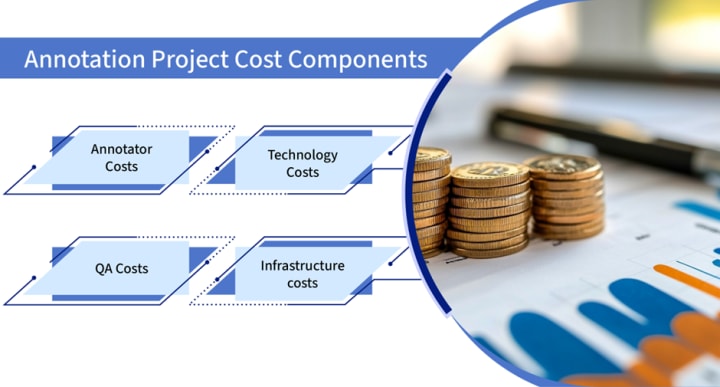
Labor Costs: The largest expense in data annotation for businesses is often the labor involved in manually tagging and labeling data.
Technology and Tools Expenses: While tools can enhance efficiency, they also add to the overall cost, which can be challenging for businesses with limited budgets.
Quality Assurance and Control Costs: Ensuring quality standards in annotation is crucial to getting the most out of their AI models. However, the cost can be another financial strain.
Infrastructure and Operational Costs: Maintaining the necessary infrastructure, such as servers and storage, to support data annotation can also contribute to costs.
Factors Contributing to Annotation Costs
Annotation costs are influenced by complexity, annotation type (manual or automated) time required for labeling, quality assurance processes, and much more. Each factor drives cost variations.
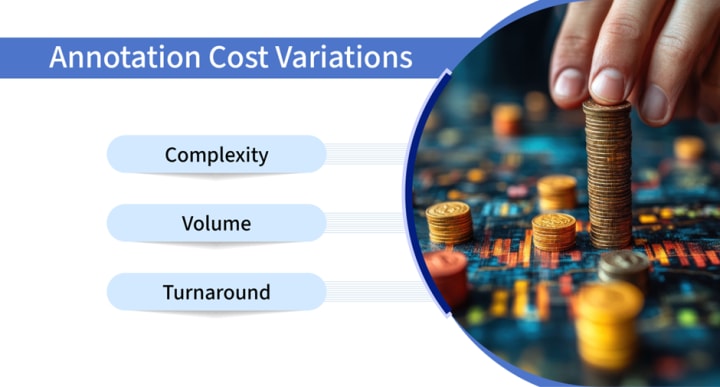
Complexity of Task: If the task is complex, such as annotating detailed images or nuanced text, it will require more time and expertise, driving up costs.
Volume of Data: The more data that need to be annotated, the higher the cost. Small businesses must balance the need for large datasets with their available budgets.
Turnaround Time: If a small business needs data annotated quickly, it may need to allocate more resources, which can increase costs. Planning for realistic timelines can help mitigate this expense.
Annotation Cost Optimization Strategies
When managing data annotation projects, controlling costs without compromising quality is critical. By understanding the primary cost drivers and identifying areas for improvement, businesses can achieve better efficiency and value. Below are some effective strategies to optimize annotation costs while maintaining high-quality outcomes.

1. Leverage Automation Tools
Automation tools are invaluable for reducing data annotation costs, particularly when dealing with repetitive tasks. These tools can automate the labeling of data based on predefined rules or patterns, allowing human annotators to focus on more complex tasks that require higher levels of expertise. Regular updates and training of these tools are essential to maintain accuracy and relevance, ultimately leading to cost savings without sacrificing quality. Implementing these cost-effective data annotation strategies is key to optimizing both efficiency and expenditure in the annotation process.
Rule-Based Systems: Implement simple rule-based automation for basic annotations as a starting point.
Active Learning: Utilize active learning to have the model identify challenging cases for human review and improve efficiency.
Continuous Model Training: Keep automation tools updated with the latest data to ensure ongoing accuracy.
Hybrid Systems: Combine supervised and unsupervised learning to handle both structured and unstructured data.
2. Outsourcing Data Annotation
Outsourcing data labeling and annotation services is a strategic way to achieve budget friendly data annotation, particularly when you partner with specialized firms. It's essential to choose outsourcing partners carefully, ensuring they have the necessary expertise in your domain and adhere to stringent quality control processes. Outsourcing to countries with lower labor costs can lead to significant annotation cost optimization, but it's important to balance these savings with the need for high-quality annotations.
Geographical Diversity: Outsource to regions with lower costs but ensure the team has relevant cultural and language expertise.
Tiered Outsourcing: Assign simpler tasks to outsourced teams and keep more complex tasks in-house or with specialized partners.
Quality Assurance Protocols: Implement strict quality checks and regular audits to maintain high standards in outsourced work.
Scalability: Choose outsourcing partners who can scale their services as your project grows, ensuring cost efficiency.
3. Implement a Human-in-the-Loop System
A human-in-the-loop (HITL) system is a powerful approach that combines the efficiency of automation with the accuracy of human oversight. In this model, automation handles straightforward labeling tasks, while human annotators review and correct errors, especially in complex cases. By strategically integrating human expertise where it's most needed, businesses can significantly reduce the costs associated with manual annotation while maintaining or even improving data quality.
Selective Intervention: Use human intervention only where automation struggles, optimizing resource allocation.
Continuous Feedback Loops: Create feedback loops between human reviewers and automation tools to improve the system's accuracy.
Quality Control: Use HITL systems for quality assurance, where humans verify the work done by automated systems.
Training Data: Leverage the insights from human corrections to refine and enhance the training data for automation tools.
4. Use Pre-Labeled Datasets
Pre-labeled datasets can serve as a cost-effective foundation for training machine learning models, reducing the need for extensive custom annotation. These datasets provide a starting point that can be adapted and refined to fit your specific project requirements. While pre-labeled datasets may not always align perfectly with your needs, they can significantly reduce the time and cost associated with annotation, particularly when combined with additional custom labeling.
Dataset Relevance: Carefully select pre-labeled datasets that closely match your project's requirements to minimize additional labeling needs.
Cost Comparison: Compare the cost of acquiring pre-labeled datasets versus the cost of manual annotation.
Quality Verification: Perform quality checks on pre-labeled datasets to ensure they meet your standards before integrating them.
Integration Strategy: Develop a strategy for integrating pre-labeled data with your own annotations to enhance model training.
5. Optimize Annotation Guidelines
Optimizing annotation guidelines is critical to ensuring consistency and efficiency in the labeling process. Clear, concise and well-structured guidelines reduce the likelihood of errors, minimizing the need for rework and lowering costs. Regularly reviewing and updating these guidelines to reflect changes in the project scope or objectives is essential. Involving annotators in the creation and refinement of guidelines can provide valuable insights, leading to more effective and streamlined annotation processes.
Clarity and Precision: Ensure guidelines are clear and precise to minimize ambiguity and errors.
Regular Updates: Periodically review and update guidelines to keep them aligned with project needs.
Annotator Involvement: Engage annotators in the guideline development process to incorporate practical insights.
Tiered Guidelines: Create tiered guidelines for different levels of annotation complexity and optimizing efficiency.
Training and Onboarding: Use guidelines as part of the training and onboarding process for new annotators to ensure consistency from the start.
Maintaining Quality Annotations on a Budget
Quality annotation on a budget can be effectively achieved by implementing quality assurance protocols that leverage a human-in-the-loop (HITL) approach. By strategically involving human reviewers in the annotation process, particularly in complex or critical cases, businesses can ensure that quality standards in annotation are upheld. This selective human intervention, combined with automated processes, allows for annotation efficiency improvement by reducing the need for exhaustive human oversight while still catching and correcting potential errors, thereby optimizing both cost and quality.
Wrapping It Up
Reducing annotation costs without compromising quality is not just a matter of cutting corners but strategically optimizing processes and leveraging the right tools.
By embracing automation, refining annotation workflows, and ensuring a balanced approach with human oversight, businesses can achieve substantial cost savings while maintaining high standards. Investing in scalable solutions, such as advanced machine learning models and efficient annotation platforms, enables companies to meet their budgetary constraints and drives long-term success.
About the Creator
Vaishali Sharma
I am a Digital Marketing Specialist at HitechDigital, a premier provider of business process services and data analytics solutions.
Keep reading
More stories from Vaishali Sharma and writers in Writers and other communities.
5 Ways Image Annotation Can Improve the Accuracy of Your Computer Vision Models
Image annotation plays a crucial role in the development and enhancement of computer vision models, serving as the backbone for training AI and ML systems to accurately recognize and interpret visual data like humans.
By Vaishali Sharma2 years ago in 01
It's Winter
Anne Bernays and Pamela Painter — What If? Writing Exercise for Fiction Writers prompts The Exercise —Write a scene involving two characters. Have the point-of-view character presume something entirely different about the situation from what the other character's overt behavior seems to imply. For example, a landlord comes to visit, and the tenant suspects that it isn't a visit but an inspection. Make up several situations in which one character can fantasize or project or suspect or even fear what another character is thinking. The Objective - To show how your characters can use their imaginations to interpret the behavior and dialogue of other characters.
By Denise E Lindquist21 days ago in Writers
Working To Find Work
Working To Find Work: How College Graduates Are Struggling for Employment By Jonathan Mandel 14 January 2026 Historically, college graduates have enjoyed higher employment rates than their high school graduate counterparts. This seemed like an obvious occurrence: Having gone through the rigors of higher education, recent college graduates have historically been granted greater, more lucrative access to the labor market due to their advanced degree.
By Jonathan Mandel6 days ago in Writers



Comments