
Centrifugal Pump: How Industrial Submersible Pumps Continually Drive Progress
Industrial Automation and Machinery
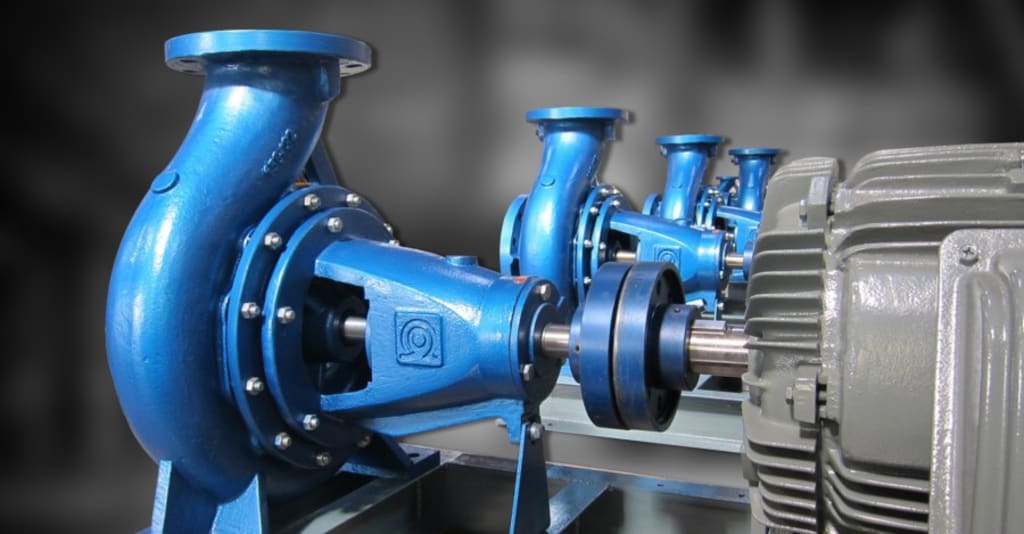
Cantilever pumps work on the basic principle of centrifugal force. Liquid enters the pump impeller eye from the pump suction and is accelerated by the rotating impeller. The rotating impeller imparts velocity and kinetic energy to the incoming liquid. As the liquid exits the impeller, it moves in a spiral manner due to the centrifugal force generated in the rotating impeller. The spiral liquid movement results in conversion of velocity head to pressure head. The high-pressure liquid is discharged through the pump outlet. The pump requires an external source of mechanical power such as electric motor to rotate the impeller. Impeller rotation causes acceleration of inlet liquid giving rise to discharge pressure.
Main Components of Centrifugal Pump
The main components of a cantilever pump include casing, impeller, shaft, mechanical seal and bearing arrangement.
Casing- It encloses the impeller and forms the liquid flow passage. Casings are usually made of alloy cast iron, carbon steel or stainless steel.
Impeller- It is the rotating component which accelerates and increases the pressure of the liquid. Impellers are enclosed type with radial or axial vanes. They are made from cast iron, bronze or stainless steel.
Shaft- It transmits rotational motion from driver to the impeller. Shafts are made of stainless steel or alloy steel.
Mechanical seal- It prevents leakage of pumped liquid along the shaft. Common sealing configurations are single or double mechanical seals.
Bearings- They support the pump shaft assembly and allow smooth rotation. Bearing arrangement consists of radial bearings, thrust bearings and bearings housing.
Applications of Cantilever pump
Due to simple construction, robustness and affordability, Centrifugal Pump find widespread use across industries for liquid handling applications. Some key application areas include:
Water and Wastewater Industry- Popular applications are water supply, water circulation, sewage transfer and sludge transfer in treatment plants.
Power Industry- Used for boiler feed, cooling water circulation and condensate extraction in thermal power and nuclear power plants.
Marine Industry- Used for bilge pumping, ballast transfer, firefighting and cooling applications in ships and marine vessels.
Oil and Gas Industry- Used for crude oil transfer, petroleum product pumping, natural gas pumping and offshore platform services.
Process Industry- Common usages are chemical transfer, product transfer, cooling service, heating service and pressure boosting in chemical, petrochemical and pharmaceutical plants.
Pulp and Paper Industry- Important applications involve black liquor transfer, stock preparation, white water collection and machine drainage.
Types of Cantilever pump Based on Impeller and Casing Configuration
Cantilever pumps are classified according to the impeller and casing configuration into the following major types:
Radial Flow Pump:- Has straight vanes to impart outward radial flow. Commonly used in low head applications.
Axial Flow Pump:- Impeller vanes are arranged parallel to axis of rotation. Used for very high flow rates against low discharge pressures.
Mixed Flow Pump:- Combines features of radial and axial designs with vanes angled between 10°-45°. Used for medium flow rates against moderate heads.
Double Suction Pump:- Impeller mounted between two suction flanges for balanced radial loads. Used for high discharge heads up to 150 m.
Multi Stage Pump:- Has two or more impellers housed in a common casing with intermediate suction and delivery chambers. Caters to higher head requirements over 200 m.
Submersible Pump:- Designed for operation submerged in water with motor section hermetically sealed. Used for bore well, open well and sewage applications.
Centrifugal Slurry Pump:- Features special wear resistant materials to handle abrasive slurries. Common designs are vortex and slurry knives.
Vertical Turbine Pump:- Shaft is vertically mounted with radially acting impeller for deep well and high head applications.
Advantages and Disadvantages of Cantilever pump
Advantages:
- Simple and compact construction with few moving parts.
- Easy installation, operation and maintenance.
- Robustness and reliability for continuous operation.
- Handle wide range of viscosities and specific gravities.
- High efficiency rating of 80-85% for most models.
- Withstand dry running conditions without damage.
- Affordable price and low cost of ownership.
Disadvantages:
- Requires minimum inlet pressure to overcome NPSH.
- Maximum head limitation below 200 m for single stage units.
- Velocity effects cause vibration and noise at higher flows.
- Damage risk from dry running and cavitation.
- Prime mover needed for imparting mechanical power.
- Impeller erosion and leakage issues with abrasive slurries.
Due to its simple yet efficient design, robust construction and flexibility to handle diverse applications, the cantilever pump remains the preeminent choice globally for liquid and slurry handling duties across all industrial sectors. Manufacturing innovations continue to enhance efficiency and cost competitiveness further cementing its position as the undisputed workhorse of industrial pumping.
Get more insights on Centrifugal Pump
Vaagisha brings over three years of expertise as a content editor in the market research domain. Originally a creative writer, she discovered her passion for editing, combining her flair for writing with a meticulous eye for detail. Her ability to craft and refine compelling content makes her an invaluable asset in delivering polished and engaging write-ups.
(LinkedIn: https://www.linkedin.com/in/vaagisha-singh-8080b91)
About the Creator
Keep reading
More stories from Sneha Biswal and writers in Writers and other communities.
Topical Corticosteroids: Harnessing the Power of Precision in Skin Therapy
In the realm of dermatology, few treatments have stood the test of time quite like topical corticosteroids. These powerful medications have revolutionized the management of various skin conditions, offering relief from inflammation, itching, and discomfort. Despite their widespread use and effectiveness, there remains a need for a nuanced understanding of their application and impact on skin health.
By Sneha Biswal2 years ago in Writers
It's Winter
Anne Bernays and Pamela Painter — What If? Writing Exercise for Fiction Writers prompts The Exercise —Write a scene involving two characters. Have the point-of-view character presume something entirely different about the situation from what the other character's overt behavior seems to imply. For example, a landlord comes to visit, and the tenant suspects that it isn't a visit but an inspection. Make up several situations in which one character can fantasize or project or suspect or even fear what another character is thinking. The Objective - To show how your characters can use their imaginations to interpret the behavior and dialogue of other characters.
By Denise E Lindquist19 days ago in Writers
Where Dreams Loved Me Back
chapter 1 Chapter One: The Quiet I Learned to Carry Matthew’s perspective, I don’t remember when life started feeling heavy. It wasn’t sudden — it was gradual, like carrying a bag that someone kept adding weight to until one day I realized I couldn’t put it down anymore.
By Anshu Giri5 days ago in Writers


Comments
There are no comments for this story
Be the first to respond and start the conversation.