
Blockchain and Real World Asset Tokenization: The Next Financial Revolution
Real World Asset Tokenization

Introduction: The Dawn of a New Financial Era
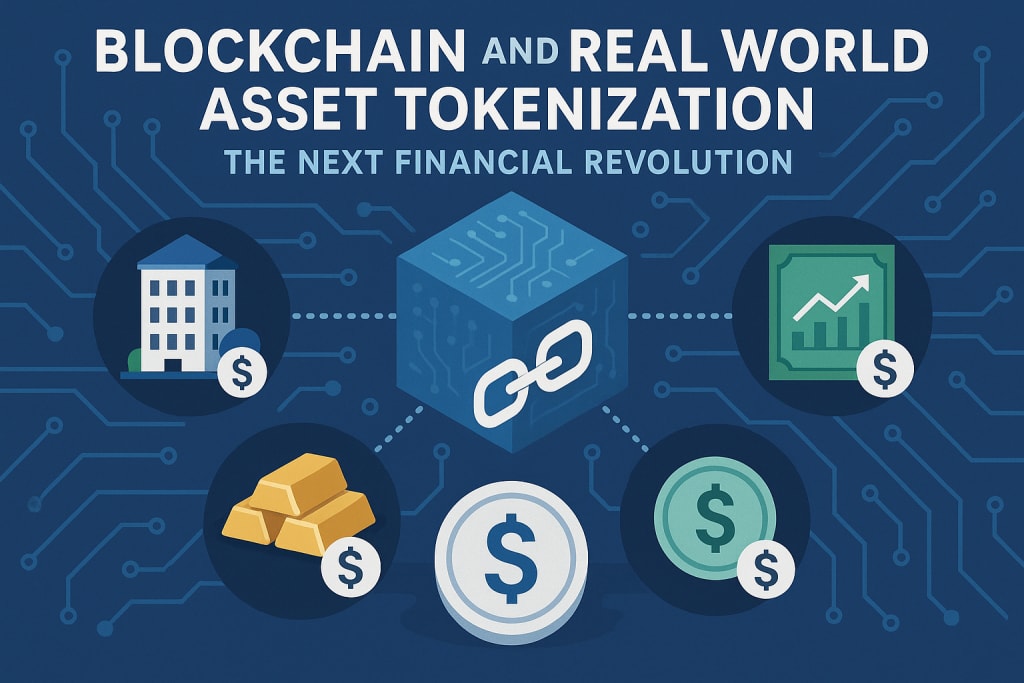
The financial world is experiencing a monumental shift — one that’s powered by blockchain technology and Real World Asset Tokenization (RWA Tokenization). Imagine a world where you can buy a fraction of a skyscraper, invest in fine art, or hold shares of government bonds directly on your digital wallet. That’s not science fiction anymore — it’s happening right now.
Blockchain finance is redefining ownership, trust, and liquidity. By tokenizing physical assets into digital tokens, traditional finance is merging with decentralized asset management, creating what experts are calling the next financial revolution.
Understanding Real World Asset Tokenization
What is Real World Asset Tokenization?
Real World Asset Tokenization is the process of converting physical or traditional financial assets — like real estate, gold, bonds, or even artwork — into digital tokens on a blockchain network. Each token represents a specific share of ownership in that asset.
Think of it like slicing a pie: instead of one person owning the entire pie, thousands of investors can each own a piece — digitally recorded, easily transferable, and securely stored.
The Core Principles Behind RWA
At its core, RWA tokenization is built on three foundational principles:
Transparency – All transactions are recorded on a blockchain ledger, eliminating fraud.
Accessibility – Anyone, anywhere, can invest in global assets without massive capital requirements.
Efficiency – Transfers, dividends, and compliance are automated via smart contracts.
Examples of Tokenized Assets in 2025
Tokenized Real Estate: Luxury apartments in Dubai and New York are being tokenized, allowing micro-investments.
Tokenized Bonds & Treasuries: Institutions are embracing RWA protocols to create on-chain fixed-income instruments.
Tokenized Commodities: Gold, oil, and agricultural assets are now being fractionalized for digital investors.
How Blockchain Powers Real World Asset Tokenization
The blockchain is the heartbeat of tokenization. It ensures security, transparency, and immutability.
Smart Contracts and Decentralized Trust
Through smart contracts, blockchain automates critical processes such as profit distribution, compliance checks, and ownership transfers. This removes the need for middlemen and drastically cuts costs.
Verification and Transparency
Every asset’s details — from valuation to ownership — are stored on-chain, ensuring that transactions are tamper-proof and auditable at any time.
Eliminating Intermediaries with Blockchain Finance
Traditional asset management often involves banks, brokers, and custodians. With decentralized asset management, blockchain replaces these intermediaries with code, increasing speed, lowering fees, and empowering direct peer-to-peer interaction.
Benefits of Real World Asset Tokenization
1. Liquidity and Accessibility
One of the biggest challenges in traditional asset markets is liquidity. Real World Asset Tokenization solves this by enabling fractional ownership, allowing investors to buy, sell, or trade small portions of high-value assets.
2. Democratization of Investments
With RWA tokenization, you don’t need to be a millionaire to invest in prime properties or government bonds. Anyone can own a digital slice of valuable assets.
3. Transparency and Security
Each transaction is recorded on an immutable ledger, ensuring that data cannot be tampered with — boosting investor confidence in blockchain finance.
4. Efficiency and Cost Reduction
Automated smart contracts handle everything from dividend distribution to compliance, slashing administrative costs.
Use Cases and Real-World Examples of Tokenized Assets

Tokenized Real Estate
Developers are using RWA protocols to tokenize luxury apartments, enabling investors to buy shares of multi-million-dollar properties. This transforms illiquid real estate into a tokenized portfolio of assets tradable 24/7.
Tokenized Treasuries and Bonds
Governments and fintech firms are issuing tokenized treasuries, making traditional debt instruments more liquid and globally accessible.
Tokenized Art and Collectibles
Fine art and collectibles are being brought onto the blockchain, where fractional ownership democratizes access to multi-million-dollar masterpieces.
Institutional Adoption
Major financial institutions are adopting decentralized asset management systems to bridge traditional and blockchain-based finance.
The Technology Stack Behind RWA Tokenization
Blockchain Networks and RWA Protocols
RWA platforms rely on secure networks like Ethereum, Polygon, and Avalanche. Each RWA protocol handles compliance, liquidity, and custody differently, making interoperability key.
Smart Contracts and Compliance
Smart contracts enforce rules automatically — from KYC verification to dividend payments — ensuring transparency and adherence to global regulations.
Decentralized Asset Management Systems
Platforms like Centrifuge, Ondo Finance, and Maple Finance are at the forefront of decentralized asset management, providing infrastructure for tokenized credit and real-world loans.
Tokenized Portfolios
Investors can now create tokenized portfolios blending real estate, bonds, and commodities — all accessible from a single digital wallet.
Challenges in Real World Asset Tokenization
Regulatory Uncertainty
While innovation moves fast, laws often lag. Different jurisdictions interpret tokenized ownership differently, creating compliance challenges.
Valuation and Liquidity
Determining real-time value for tokenized physical assets remains complex. Liquidity, though improving, still depends heavily on secondary market adoption.
Cybersecurity Risks
Since assets are stored digitally, ensuring protection against hacking and fraud is crucial for investor trust.
Interoperability
Different RWA platforms often use varied standards, making cross-chain transfers difficult — a challenge the industry is actively solving.
The Future of Real World Asset Tokenization

The next decade will see Real World Asset Tokenization evolve from experimental to mainstream finance.
The Rise of Hybrid Finance
By merging Traditional Finance (TradFi) and Decentralized Finance (DeFi), tokenization is paving the way for Hybrid Finance (HyFi) — a seamless blend of both systems.
Institutional Adoption
Banks, hedge funds, and governments are exploring RWA protocols to bring regulated real assets on-chain.
Predictions for 2030
By 2030, analysts predict that over $16 trillion in real-world assets could be tokenized globally — unlocking immense opportunities for investors and businesses alike.
Conclusion: The New Era of Blockchain Finance
Real World Asset Tokenization is not just a technological upgrade — it’s a financial revolution. By merging blockchain’s transparency with real-world value, it’s democratizing wealth creation and transforming how we think about ownership.
In a few years, buying a tokenized share of a building, treasury bond, or even a luxury yacht will be as simple as purchasing stock online. The fusion of decentralized asset management and RWA protocols is shaping the future — a future that’s more inclusive, transparent, and borderless.
FAQs
1. What are Real World Assets (RWA)?
Real World Assets are tangible or financial assets like real estate, bonds, or commodities that can be tokenized and represented on a blockchain.
2. How does blockchain support Real World Asset Tokenization?
Blockchain provides a transparent and secure ledger that records ownership, transactions, and compliance, ensuring trust without intermediaries.
3. What are the benefits of tokenizing real assets?
Benefits include increased liquidity, fractional ownership, transparency, reduced costs, and global accessibility.
4. Are there risks involved in RWA tokenization?
Yes, challenges like regulation, valuation, cybersecurity, and liquidity still exist but are being actively addressed by emerging RWA protocols.
5. What is the future of Real World Asset Tokenization?
The future points toward mainstream adoption, institutional participation, and hybrid finance models integrating both blockchain and traditional financial systems.
About the Creator
Jennify Blogz
Launch your unique cryptocurrency coin with the expertise of a top-tier cryptocurrency development service provider
Keep reading
More stories from Jennify Blogz and writers in Writers and other communities.
Create Your Own Cryptocurrency With Low Upfront Costs
In today’s digital economy, the idea of launching your own cryptocurrency sounds like something only tech geniuses or millionaire investors could pull off. But guess what? That’s far from the truth. If you've ever dreamed of launching your own token or coin but were held back by the fear of high costs, then you're in the right place. With the right approach and tools, you can create your own cryptocurrency with surprisingly low upfront costs—and in this guide, we'll show you how.
By Jennify Blogz6 months ago in Writers
Seeking Justice for Renee Nicole Good
A photo of Renee Nicole Good, who was shot and killed by a U.S. Immigration and Customs Enforcement agent, sits near near candles bearing the names of people who have been killed by ICE agents or died in custody, during a vigil for her in Seattle, Jan. 8, 2026.
By Organic Products 5 days ago in Writers
📢 Raise Your Voice Thread: 01/08/2026
Our “Raise Your Voice Threads” are hosted most alternating Thursdays at 12PM ET to offer creators more avenues to uncover exceptional stories on Vocal. As we are continuously searching for fresh creators and inspiring stories, this thread provides an opportunity to exchange and discuss the stories that have moved and motivated us on Vocal.
By Raise Your Voice by Vocal7 days ago in Resources



Comments
There are no comments for this story
Be the first to respond and start the conversation.