
Are You Really 'Destined' to Be a Writer?
Typical Traits, Tendencies of the Would-Be Writer
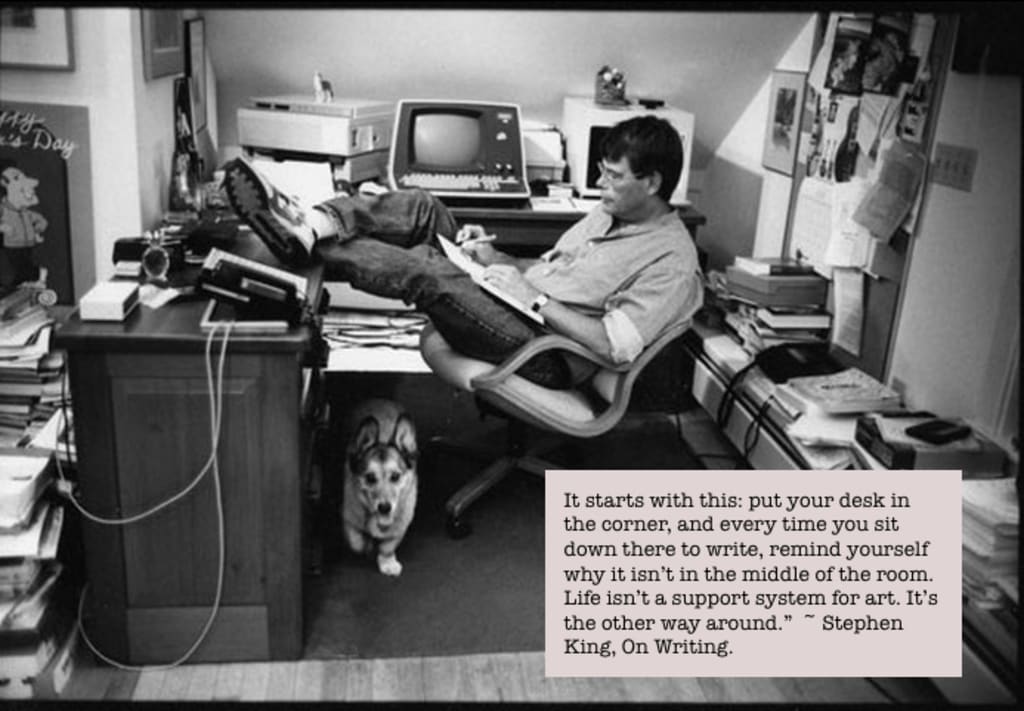
The idea of an ineluctable destiny—something people are incapable of resisting because it is ordained—is appealing indeed. It feeds our hunger for a sense of control and order; it gives the illusion of a clear plan, a map through the already difficult maze of life.
To think that some individuals have no choice but to become novelists is, however, I believe, to miss the far richer, deeper, and more complex reality of the novelist’s apprenticeship.
Although there is no single definitive psychological profile for a novelist, certain recurrent traits can be observed.
Writers frequently possess a profound empathy, which aids in their ability to create believable characters. Introspection is common as well; many writers find that solitude serves as a font of creativity. Writers not only have vivid imaginations; they also possess sharp eyes for quotidian and exceptional human behavior.
But, of course, the real trick is not merely to observe but to transform novelistic raw materials into a cohesive narrative. And that requires a problem-solving mentality, a sense of structure, and, often enough, plain old stubbornness.
Listen to Stephen King's book on writing for free with a 30-day trial.
After all, the writing life can be as unyielding as it is beautiful.
The routines of successful novelists can often be traced with a pencil and a straight edge. The early morning is their time of solitude, they find. The night is when fortune favors their buzzing energies. Yet for some, writing can hardly be called a routine since the words rarely flow, and when they do, it's in fits and starts.
But still, every novelist must embrace at least some level of discipline; a writer's life is too precarious to leave much to chance. No matter how or when, they must put regular hours in. If they cannot write, they must read.
Van Gogh makes a curious case. Would writing about him in a novel—or, as I have done here, in a non-novel—be an act of draping an imagined world over the real one, of creating a fictional narrative that links one to the other?
Getting published often seems like a path strewn with rejections.
As the inevitable part of getting published, rejections can feel demoralizing. But here's where optimism must come into play: Rejections should not be thought of as failures, but rather as a chance to redirect. Each one can serve as a powerful learning experience that can grow us into the kind of writers who can command a fair hearing and serve a clear purpose in the world of readers and books.
If you're like me, building a "bounced back" resilience can feel almost as tough as the actual writing itself. If rejection can be a fire in the forge of better writing, self-doubt can feel like the same fire in the forge of wisdom.
In the end, choosing to be a novelist requires a person to have faith.
There are no surefire ways to achieve success, but the rewards potential novelists can reap greatly outweigh the risks. When I talk about "rewards," I don't mean things like money or fame; I'm talking about the priceless experiences you can have simply by creating.
Writing a novel gives you the chance to go deep inside the human condition in ways few other activities allow. It also lets you connect with ... Converse with a character, and you're on the road to conversing with every person who ever picks up your book.
The rewards can be immense; the process can be fun. But becoming a novelist takes time, and it's not easy even if ... even when.
About the Creator
Keep reading
More stories from The Cosmic Bard and writers in Writers and other communities.
"I Will Teach You to Be Rich", by Ramit Sethi, Review
The complete title is: “I Will Teach You to Be Rich: No Guilt. No Excuses. No B.S. Just a 6-Week Program That Works” And Ramit Sethi's “I Will Teach You to Be Rich” really stands in sharp contrast to the usual half-voiced, traditional financial advice.
By The Cosmic Bardabout a year ago in BookClub
Emerging Trends in Healthcare RAG Systems
Retrieval-Augmented Generation (RAG) is rapidly evolving in healthcare, driven by the need for accuracy, explainability, and regulatory compliance. Below are the key trends shaping how healthcare organizations are adopting and scaling RAG systems.
By Lilly Scotta day ago in Writers



Comments (1)
Interesting piece