
Ambient AI & Workflow Automation in Clinical Settings
What if your app could predict your next mistake and stop it before it happens? Machine learning is redefining how humans and systems interact.

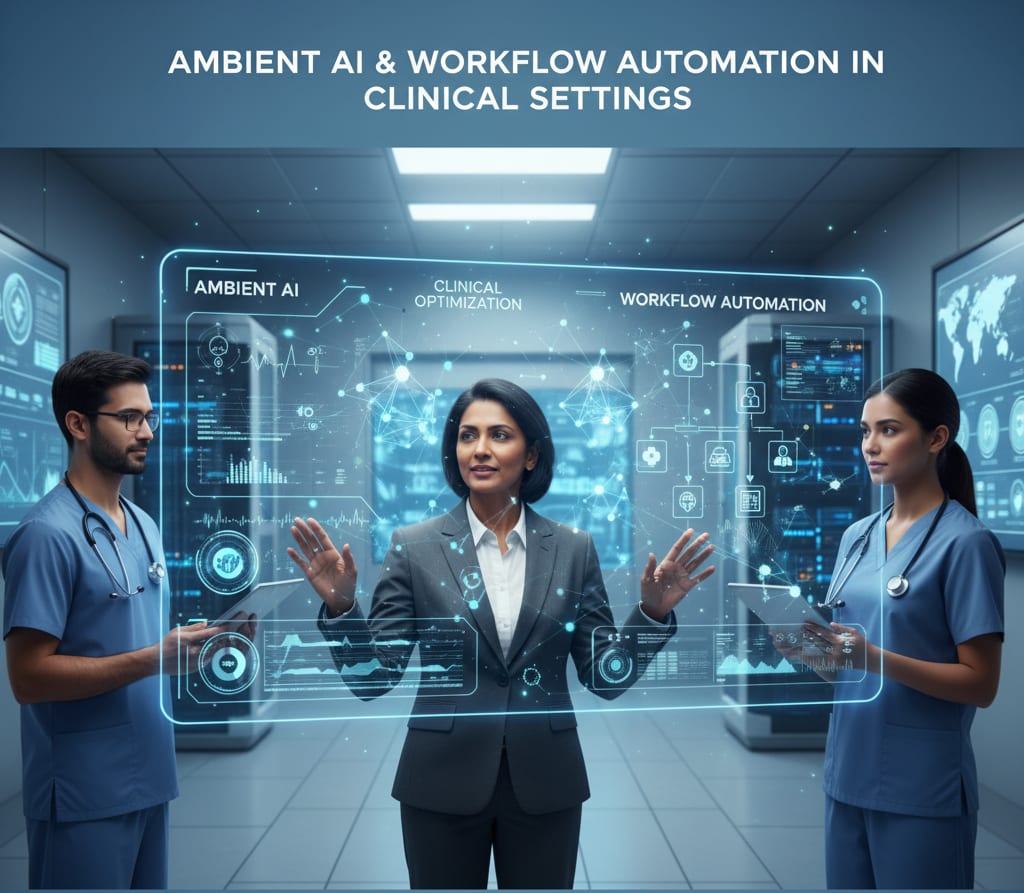
Hospitals run on information, but too often, that information runs clinicians instead. Every minute spent documenting, typing, or updating a system is a minute not spent with a patient. Ambient AI and workflow automation are quietly transforming that imbalance, freeing doctors and nurses to focus on care rather than clicks.
This isn’t science fiction; it’s the next stage of healthcare productivity, built on real data, real sensors, and real human relief.
1. The Problem Beneath the Surface: Documentation Fatigue
Ask any physician what drains their energy most, and the answer rarely involves patients. It’s paperwork, digital or otherwise.
Physicians spend nearly twice as much time on EHR tasks as on patient interactions. That imbalance fuels burnout, reduces accuracy, and drives attrition across healthcare systems.
For years, administrators added new digital tools hoping for efficiency. Instead, many created what clinicians call “click burden”, systems that record everything but rarely reduce the workload.
Ambient AI aims to reverse that. It’s not about another platform; it’s about disappearing technology that works in the background.
2. What Ambient AI Really Means
Ambient AI refers to intelligent systems that sense, process, and act without requiring active input. In a clinical context, it listens, observes, and translates real-time activity into structured data.
Think of a digital scribe that records a consultation, extracts key medical terms, and populates the EHR accurately, without interrupting the flow of conversation.
But true ambient intelligence goes beyond transcription. It can recognize context, detect emotion, and trigger next steps automatically. A clinician discussing chest pain might see the system queue a relevant diagnostic form or pull up previous cardiology notes, all quietly, without a prompt.
Ambient AI blends audio recognition, natural language processing (NLP), and context-aware algorithms into a silent partner that learns over time.
3. Automation That Actually Frees Clinicians
Automation in healthcare isn’t new. What’s new is who it serves.
Traditional automation optimized billing, scheduling, and back-office operations. Ambient workflow automation, by contrast, targets frontline efficiency. These are the direct daily tasks that consume clinicians’ time.
Examples are emerging across hospitals and clinics:
- Real-time documentation: Systems like Nuance Dragon Ambient eXperience (DAX) record and structure patient visits, producing documentation ready for clinician sign-off.
- Smart task routing: AI tools prioritize lab orders, prescriptions, or follow-ups, automatically directing them to the right department.
- Predictive alerts: When a patient’s tone or data pattern signals concern, the system suggests intervention early, without manual entry.
- Integration with legacy EHRs: Many systems are closed, making it difficult to push structured notes back seamlessly. Vendors are racing to support standardized APIs like FHIR.
- Bias and context errors: AI may misinterpret tone or context, especially in emotionally charged conversations. Continuous model refinement is essential.
- Cost barriers: Ambient AI requires hardware (microphones, edge devices) and software subscriptions. Smaller clinics face higher upfront costs.
- Change management: Shifting workflows and habits takes time. Without leadership support, adoption can stall despite the technology’s promise.
By automating what used to require dozens of micro-decisions, hospitals are reclaiming both time and accuracy.
4. The Economics Behind the Shift
Hospitals rarely adopt technology because it’s trendy. They adopt it because it changes the economics of care.
Burnout-driven turnover costs the U.S. healthcare system an estimated $4.6 billion annually, according to the Annals of Internal Medicine. Replacing one physician can cost between $250,000 and $500,000.
Ambient AI directly targets those hidden costs. It reduces after-hours charting, lowers administrative staffing needs, and improves accuracy for reimbursement claims. More importantly, it lifts morale, something difficult to measure but vital for retention.
For large hospital networks, the equation is clear: if automation can reclaim one hour per clinician per day, the return compounds across thousands of employees. The result isn’t just efficiency. It’s financial sustainability.
5. Data, Privacy, and the Trust Question
Every advance in AI invites a parallel question: Can it be trusted?
In healthcare, that question carries higher stakes than anywhere else. Ambient systems constantly listen, record, and analyze sensitive patient data.
The best systems are built with privacy by design, like processing most data locally or anonymizing it before it ever reaches the cloud. Some vendors now use on-device processing to transcribe conversations instantly without sending them to external servers.
Regulators are watching closely. The U.S. Department of Health and Human Services has issued new guidelines around voice data under HIPAA, while the EU’s AI Act sets transparency and explainability standards. Compliance isn’t optional; it’s foundational.
Clinicians must also understand what the AI captures and how it interprets context. Trust grows when the system explains itself, such as why it flagged a symptom, how it structured a note, or what source it referenced. Transparency turns a black box into a co-pilot.
6. The Patient Experience Reimagined
While the technology serves clinicians, patients feel the difference most. In a typical 15-minute visit, studies show that doctors spend less than one-third of the time making eye contact with patients. Ambient systems change that dynamic.
When documentation fades into the background, doctors can listen fully. No screen between them. No typing mid-sentence. The subtle shift in attention transforms trust. Patients describe feeling “heard,” and satisfaction surveys confirm it.
Moreover, automation improves follow-up care. When the AI extracts structured data in real time, it can trigger reminders, patient education, or telehealth scheduling instantly like reducing friction and delays. The experience feels coordinated, even though much of the work happens silently.
7. Training the System and the Workforce
Deploying ambient AI isn’t plug-and-play. It requires contextual training-not of clinicians, but of algorithms. Hospitals must feed models high-quality, domain-specific data, including accents, medical terminologies, and workflow variations.
Human oversight remains critical. AI can summarize, but clinicians must validate. The most successful implementations combine AI assistants with human review loops, ensuring data accuracy while reducing manual load.
Equally, staff training must evolve. Clinicians need to understand what ambient tools can and can’t do.
8. Challenges That Still Need Solving
Even as adoption accelerates, several challenges remain:
The solution isn’t more technology, but smarter deployment, starting with high-burden specialties like emergency medicine or primary care, where ROI is quickest.
9. Global and Regional Momentum
This isn’t a U.S.-only story. Health systems in the UK, Australia, and parts of Asia are piloting similar models. The NHS recently launched trials integrating voice-based AI scribes across general practices, cutting documentation time by up to 30%.
In India, startups like Augnito and Scribetech are making ambient documentation accessible via mobile devices, addressing resource constraints in smaller hospitals. Meanwhile, in the Middle East, AI-driven workflow tools are gaining traction in private healthcare chains focused on operational efficiency.
As adoption grows, regional adaptation will matter. Language diversity, patient volume, and regulatory maturity all shape how ambient AI evolves globally.
10. The Ethical Imperative
Every major healthcare innovation forces an ethical conversation. Ambient AI is no exception. Who owns the data? Who bears responsibility when automation makes a mistake? How do we preserve the human touch while automating human tasks?
These aren’t theoretical questions. They shape design decisions right now. Responsible developers prioritize explainability, patient consent, and human oversight as built-in safeguards.
The goal isn’t to create a system that replaces clinicians, but one that restores their time and attention to what matters most: care. Technology must fade into the background, not take center stage.
11. Looking Ahead
Once documentation and workflows are automated, something profound happens: healthcare starts generating cleaner, richer data. That data becomes the foundation for predictive analytics, population health insights, and precision medicine.
Ambient AI, therefore, is a gateway-not just a tool for saving time, but a bridge toward smarter care delivery. Every automated note becomes a structured data point that can improve diagnosis, detect risk, and inform better public health decisions.
Hospitals that view ambient AI through that lens-not as a cost, but as a capability-will lead the next chapter of health innovation.
Wrapping it Up
Ambient AI isn’t about replacing people with machines. It’s about giving clinicians their time, focus, and humanity back. Workflow automation that operates quietly, almost invisibly, may soon become the unseen hero of healthcare.
As hospitals race to do more with less, those who harness ambient intelligence effectively will find themselves closer to the real goal, like care that feels personal again.
About the Creator
Kazim Qazi
CEO at AppVerticals, building digital products that bridge ideas and impact. I write about HealthTech, startups, and the mindset behind turning ambitious visions into real, scalable businesses.
Keep reading
More stories from Kazim Qazi and writers in Writers and other communities.
Average Cost of 2D Animation Outsourcing Projects
Outsourcing 2D animation allows businesses to create explainer videos, ads, onboarding content, and product demos without building an in-house team. In the US market, pricing varies based on animation style, complexity, and production scope.
By Leo Johnson6 days ago in Writers



Comments