
A Sound That Never Leaves
A Sound That Never Leaves

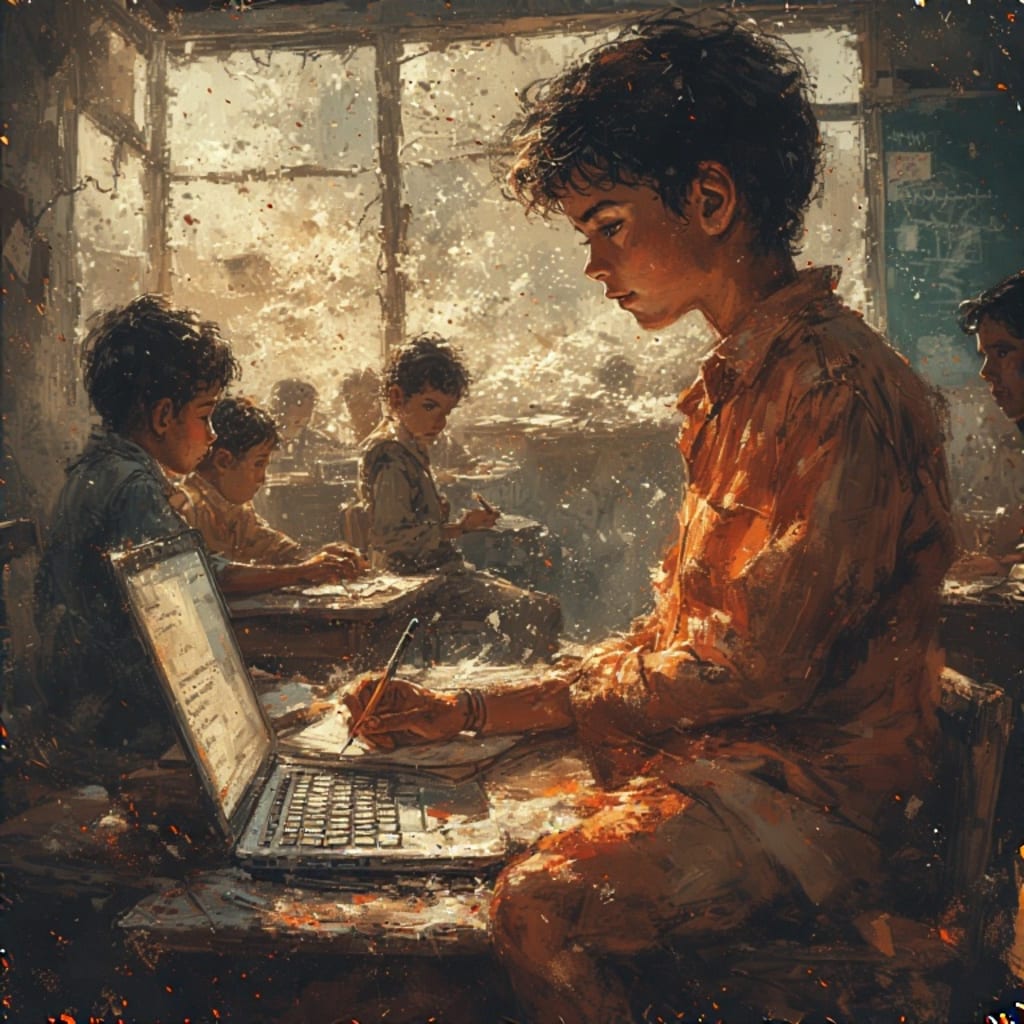
The first time Amir heard the whistle of a missile overhead, he was holding a pencil. He was ten, sitting cross-legged in a classroom with no door, no glass in the windows, and no teacher — just the sound of his mother’s voice in his head: “Learn something today, even if the world is falling apart.”
And it was.
They called it a “conflict” on the news, but to Amir, it felt more like a reset button pressed too often. Streets where bicycles once raced now held silence and broken concrete.
That first whistle never hit them. It landed two blocks away, tearing through a bakery. But the sound stayed in his chest for weeks.
His mother was a nurse. She worked long nights at the field hospital, stitched wounds by candlelight, and came home with stories instead of money.
“One boy lost his whole family. Seven people. He didn’t even cry,” she whispered once, peeling potatoes with shaking hands. “He just asked if anyone had seen his cat.”
There were things Amir never said out loud. Like how he sometimes envied the dead — not because he wanted to die, but because he was tired of flinching at every crackle in the sky.
Still, there was school. Not a proper one — just a repurposed storeroom with chalk and tarpaulin sheets — but it was a place where books replaced bullets. Where he was just a boy, not a headline.
One day, a stranger arrived.
Her name was Clara, and she came with a small international team of aid workers. She was not like the others who gave out food and left. She stayed. She taught. She asked questions no one had time to ask anymore
“What do you want to become when this is over?”
Amir blinked. When this is over? It was the first time someone had spoken as if it might end.
“A sound engineer,” he said. “I want to record silence. Real silence. I’ve forgotten what it sounds like.”
Over months, Clara brought in books about audio, donated a used laptop, and taught Amir how to record and edit sound. They found beauty in small things: rain on a tin roof, goats bleating at dawn, children laughing — rare, but real.
Each recording was a rebellion. Proof that life existed here, beyond the violence.
Then, one evening, the sky split again. A hospital was hit. Clara was inside.
She never walked out.
Amir didn’t speak for days. But eventually, he opened the laptop. On it was a folder labeled “AMIR’S WORLD.” Inside: dozens of files, notes, audio clips, and one final message.
“If you’re reading this, it means I didn’t make it out. That’s okay. What matters is that you do. Keep recording the truth — the way only you can hear it.”
Years later, Amir’s podcast became one of the most listened-to in the region. It wasn’t flashy. Just raw sounds of life in places forgotten by headlines: water being drawn from a broken pipe, lullabies sung over candlelight, the hush that follows an explosion.
He called it:
“The Sound That Never Leaves.”
And people listened.
Because somehow, his story — and Clara’s — lived in every wave of sound he sent out into the world
About the Creator
Keep reading
More stories from Fawad Khan babar and writers in Writers and other communities.
The Fox Under the Oak
In a quiet village nestled between rolling hills and fields of golden wheat, lived a curious boy named Eli. He was no more than ten, always barefoot, with a straw hat on his head and a sparkle in his eyes. Eli lived on a small farm with his grandparents. Every day after his chores, he wandered into the meadows with a heart full of wonder and a pocket full of bread crusts for any animal he might meet.
By Fawad Khan babar7 months ago in Education
I met you at the grocery store
As I was walking around the grocery store, my eyes met with a guy as we were passing by each other. It was intimate. His eyes first introduced himself to me and then be slid into my mental space through my pupils. Whether I liked it or not was questionable but I didn’t hate it. After I got home, he didn’t leave my eyes. He made me feel too many things at once and later on I started bawling my eyes out. As the tears came out of the inner corners of my eyes, he slipped out too. I cried more but this time they were more tears of clarity than confusion. I needed to cry long before I met him but was too numb to it all and he made me realize that in just 2 seconds
By Marianne Lee4 days ago in Writers




Comments
There are no comments for this story
Be the first to respond and start the conversation.