
4 Hydraulic Grabs Failures You Must Know
Preventing Catastrophic Hydraulic Grab Failures


The maintenance of hydraulic grabs for cranes is essentialto ensure their normal operation and extend the service life of the equipment. Hydraulic grabs are often prone to various failures when used in work. Most of the hydraulic grabs failures of common crane hydraulic systems in equipment are caused by overheating of hydraulic oil, air intake, pollution, and oil leakage. Due to the failure of the hydraulic system, the failure of the main system will directly lead to the failure of the main system, resulting in more serious economic losses. Therefore, it is important to analyze the causes of these hydraulic grabs failures and take corresponding preventive measures. This article will introduce 4 common failures and their repair methods in detail.
Hydraulic Grabs Failure 1: Air enters the hydraulic system

Cause hydraulic grabs failure:
- Hydraulic grabs cylinder piston moving position.
- The hydraulic cylinder of the hydraulic grabs vibrates or even makes abnormal noises.
- The hydraulic cylinder of the hydraulic grabs produces local strain and sintering.
- As a result, the centerline of the hydraulic cylinder of the hydraulic grabs is not parallel to the guide rail of the guide sleeve and is skewed.
- The volumetric efficiency of the hydraulic pump of the hydraulic grabs decreases, the energy loss increases, and the hydraulic system cannot exert its due efficiency.
- The hydraulic oil's thermal conductivity in the hydraulic grabs' hydraulic cylinder deteriorates, and the oil temperature rises, causing chemical changes.

Hydraulic Grabs Failure 2:Hydraulic system pollution

Cause failure:
- Pollutants will clog the hydraulic components of the hydraulic grabs in and out of the oil or gaps between them, causing movement failure, affecting working performance or causing accidents.
- It may also cause clogging of the filter and may cause the filter to completely lose its filtering effect, , causing a vicious circle of the hydraulic system of the hydraulic grabs.
- The hydraulic oil and water of the hydraulic grabs are mixed.

Hydraulic Grabs Failure 3:Hydraulic system oil leakage

Cause failure:
- The hydraulic cylinder of the hydraulic grabs can move, but the speed of movement is too slow.
- Once a serious leakage occurs in the hydraulic system of the hydraulic grabs, the pressure of the system will be insufficient, causing the bucket to fail to open and close normally.
- Hydraulic oil leakage can also cause environmental pollution, affect production, and even have serious consequences that cannot be estimated.
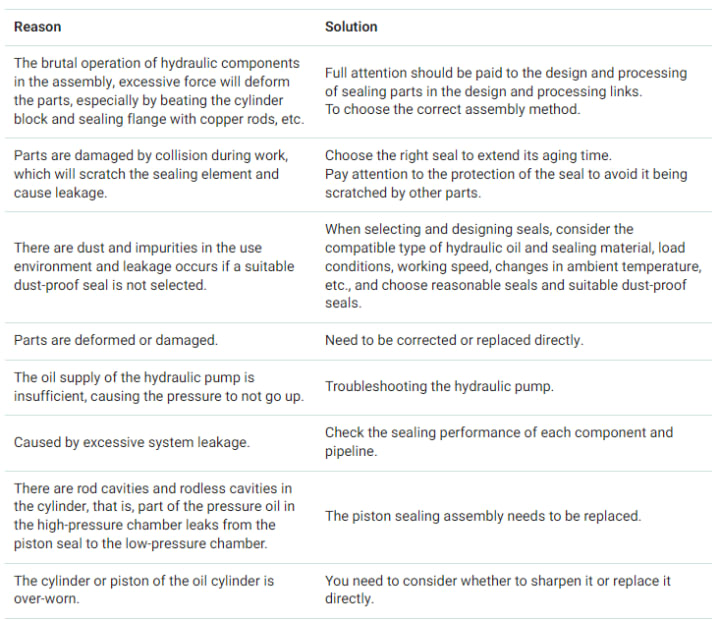
Four leakage methods of hydraulic system
Gap leakage:There are two main types of gap leakage in the hydraulic system of construction machinery, leakage at the fixed seal (static joint surface) and leakage at the moving seal (dynamic joint surface). The leaking parts of the fixed seal mainly include the joint between the cylinder head of the hydraulic cylinder and the cylinder; the motion seal mainly consists of the piston of the hydraulic cylinder and the inner wall of the cylinder, between the piston rod and the cylinder head guide sleeve. The size of the gap leakage is related to factors such as pressure difference and gap.
Porous leakage:Various cover plates in hydraulic components, due to the influence of surface roughness, it is impossible to fully contact between the two surfaces. In the microscopic depressions where the two surfaces are not in contact, many voids of various cross-sectional shapes and varying sizes are formed. The cross-sectional size of the voids is related to the surface roughness. Multiple voids leak and the liquid needs to flow through many curved voids. During the sealing performance test, it takes a certain holding time before the leakage can be revealed.
Mucus attachment leakage:There is a certain adhesion between the viscous liquid and the solid arm. After the two come into contact, a thin layer of liquid is adhered to the solid surface. If the film on the solid surface is thicker, the oil film will be scraped off by the sealing ring due to mutual movement. Adhesion leakage. The basic way to prevent adhesion leakage is to control the thickness of the liquid adhesion layer.
Power leakage:On the sealed surface of the rotating shaft, if there are traces of spiral processing when the shaft rotates, the liquid flows along the groove of the spiral trace under the action of the rotating force of the rotating shaft. If the direction of the spiral trace is consistent with the direction of rotation of the shaft, power leakage will occur due to the “pump oil” effect of the spiral trace. The characteristic of power leakage is that the higher the speed of the shaft, the greater the leakage. To prevent power leakage, the presence of “pump oil” processing traces on the sealing surface of the shaft and the lip of the sealing ring should be avoided, or the principle of power leakage should be used, and the oil pumping effect of spiral traces should be used to pump the leaking oil back to prevent leakage.Hydraulic Grabs Failure 4 : Hydraulic oil overheating
Hydraulic Grabs Failure 4 : Hydraulic oil overheating

Cause failure
- The viscosity of the hydraulic oil and the working efficiency of the hydraulic system have all decreased, and even the machinery and equipment cannot work properly in severe cases.

About the Creator
Dafang Crane
A manufacturing and trading combo for crane industry, with more than 17 years full experience and a professional sales team. main product: overhead crane, gantry crane, jib crane, hoist and crane spares, such as wheel, hook, pulley, etc.
Keep reading
More stories from Dafang Crane and writers in Writers and other communities.
Unofficial Challenge: Black History Celebration
Forward: February 28th, 10:53 PM, EST... The final hour of Black History Month, 2026. Hello fellow writers. I've had this challenge waiting in my drafts for most of the month. But I held off on publishing it, until now.
By Sam Spinelli3 days ago in Writers
Why Golf Is a Powerful Teacher of Emotional Stability
Golf is one of the few sports where the greatest battle takes place not against an opponent, but within the mind. Each round requires patience, discipline, and a calm response to unpredictable challenges. The quiet environment, long pauses between shots, and high degree of precision expose a player’s emotional patterns more clearly than almost any other activity.
By Jeb Kratzig2 days ago in Writers


Comments
There are no comments for this story
Be the first to respond and start the conversation.