
Yamaha R7: A Perfect Middleweight Sportbike
The Yamaha YZF-R7, introduced in 2021, fills a crucial gap in Yamaha’s legendary R-series lineup. Sitting between the approachable R3 and the ferocious R1, the R7 blends everyday usability with sharp, race-inspired styling and handling. It’s designed for riders who crave a sporty feel without stepping into the extreme performance (and price) territory of liter-class superbikes.
Engine and Performance
At the heart of the R7 lies a 689cc parallel-twin CP2 engine, borrowed from the MT-07. This engine is beloved for its torquey character and linear power delivery, making it versatile for both street riding and occasional track days. Producing around 72 hp at 8,750 rpm and 67 Nm of torque at 6,500 rpm, the R7 isn’t the fastest in its class, but it delivers usable power that’s fun and confidence-inspiring.
The engine is mated to a 6-speed gearbox, now with a slipper clutch and optional quickshifter (on some trims or as an add-on), making gear changes smooth and aggressive downshifts less jarring—perfect for twisty roads or track use.
Chassis and Handling
Unlike its naked MT sibling, the R7 gets a fully faired body, with aerodynamic lines inspired by the R1. But it’s not just about looks—the R7 features a sport-tuned chassis, including a fully adjustable 41mm KYB USD fork and a linkage-type rear shock, making it far more track-capable than the MT-07.
With a wet weight of around 414 lbs (188 kg) and a narrow profile, the R7 is incredibly agile. It’s a joy in the corners and nimble enough for city riding. The clip-on handlebars and aggressive riding posture give it a supersport feel, though it’s still more comfortable than a full-on superbike for longer rides.
Brakes and Electronics
The R7 features dual 298mm front discs with radial-mount four-piston calipers, offering solid stopping power. ABS is standard, but the electronics suite is kept relatively simple—no traction control, ride modes, or IMUs here. That’s intentional, keeping the bike accessible and engaging for riders who want a more analog experience.
Styling and Ergonomics
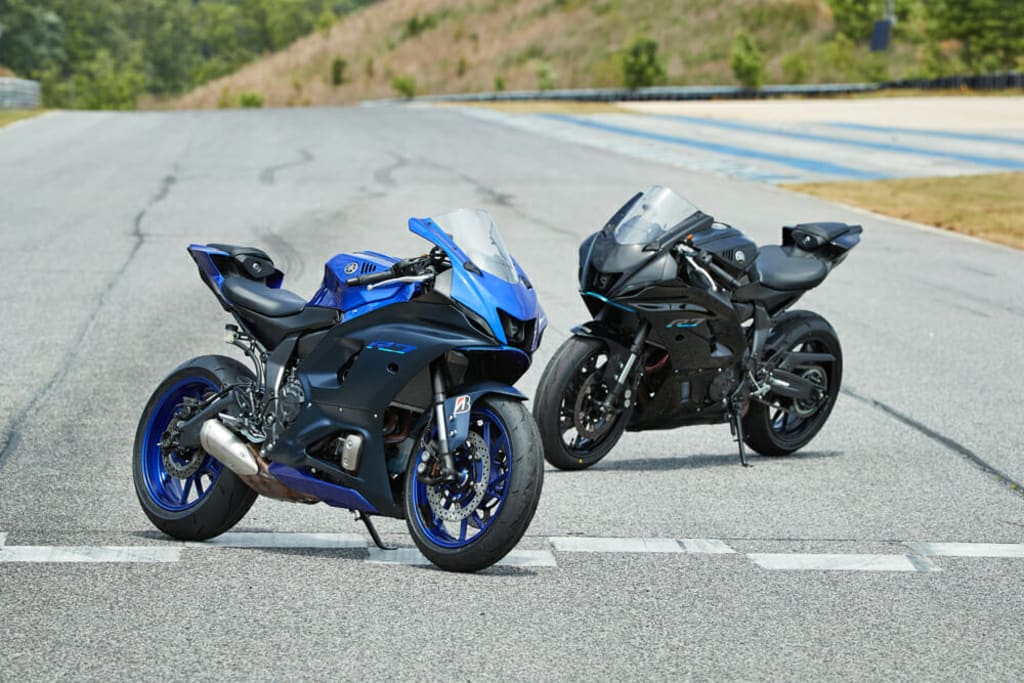
The R7 borrows its visual DNA from the R1, with a central LED headlight, aggressive fairings, and a compact tail section. It looks every bit the part of a supersport, turning heads without overwhelming new riders. The cockpit features a compact LCD display, showing essential info with a clean layout.
Ergonomically, it’s sport-focused but not punishing. Riders under 6 feet generally find it comfortable enough for daily use, though longer rides will remind you of its sporty intent.
Price and Competitors
As of 2025, the Yamaha R7 sits at around $9,200 USD, making it one of the more affordable full-faired sportbikes in its segment. Its main rivals include:
Kawasaki Ninja ZX-6R – More powerful, more track-oriented, and pricier.
Suzuki GSX-8R – Newer competitor with a similar twin-cylinder layout.
Honda CBR650R – Inline-four, smoother top-end, but heavier and less nimble.
Who’s It For?
The R7 is aimed at intermediate riders—those who’ve outgrown a 300-400cc bike but don’t want the brute force of a 1000cc machine. It’s also a great fit for weekend warriors who want something exciting and stylish without breaking the bank or sacrificing everyday usability.
One of the biggest selling points of the Yamaha R7 is how connected it makes you feel. There’s no overwhelming electronics package stepping in between the rider and the road—just pure, mechanical feedback. The linear throttle response, combined with the bike’s light weight and tight chassis, gives riders the confidence to push their limits without getting in over their heads.
Whether carving canyons, commuting through traffic, or spending a weekend at the track, the R7 handles it all with a surprisingly refined balance. It's sporty enough to excite seasoned riders and friendly enough to welcome newer ones transitioning from entry-level machines.
While it doesn’t have the razor-edge performance of a supersport like the R6, it makes up for it in rideability. The torque-rich midrange is where most real-world riding happens, and that’s exactly where the R7 shines.
Customization and Aftermarket
Another reason the R7 has quickly become popular in the community is its modding potential. Since it shares its engine with the MT-07, there’s already a deep catalog of performance parts available—think exhaust systems, air filters, ECU tunes, and suspension upgrades.
Common upgrades include:
Full exhaust systems (Akrapovič, Yoshimura, etc.)
Rearsets and adjustable levers for improved ergonomics
Tail tidy kits to clean up the rear end
Frame sliders and crash protection for track riders
Quickshifter kits for seamless upshifts
With the right tweaks, many R7 owners are turning their bikes into serious track weapons or perfectly tailored street machines.
The Verdict
The Yamaha R7 is a bike that understands its audience. It’s not trying to be the fastest or the most high-tech—it’s built for real riders who want real fun. It brings the spirit of sportbike riding to a wider audience, offering something thrilling, stylish, and accessible.
If you’re looking for:
A sportbike with everyday comfort
A stepping stone to bigger track machines
An affordable and stylish full-faired ride
Or just a bike that makes you want to ride…
…the R7 should definitely be on your shortlist.
Final Thoughts
The Yamaha R7 is more than just a name revival. It carries the DNA of the R-series while adapting to modern-day needs—fun, functional, and full of character. In a world where middleweight sportbikes are becoming more niche, the R7 stands out as a smart, soulful option that proves you don’t need four cylinders to have big thrills.
About the Creator
B_S_Bike_Sports
Sports bikes are built for speed, agility, and performance. With sleek aerodynamic designs, powerful engines, and precision handling, they offer an adrenaline-packed riding experience.
Keep reading
More stories from B_S_Bike_Sports and writers in Wheel and other communities.
Yamaha YZF-R6
🏍️ Yamaha YZF- R6 A Supersport Legend preface The Yamaha YZF- R6 is one of the most iconic and cherished supersport motorcycles in the world. Introduced in 1999, it snappily earned a character for razor-sharp running, aggressive styling, and race-ready performance. erected for riders who thrive on the exhilaration of the track and the dexterity of a featherlight machine, the R6 has come a chief in the 600cc sportbike class.
By B_S_Bike_Sports11 months ago in Wheel
Self-Driving Cars
If you watched the 2004 Will Smith film ‘I Robot’, you’ll know that a minor plot point is that cars in this future are, by default, self-driving. They can still be driven manually, but this is considered a risky choice which only Smith’s character chooses to do, due to being a fan of such ‘retro’ choices. When his car is wrecked during an attack late in the film, his boss assumes that he crashed due to driving manually (the one time in the film he actually wasn’t). At the time of the film’s release, self-driving cars must have seemed hugely futuristic to help to sell the future setting.
By Joe Morgan5 days ago in Wheel
Common Mercedes Repair Issues Drivers Experience As Their Vehicle Ages
Mercedes-Benz is a constant competitor when it comes to discussing the best luxury brands. By combining high-end materials and superior craftsmanship, Mercedes models continue to be highly desirable even as they age. Buying an older Mercedes has become the go-to option for drivers looking for luxury on a more reasonable budget. Whether you’re looking at buying an older Merc, or just can't seem to part ways with your aging Bavarian, these are some of the common Mercedes repair tasks to be aware of.
By Foreign Affiars Motorsportabout an hour ago in Wheel
📢 Raise Your Voice Thread: 03/05/2026
Our “Raise Your Voice Threads” are hosted most alternating Thursdays at 12PM ET to offer creators more avenues to uncover exceptional stories on Vocal. As we are continuously searching for fresh creators and inspiring stories, this thread provides an opportunity to exchange and discuss the stories that have moved and motivated us on Vocal.
By Raise Your Voice by Vocal4 days ago in Resources



Comments
There are no comments for this story
Be the first to respond and start the conversation.