
Understanding the SMT Process and Its Importance for OEMs
SMT Process and Its Significance for OEMs
Original Equipment Manufacturers (OEMs) are organizations that manufacture or sell products to another company. This company then uses these components as part of a wider process to create products for their customers under their own branding. A significant part of creating products to sell to other companies involves the SMT process.
What is SMT?
Surface mount technology (SMT) is a process where components are mounted onto the surface of a printed circuit board. The components are specifically designed to be directly mounted, rather than hardwired, onto the circuit board, which is the standard for most electronics.
Surface mount technology has been widely used since the 1980s. This widespread adoption is due to the SMT process being automated, which saves time and costs for both the manufacturer and the customer. Previously, methods involved hand wiring through holes between the boards to connect components. This manual labor introduced risks of human error. The SMT process, however, is more adaptable to future technological advances than the through-hole wire method.
Other advantages of surface mount technology include higher component density and smaller components that offer better performance under pressure. Additionally, SMT allows components to be mounted on either side of the board.
What is the typical SMT process?
The SMT process consists of three main steps: solder paste printing, component placing, and reflow soldering.
Solder Paste Printing
The solder paste printing process is performed by a machine to ensure accuracy and speed.
In this phase, a printer applies solder paste using a pre-made stencil of the PCB and squeegees. This solder paste, usually a mixture of flux and tin, is used to connect the SMC and solder pads on the PCB.
Each pad must be covered with the correct amount of paste to establish a connection when the solder melts in the reflow oven. Controlling the quality of the solder paste printing process is crucial. Undetected printing defects at this stage can lead to other defects further down the line. Therefore, the stencil's design is key, and the assembly team must ensure the process is repeatable and stable. Fortunately, most solder paste printers offer automatic inspection options to smooth the process.
However, external machines are sometimes used to assess the printing quality. These solder printer inspection machines use 3D technology for a more thorough inspection, checking for solder paste volume per pad, not just the print area.
Component Placement
Once the PCB passes inspection, it moves to the component placement phase of the SMT assembly process.
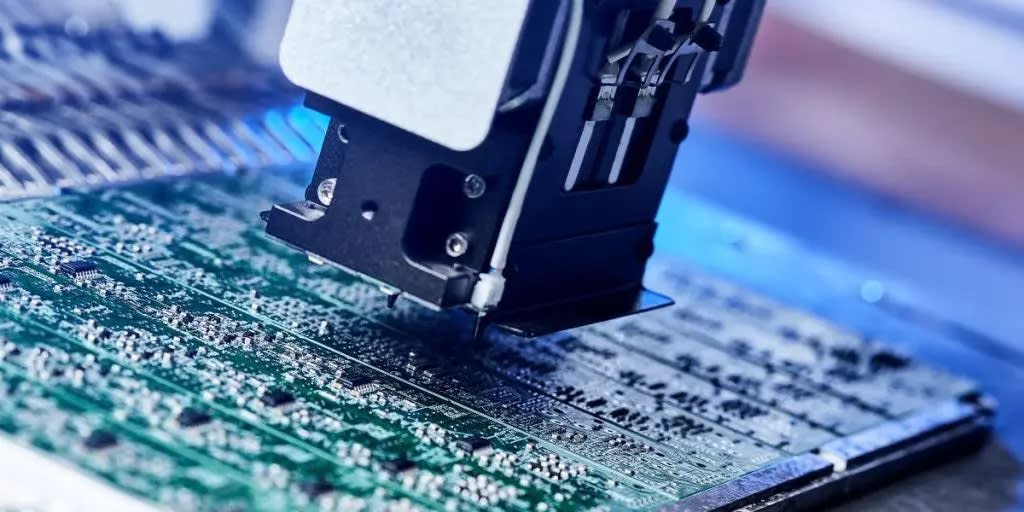
During this phase, each component to be mounted on the PCB is removed from its packaging using a vacuum or a gripper nozzle. A machine then places the component in its programmed location. These machines are highly accurate and incredibly quick, with some advanced models placing 80,000 individual components every hour.
After placing all individual components on the PCB, an inspection ensures correct placement. This step is crucial because undetected placement errors, if soldered, can lead to high volumes of rework, which is both costly and time-consuming.
Reflow Soldering
After passing inspection, the placed components move to the reflow soldering phase. During this part of the SMT process, the PCB is placed into a reflow soldering machine (commonly referred to as reflow ovens).
In this machine, all electrical solder connections between the components and the PCB are formed using heat. The previously applied solder paste is converted into solder. Accuracy is vital at this stage because overheating can damage the parts or assembly, while underheating may prevent a connection from being established.
To ensure the best results, all PCBs within the soldering machine are placed on a conveyor belt. They are gradually heated in a series of zones before being passed through a cooling zone.
To avoid joint defects, the PCBs must remain in each zone for the correct period and be completely cooled before handling or moving. If not, they may warp.
After passing through the reflow solder machine, the PCBs undergo a final inspection. This inspection is usually performed by a 3D automated optical inspection machine (AOI) to ensure the solder joint quality meets expectations and no mistakes were made during the SMT process. Machines are preferred for this task as they are quicker and more accurate than humans.
About the Creator
Keep reading
More stories from writers in Wheel and other communities.
You Won't Believe How Easy it is to Get 100,000 Miles Between Brake Jobs
Most drivers are destroying their brakes prematurely — and it has nothing to do with speed. As a Master Mechanic for 25 years, I’ve seen every driving style imaginable. And nothing reveals a driver’s habits faster than how often they need brake work.
By Jack Martin4 days ago in Wheel
The Volkswagen T1 Camper Van Decanter Whiskey Bottle
Get it on : https://apparelabyssbrand.com/product/volkswagen-t1-camper-van-decanter-whiskey-bottle/ The Ultimate Blend of Nostalgia and Spirits: The Volkswagen T1 Camper Van Whiskey DecanterFor decades, the Volkswagen T1 Camper Van—affectionately known as the "Bus" or the "Bulli"—has been a global symbol of freedom, adventure, and the "Van Life" spirit. Today, that iconic silhouette has found a new home: not on the open road, but on the top shelf of the world’s most stylish home bars. The Volkswagen T1 Camper Van Whiskey Decanter is a stunning piece of functional art that captures the heart of 1960s counter-culture and pours it into a glass of premium bourbon or scotch.A Design That Drives ConversationAt first glance, these decanters are a masterclass in detail.
By gia ton hanh6 days ago in Wheel
📢 Raise Your Voice Thread: 01/22/2026
Our “Raise Your Voice Threads” are hosted most alternating Thursdays at 12PM ET to offer creators more avenues to uncover exceptional stories on Vocal. As we are continuously searching for fresh creators and inspiring stories, this thread provides an opportunity to exchange and discuss the stories that have moved and motivated us on Vocal.
By Raise Your Voice by Vocal3 days ago in Resources




Comments
There are no comments for this story
Be the first to respond and start the conversation.