
The Beginning of Imagination: A Simple Circle
Rolling Through Time: The Invention That Made Modern Life Possible

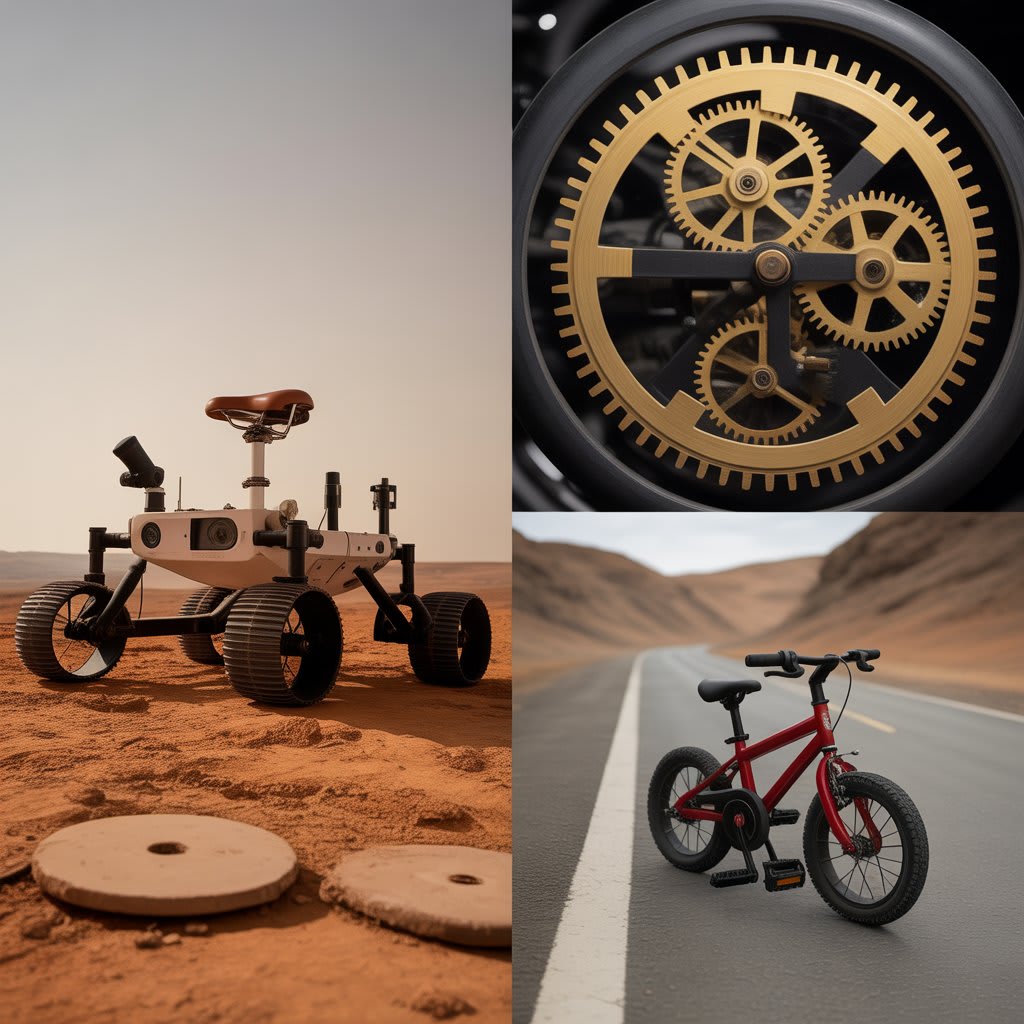
Imagine a world where people dragged their belongings across rugged dirt paths. Their shoulders strained, feet blistered, and every movement was a battle against nature. The only way to carry something heavy was to drag it or balance it on one’s back.
There were no carts, no roads, no easy way to move from place to place. Life was slower — not because people were lazy or weak, but because there was no system in place to make things easier.
Then, a spark ignited — not the kind that lights a fire, but one that sparks imagination.
A circle.
At first, just a shape. But to someone — somewhere — it was something more. It was potential. That humble circle, simple and silent, would go on to reshape the course of history.
It didn’t announce itself with thunder or glory. It rolled in quietly, and the world would never be the same again.
🏺 Early Days: The First Wheel
Historians trace the invention of the wheel to around 3500 BCE in Mesopotamia — often referred to as the cradle of civilization. Surprisingly, the first known use of the wheel wasn’t for transport. It was for pottery. Artisans used a rotating platform to shape clay into smooth, symmetrical vessels.
But then came a turning point — quite literally.
Someone brilliant made the connection: What if this rotating motion could help move things? What if a round object could carry heavy loads across distance?
By combining the wheel with a fixed axle and attaching it to a platform or frame, early humans created the first cart. And with that, the concept of transportation was born.
That small leap of thinking changed everything. Humans no longer had to carry weight — the wheel would carry it for them. It wasn’t just innovation. It was a transformation.
🚂 The Journey That Never Stopped
The wheel turned nomads into explorers, wanderers into settlers. Roads were created, trade routes established, and cities began to grow around them. Goods could now travel faster and farther. So could ideas, stories, and cultures.
The wheel connected people — physically and metaphorically. It helped empires rise, armies march, and civilizations thrive.
From ancient oxcarts plowing across muddy terrain to sleek cars on highways, to spacecraft gliding across Martian soil — the wheel has carried us every step of the way. It's the invisible force behind much of our progress.
And yet, we rarely stop to thank it.
⚙️ The Wheel in Our Daily Lives
The wheel isn’t just something we see on roads. It’s woven into the very fabric of our daily lives.
Take a moment to think:
Your alarm clock ticks because of internal gears (tiny wheels).
The bicycle you ride runs on wheels.
Your car’s movement is made possible by tire rotation.
Factory machines rely on spinning mechanisms to function.
Elevators use pulley systems.
Your ceiling fan? A wheel in motion.
Even your laptop’s cooling fan and internal hard drive contain rotating discs.
Behind the screens we touch and the buttons we press, the wheel is still spinning — often unseen, but always essential.
It is more than just a tool. It is a symbol of continuous motion — of life itself moving forward.
🚀 A Symbol of Human Progress
The wheel stands as one of the most powerful symbols of innovation in human history.
"You don’t need something enormous to change the world.
Sometimes, even the simplest shapes can reshape history."
We often celebrate space exploration, artificial intelligence, and towering skyscrapers — but each of these triumphs owes something to the quiet turning of wheels behind the scenes. In labs, in factories, in creative minds — the wheel has been there all along.
It represents not just movement, but momentum — the drive to keep going.
❓ What If the Wheel Had Never Been Invented?
No cars.
No airplanes.
No trains, no escalators, no machines.
No agricultural revolution.
No factories, no automation.
No Mars rover.
Without the wheel, progress as we know it wouldn’t exist. Humanity would remain grounded, limited by the burden of physical labor. We'd still be dragging the past — instead of building the future.
The wheel didn’t just carry goods — it carried the dreams of generations.
🔄 Final Thoughts
Every wheel that turns today — in your car, your watch, your world — echoes a moment from 5,000 years ago.
A simple circle imagined by a curious mind.
It didn’t roar. It rolled. And it changed everything.
About the Creator
Keep reading
More stories from Musa Al-Khwarizmi and writers in Wheel and other communities.
From Spears to Circuits: Humanity’s Journey Through the Four Great Eras
What if you could witness the entire evolution of humanity—not over centuries, but in one single, breathtaking journey? Picture a traveler standing at the edge of time, watching as our world transforms through fire, soil, steel, and now, code.
By Musa Al-Khwarizmi8 months ago in Motivation
The Ultimate Checklist Before Selling Your Car to a Wrecker
If your car has reached the end of its life or has serious damage, selling it to a wrecker can be a fast and convenient solution. Many car owners assume wreckers only provide scrap value, but professional wreckers often pay based on the condition and reusable parts of your vehicle.
By Alec Johnsonabout 5 hours ago in Wheel
No Word Comes Near Enough
The English language has its limits. I learned this when I became a student of the Bible and looked up the Greek and Hebrew definitions behind the Scriptures I loved. Some languages have so much more depth and power than the one I use to convey my thoughts. But, even so, I don't think any word could ever come close to describing this void and pain I am journeying through. I don't know how to swim through its murky waters.
By Shirley Belk6 days ago in Poets



Comments (2)
Good
good bro