
The 60,000-Mile Ticking Clock
When to Inspect Your Mercedes Hydraulic Mounts
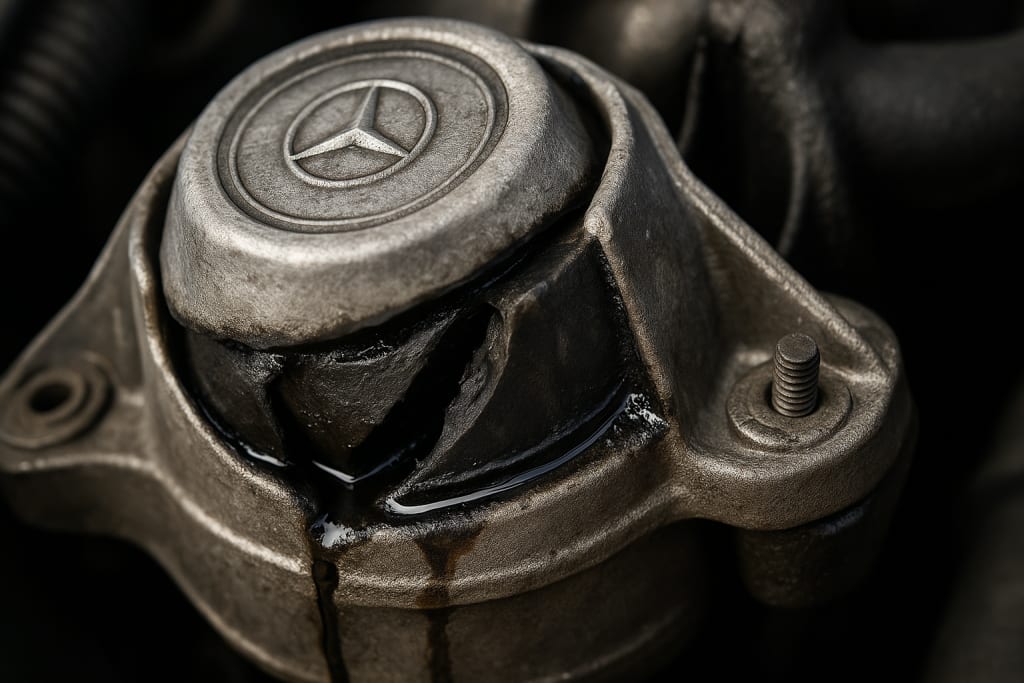
I. The Invisible Wear: The Hydration Clock
You bought a Mercedes-Benz for its effortless composure: quiet cabins, flat cornering, and the promise of a smooth glide. Yet, after several years or sometime between the 60,000 and 100,000-mile mark, many Mercedes owners begin to notice something subtle but unwelcome: a tremor at a stoplight or a new, low vibration through the floorboard.
This is the ticking clock of the hydraulic engine mount.
Engine mounts are essential stabilizers. They secure the heavy engine and transmission to the chassis while simultaneously dampening the constant vibrations generated by the engine. In most modern Mercedes models, these mounts are not simple rubber blocks; they are sophisticated, liquid-filled units designed to provide superior comfort.
Unfortunately, time and stress are their enemies. As the rubber casing of the hydraulic mount ages, it becomes old, dry, and develops tiny cracks. These micro-cracks allow the internal dampening fluid (glycol or hydraulic fluid) to leak out. Once the fluid is gone, the mount collapses, and its ability to absorb vibration is lost completely.
II. Symptom Deep Dive: Interpreting the Mercedes Body Language
A failing mount rarely throws a specific warning light. Instead, it communicates through noise and feel. It is vital to recognize these sensory clues early, as the symptoms will worsen slowly, making it easy to get accustomed to a degraded driving experience.
The four clearest signs that your mounts may be compromised include:
- Excessive Cabin Vibration at Idle: This is the most common early sign of a hydraulic mount problem. When you stop at a light with the car in drive, you feel an unusual, strong shaking through the steering wheel, seat, or floor. This means the rubber has lost stiffness and is no longer effectively dampening the engine's movement.
- Lurching on Start/Stop: When turning the ignition on or off, you may notice a significant jerk or lurch in the vehicle. This is due to the loss of constraint, allowing the engine to torque and move more than normal within the compartment.
- Loud Clunking or Thumping Noises: If the mount has completely collapsed, the engine is free to move significantly. You will hear a loud "clunk" or "thump" when accelerating, braking, or shifting from Park to Drive or Reverse. This noise is the sound of the metal engine components hitting the chassis.
- Visible Fluid Leaks: For hydraulic mounts, failure can be confirmed by a dark, oily stain or reddish residue directly underneath the part. This signals that the hydro-mount has ruptured and lost its internal fluid.
III. The Local Factor: How South Florida Heat Kills Rubber
The environment plays a major role in engine mount longevity, especially in our climate. While normal wear is inevitable, Florida's high heat and humidity accelerate the deterioration process.
The rubber surrounding the hydraulic chamber hardens and loses elasticity due to constant exposure to heat and stress. This process of aging and stress causes the micro-cracks that allow the internal fluid to escape.
Even more damaging is fluid contamination. If your engine has minor oil or coolant leaks (a common issue as Mercedes vehicles age), these fluids aggressively drip onto the engine mount's rubber compound. Oil and fuel attack natural rubber, causing it to soften and fail prematurely, sometimes long before the 100,000-mile mark. For local drivers, proactive leak repair isn't just about preserving engine oil—it's about protecting the rubber components below.
IV. What Happens During a Professional Inspection?Catching this wear pattern early is key to avoiding more expensive engine repair.
During a professional inspection, certified Mercedes technicians look beyond the obvious symptoms. The process involves:
- Visual Confirmation: Checking for visible cracks or tears in the rubber, or any signs of that dark, oily fluid leakage.
- Engine Movement Testing: Technicians observe engine movement when the car is shifted from Drive to Reverse. Excessive jumping or movement on one side shows the mount on that side is bad.
- Assessing All Components: It is vital to inspect not just the two primary engine mounts (left and right), but also the transmission mount. When one mount fails, the other mounts take on more pressure, accelerating their deterioration in a process called "sympathetic failure". Because of this, it is often recommended to replace them in pairs, or even all at once.
If you are concerned about any noise or excessive engine movement, our comprehensive Mercedes engine mount guide provides a detailed breakdown of the warning signs and the necessity of immediate action.
The Test: Proving Engine Mount Failure
How does a Mercedes specialist definitively prove a mount has failed, beyond visible cracks or cabin vibration? We perform a simple, controlled test that isolates the fault and determines which side needs replacement.
The technician raises the hood and applies controlled torque to the engine while the vehicle is stationary, often referred to as a "power brake test" or simple shift-and-rev test. The goal is to observe engine movement against the chassis.
The results are distinct. If the engine jumps excessively when the car is placed in Drive (forward torque), the technician knows the driver's side (left) engine mount is likely bad. Conversely, if the engine jumps excessively when the car is placed in Reverse (rearward torque), the passenger's side (right) engine mount is likely the culprit.
This test confirms not only that excessive movement is happening but also precisely identifies the failed mount, allowing us to quote the repair accurately and prevent unnecessary work.
After the Fix: What to Expect from New Mounts
Engine mount replacement is a highly technical task that requires specialized tools, such as an engine support bridge, to securely hold the engine's weight. Once the new, OEM-grade hydraulic mounts are installed and precisely torqued to manufacturer specifications, the benefits are immediate and dramatic:
- Vibration Elimination: The strong shaking at idle disappears completely, and the car returns to its original composure.
- Shift Quality: Jerks or thuds when changing gears are eliminated, restoring smooth, predictable shifts.
- Protection: The engine is secured against the chassis, ending the dangerous movement that can damage radiator hoses, belts, and the transmission.
Maintaining your Mercedes means staying ahead of predictable wear items. By understanding the 60,000-mile clock on your hydraulic engine mounts, you protect not only your comfort but the long-term health of your entire drivetrain.
About the Creator
Keep reading
More stories from jeremy baker and writers in Wheel and other communities.
Is Your Audi in "Limp Mode"? It Might Not Be What You Think.
When your Audi suddenly loses power, refuses to accelerate, and feels sluggish, it has likely entered a protective state called "limp mode." This nerve-wracking experience is often a direct result of the EPC (Electronic Power Control) light illuminating on your dashboard, indicating a fault with the throttle body or a critical engine sensor. While many drivers assume this means a catastrophic engine failure is imminent, the root cause is often a failure in the complex "drive-by-wire" system that manages throttle response. We cover the full range of causes in our complete guide to the Audi EPC light, but understanding why your car enters this limp mode is the first step to a proper diagnosis.
By jeremy baker5 months ago in Wheel
This Is What I Do When People Throw Rocks At Me
Rocks have been thrown at me for a greater part of my life. Some have been small and missed hitting me. When people don't get a reaction from me, they throw bigger rocks with a better aim. Many have been hurled at me with precision over the years. For a long time, I thought my only options were to dodge them or be crushed by them.
By Margaret Minnicks3 days ago in Confessions




Comments
There are no comments for this story
Be the first to respond and start the conversation.