
Raw Roar To Quite "EV"
The raw power of mustang to electric mustang did Ford evolution towards the future is worth it?
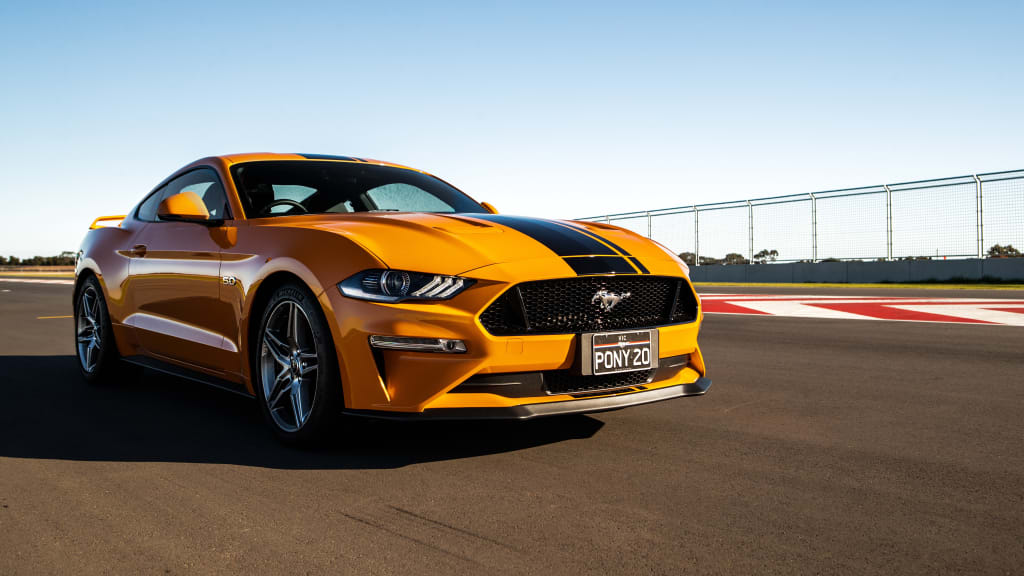
The mighty ford mustang is one of the best classic muscle cars ever made in history the way it delivers the horsepower and torque in higher rpm drives us mad so her is my opinion that the conversion of the raw power of mustang to the quite future EV is worth it?
THE CONCEPTION OF "FOAL"
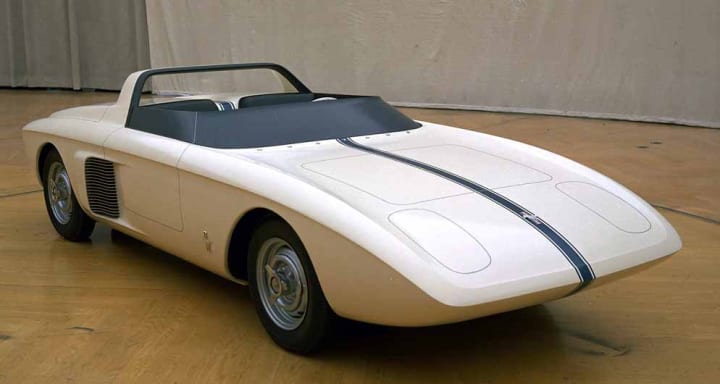
The Ford Mustang is a series of American automobiles manufactured by Ford. In continuous production since 1964, the Mustang is currently the longest-produced Ford car nameplate. Currently in its sixth generation, it is the fifth-best selling Ford car nameplate. The namesake of the "pony car" automobile segment, the Mustang was developed as a highly styled line of sporty coupes and convertibles derived from existing model lines, initially distinguished by "long hood, short deck" proportions.
Originally predicted to sell 100,000 vehicles yearly, the 1965 Mustang became the most successful vehicle launch since the 1927 Model A Introduced on April 17, 1964[5] (16 days after the Plymouth Barracuda), over 400,000 units in its first year; the one-millionth Mustang was sold within two years of its launch.[6] In August 2018, Ford produced the 10-millionth Mustang; matching the first 1965 Mustang, the vehicle was a 2019 Wimbledon White convertible with a V8 engine.
The success of the Mustang launch led to multiple competitors from other American manufacturers, including the Chevrolet Camaro and Pontiac Firebird[8] (1967), AMC Javelin (1968), and Dodge Challenger(1970). The Mustang also had an effect on designs of coupés worldwide, leading to the marketing of the Toyota Celica and Ford Capri in the United States (the latter, by Lincoln-Mercury). The Mercury Cougar was launched in 1967 as a unique-bodied higher-trim alternative to the Mustang; during the 1970s, it was repackaged as a personal luxury car.
For 1965 to 2004, the Mustang shared chassis commonality with other Ford model lines, staying rear-wheel-drive throughout its production. From 1965 to 1973, the Mustang was derived from the 1960 Ford Falcon compact. From 1974 to 1978, the Mustang (denoted Mustang II) was a longer-wheelbase version of the Ford Pinto. From 1979 to 2004, the Mustang shared its Fox platform chassis with 14 other Ford vehicles (becoming the final one to use the Fox architecture). Since 2005, Ford has produced two generations of the Mustang, each using a distinct platform unique to the model line.
Through its production, multiple nameplates have been associated with the Ford Mustang series, including GT, Mach 1, Boss 302/429, Cobra (separate from Shelby Cobra), and Bullitt, along with "5.0" fender badging (denoting 4.9 L OHV or 5.0 L DOHC V8 engines).
THE FIRST GEN
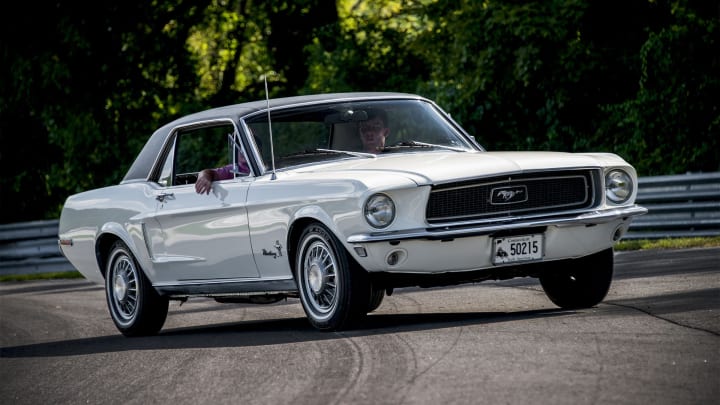
Ford introduced their 1st gen in 1962 it was a two seater it is also called as ford T-5 production the ford T=5 was started in 1965. Designed by Gale Halderman in 1962 and assembled in Dearborn, Michigan San Jose, California ,Edison, New Jersey ,Valencia, Venezuela ,Mexico City, Mexico and ended their production of T-50 in 1973 it's a classic muscle car featured with front small block engine with a horsepower of 450 which can run in streets with an EZ with a four speed automatic pretty good horse power in those times the sales are only 559,451 and ford ended the T50 and started working on second gen.
THE SECOND-GEN PONY
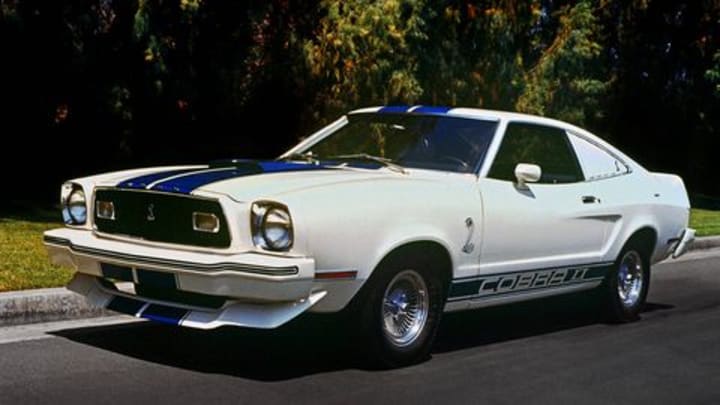
The second gen ford mustang is also called as mustang ii. Production of ford mustang ii hits the lines in 1973 and was designed by Dick Nesbitt in the year 1972 and assembled in the production line of the first gen mustang and available in two door coupe and a three door hatchback with a front engine and a rear wheel drive and with variants of 2.3L4 and 2.8v6 and a 4.9v8 and a four speed manual and a three speed automatic ford ende their production in 1978 f first generation Mustang production numbers were off the charts, the second generation Mustang did little to live up to the same success. For 1974, Ford introduced the Mustang II, a smaller and sleeker Mustang. Ford pitched the Mustang II as an upscale economy car.
THIRD GEN MUSTANG
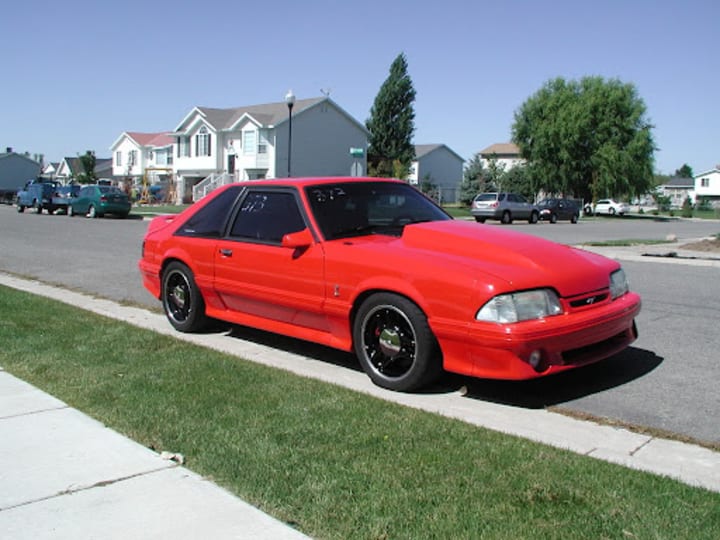
The third gen ford mustang is expected to surpass his elders who put their landmark on the auto mobile industry and it's production was started in the year....... The larger body with an increased wheelbase yielded more interior space for four passengers, especially in the back seat, as well as a larger capacity trunk and a bigger engine bay.[46]
Body styles included a coupé (or notchback), hatchback, and convertible. Available trim levels included an unnamed base model (1979–1981), Ghia (1979–1981), Cobra (1979–1981, 1993), L (1982–1984), GL (1982–1983), GLX (1982–1983), GT (1982–1993), Turbo GT (1983–1984), LX (1984–1993), GT-350 20th anniversary edition (1984), SVO (1984–1986) and Cobra R (1993). Engines and drivetrains carried over from the Mustang II including the 2.3 L I4, 2.8 L V6, and 4.9 L V8 engines. A troublesome 2.3 L turbocharged I4 was available during initial production startup and then reappeared after undergoing improvements for the mid-year introduction of the 1983 turbo GT. The 2.8 L V6, in short supply, was replaced with a 3.3 L I6 engine during the 1979-model year. That engine was ultimately replaced with a new 3.8 L V6 for 1983. The 302 cu in (4.9 L) V8 was suspended after 1979 and replaced with a smaller, 4.2 L V8 which was dropped in favor of the high output 302 cu in (4.9 L) V8 for 1982. From 1979 to 1986, the Capri was domestically produced as a Mercury-badged version of the Mustang, using a few of its own styling cues.
The third-generation Mustang had two different front-end styles. From 1979 to 1986, the front end was angled back using four rectangular headlights, known by enthusiasts as "four eyes". The front end was restyled for 1987 to 1993 model years to reflect the contemporary, rounded-off "aero" style of the Ford Taurus using flush-composite headlamps and a smooth grille-less nose. The Mustang was selected as the 1979 Official Indianapolis 500 Pace Car with replicas sold to the public. Its special body-appearance parts were adapted by the Cobra package for 1980–81. 1982 marked the return of the Mustang GT (replacing the Cobra) which used a specially-modified high-output 302 cu in (4.9 L) engine. 1983 saw the return of the Mustang convertible after a nine-year absence. The front fascias of all Mustangs were restyled, featuring new grilles, sporting "blue oval" Ford emblems for the first time.
1984 introduced the high-performance Mustang SVO, which featured a 2.3 L turbocharged and intercooled four-cylinder engine and unique bodywork.
The Mustang celebrated its 20th anniversary with a special GT350 model in white with red interior and red lower-bodyside rocker stripes. 1985 Mustangs received another front-fascia restyle.
In response to poor sales and escalating fuel prices during the early 1980s, a new Mustang was in development. It was to be a variant of the Mazda MX-6 assembled at AutoAlliance International in Flat Rock, Michigan. Enthusiasts wrote to Ford objecting to the proposed change to a front-wheel drive, Japanese-designed Mustang without a V8 option. The result was the continuation of the existing Mustang while the Mazda MX-6 variant had a last-minute name change from Mustang to Probe and released as a 1989 model.
The Mustang received a major restyling for 1987, including the interior, which carried it through the end of the 1993 model year.
Under the newly-established Ford SVT division, the 1993 Ford Mustang SVT Cobra and Cobra R were added as special, high-performance models which closed out the third generation of the mustang
THE FOUTH GEN MUSTANG
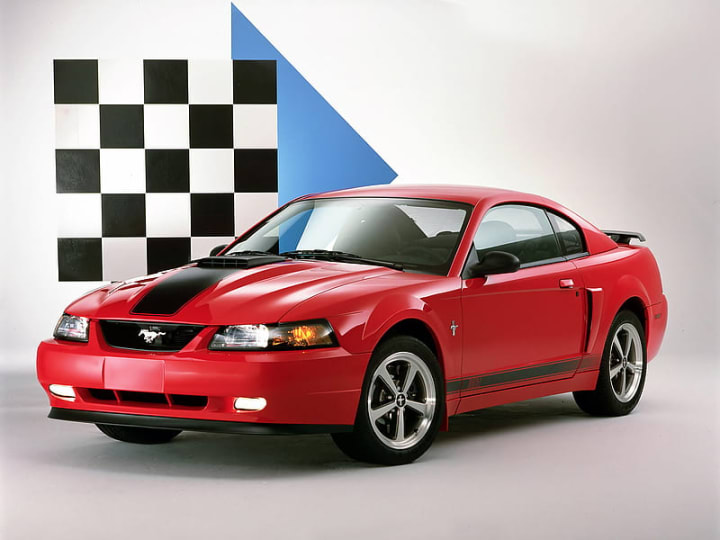
In November 1993, the Mustang debuted its first major redesign in fifteen years. Code-named "SN-95" by the automaker, it was based on an updated version of the rear-wheel drive Fox platform called "Fox-4." The new styling by Patrick Schiavone incorporated several styling cues from earlier Mustangs. For the first time since its introduction 1964, a notchback coupe model was unavailable. Door windows on the coupe were once again frameless; however, the car had a fixed "B" pillar and rear windows.
The base model came with a 3.8 OHV V6 3.8 L engine rated at 145 bhp in 1994 and 1995, or 150 bhp (1996–1998), and was mated to a standard 5-speed manual transmission or optional 4-speed automatic. Though initially used in the 1994 and 1995 Mustang GTS, GT and Cobra, Ford retired the 302 cid pushrod small-block V8 after nearly 30 years of use, replacing it with the newer Modular 4.6 L SOHC V8 in the 1996 Mustang GT. The 4.6 L V8 was initially rated at 215 bhp, 1996–1997, but was later increased to 225 bhp in 1998.
For 1999, the Mustang was reskinned with Ford's New Edge styling theme with sharper contours, larger wheel arches, and creases in its bodywork, but its basic proportions, interior design, and chassis remained the same as the previous model. The Mustang's powertrains were carried over for 1999, but benefited from new improvements. The standard 3.8 L V6 had a new split-port induction system, and was rated at 190 BHP 1999–2000, while the Mustang GT's 4.6 L V8 saw an increase in output to 260 bhp (190 kW) (1999–2004), due to a new head design and other enhancements. In 2001, the 3.8 L was increased to 193 bhp. In 2004, a 3.9 L variant of the Essex engine replaced the standard 3.8 L mid year with an increase of 3 ft⋅lb (4 N⋅m) of torque as well as NVH improvements. There were also three alternate models offered in this generation: the 2001 Bullitt, the 2003 and 2004 Mach 1, as well as the 320 bhp 1999 and 2001,and 390 bhp 2003 and 2004 Cobra. This generation was sold in Australia between 2001 and 2002, to compete against the Holden Monaro (which eventually became the basis for the reborn Pontiac GTO). Due to the fact that the Mustang was never designed for right-hand-drive, Ford Australia contracted Tickford Vehicle Engineering to convert 250 Mustangs and modify them to meet Australian Design Rules per year. The development cost for redesigning the components and setting up the production process was A$4,000,000.Sales did not meet expectations, due in part to a high selling price. In total, just 377 Mustangs were sold in Australia between 2001–2003.For promotional purposes, Ford Racing Australia also built a Mustang V10 convertible, which was powered by a Ford Modular 6.8 L V10 engine from the American F truck series but fitted with an Australian-made Sprintex supercharger.
THE FIFTH GEN LEGACY
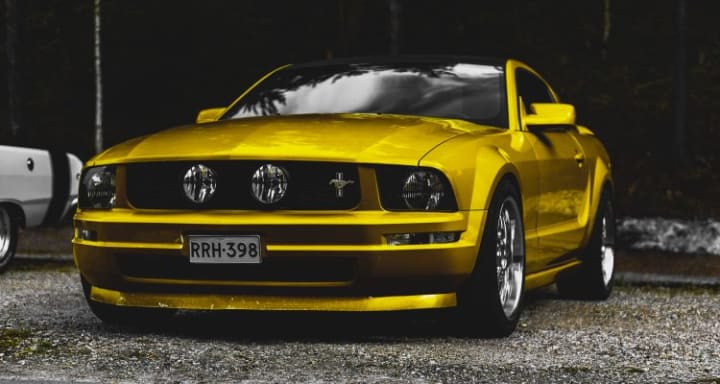
Ford introduced a re-designed 2005 model year Mustang at the 2004 North American International Auto Show, codenamed "S-197", that was based on the new D2C platform. Developed under the direction of chief engineer Hau Thai-Tang, a veteran engineer for Ford's IndyCar program under Mario Andretti, and exterior styling designer Sid Ramnarace,the fifth-generation Mustang's styling echoes the fastback Mustang models of the late-1960s. Ford's senior vice president of design, J Mays, called it "retro-futurism". The fifth-generation Mustang was manufactured at the Flat Rock Assembly Plant in Flat Rock, Michigan.
For the 2005 to 2010 production years, the base model was powered by a 210 hp cast-iron block 4.0 L SOHC V6, while the GT used an aluminum block 4.6 L SOHC three-valve Modular V8 with variable camshaft timing (VCT) that produced 300 hp . Base models had Tremec T5 five-speed manual transmissions with Ford's 5R55S five-speed automatic being optional. Automatic GTs also featured this, but manual GTs had the Tremec TR-3650 five-speeds.
The 2010 model year Mustang was released in the spring of 2009 with a redesigned exterior — which included sequential LED taillights — and a reduced drag coefficient of 4% on base models and 7% on GT models. The engine for base Mustangs remained unchanged, while the GT's 4.6 L V8 was revised resulting in 315 hp at 6,000 rpm and 325 lb⋅ft of torque at 4,255 rpm. Other mechanical features included new spring rates and dampers, traction and stability control system standard on all models, and new wheel sizes.
Engines were revised for 2011, and transmission options included the Getrag-Ford MT82 six-speed manual or the 6R80 six-speed automatic based on the ZF 6HP26 transmission, licensed for production by Ford. Electric power steering replaced the conventional hydraulic version. A new 3.72 L aluminum block V6 engine weighed 40 lb (18 kg) less than the previous version. With 24 valves and twin independent variable cam timing (TiVCT), it produced 305 hp (227 kW; 309 PS) and 280 lb⋅ft (380 N⋅m) of torque. The 3.7 L engine came with a new dual exhaust.GT models included 32-valve 5.0 L engine (also referred to as the "Coyote") producing 412 hp and 390 ft-lbs of torque. Brembo brakes were optional along with 19-inch wheels and performance tires.
The Shelby GT500's 5.4 L supercharged V8 block is made of aluminum making it 102 lb (46 kg) lighter than the iron units in previous years. It was rated at 550 hp (410 kW; 558 PS) and 510 lb⋅ft (690 N⋅m) of torque.
For 2012, a new Mustang Boss 302 version was introduced. The engine had 444 hp and 380 lb⋅ft (520 N⋅m) of torque. A "Laguna Seca" edition was also available, which offered additional body bracing, the replacement of the rear seat with a steel "X-brace" for stiffening, and other powertrain and handling enhancements.
In the second quarter of 2012, Ford launched an update to the Mustang line as an early 2013 model. The Shelby GT500 had a new 5.8 L supercharged V8 producing 662 hp . Shelby and Boss engines came with a six-speed manual transmission. The GT and V6 models revised styling incorporated the grille and air intakes from the 2010–2012 GT500s. The decklid received a black cosmetic panel on all trim levels. The GT's 5.0 liter V8 gained eight horsepower from 412 hp to 420 hp.
THE PRESENT GNE MUSTANG
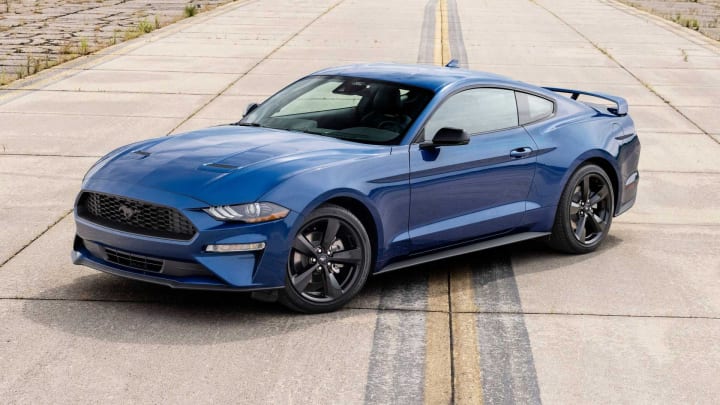
The sixth generation Mustang was unveiled on December 5, 2013, in Dearborn, Michigan; New York, New York; Los Angeles, California; Barcelona, Spain; Shanghai, China; and Sydney, Australia. The internal project code name is S-550.
Changes include a body widened by 1.5 inches and lowered 1.4 inches, a trapezoidal grille, and a 2.75-inch lower decklid, as well as new colors. The passenger volume is increased to 84.5 cubic feet, the wheelbase is still 8 ft. 11.1 in. (107.1 in.), and three engine options are available: a newly developed 2.3 L EcoBoost 310 hp four-cylinder introduced to reach high tariff global markets like China,3.7 L 300 hp V6, or 5.0 L Coyote 435 hp V8, with either a Getrag six-speed manual or six-speed automatic transmission with paddle shifters
A new independent rear suspension (IRS) system was developed specifically for the new model.It also became the first version factory designed as a right hand drive export model to be sold overseas through Ford new car dealerships in right hand drive markets. During this model year, left hand drive versions were expanded to new export markets.[citation needed]
In February 2015, the Mustang earned a five-star rating from the National Highway Traffic Safety Administration (NHTSA) for front, side, and rollover crash protection.
In May 2015, Ford issued a recall involving 19,486 of the 2015 Ford Mustang with the 2.3 L EcoBoost turbocharged four-cylinder engine with a production date between February 14, 2014, and February 10, 2015, that were built at the Flat Rock Assembly Plant. As of June 2015, 1 million Mustangs (between 2005 and 2011) and GTs (between 2005 and 2006) were affected by a recall of airbags made by Takata Corporation. This was after Takata announced that it was recalling 33.8 million vehicles in the U.S. for airbags that could explode and send metal pieces flying at drivers and passengers.
Euro NCAP crash-tested the left hand drive (LHD) European version of the 2017 Mustang which received only two stars due to the lack of auto safety features such as lane assist and auto braking. EuroNCAP also pointed to insufficient pressure of the Airbag resulting in the driver's head hitting the steering wheel. In the full-width test, the rear passenger slipped under the seatbelt.
The 2018 model year Mustang was released in the third quarter of 2017 in North America and by 2018 globally. It featured a minor redesign to the exterior. The 2018 Mustang engine line up was revised. The 3.7 L V6 was dropped and the 2.3 L I4 Ecoboost (direct-injection turbocharged) engine now serves as the base power plant for the Mustang, producing 310 hp (231 kW) and 350 lb⋅ft (475 N⋅m) of torque when using 93-octane fuel. The 5.0 L V8 gets a power increase to 460 hp (343 kW) and 420 lb⋅ft (569 N⋅m) of torque. The automatic transmission in both engines is now a ten-speed Ford 10R80.[80] In January 2018, Ford displayed a prototype of the special edition 2018 Bullitt model, to be released in the summer; this vehicle commemorated the 50th anniversary of the movie Bullitt that helped attract interest in the marque.
For the 2019 model year, Ford revised many components on the 2019 Shelby GT350 including stickier Michelin Pilot Sport Cup 2 tires along with steering and suspension components.
The 2020 model year saw the re-introduction of the GT500. The 2020 GT500 includes a hand-built 5.2-liter "Predator" aluminum-alloy V8 engine with a 2.65-liter roots-type supercharger. The Shelby GT500 produces 760 hp (567 kW; 771 PS) and 625 lb⋅ft (847 N⋅m) of torque. The GT350 was discontinued at the end of the 2020 model year. For the 2021 model year, Ford re-introduced the Mach 1 after a 17-year hiatus. The 2021 Mach 1 utilizes the current Coyote 5.0L engine with GT350 parts, including the intake manifold, increasing performance to 480 hp (358 kW) at 7,000 rpm and 420 lb⋅ft (569 N⋅m) at 4,600 rpm in addition to utilizing the GT350's light weight Tremec six speed manual transmission, oil-filter adapter, engine oil cooler, and front and rear subframe. The Mach 1 also utilizes parts from the GT500, including the rear axle cooling system, rear toe link, and rear diffuser.
THE EV
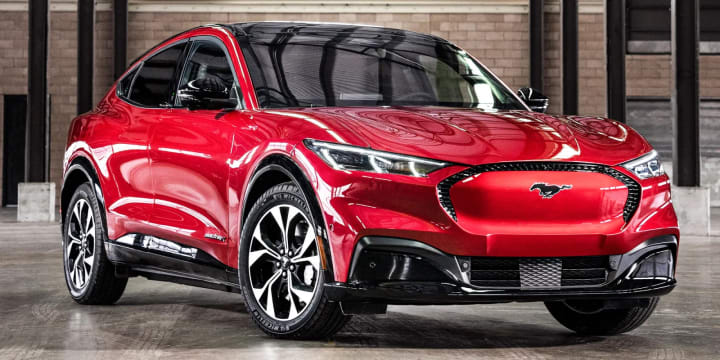
And now the mustang also enters the EV market by add MACH-E to their line up to creat their signature to their EV In 2021, the Mustang Mach-E won Car and Driver's first "EV of the Year" award. It was up against 10 other vehicles including three Tesla models, Audi e-tron, Volvo XC40 Recharge, and Porsche Taycan.All vehicles were tested on how far they could travel at 70 miles-per-hour, performance tests, subjective feel tests on public roads and finally a 1,000 mile road trip from Michigan to Virginia and back. The magazine stated that: "The Mach-E has the driving dynamics and design to push new buyers past mere acceptance of EVs to excitement." They also made note of the premium materials and build quality in their scoring.
The model was launched with two battery pack sizes and three power outputs. The entry-level rear-wheel drive version is offered with either a 68 kWh battery pack driving a 266 hp (198 kW) motor or a 88 kWh extended battery pack driving a 290 hp (220 kW) motor. Both battery packs have a claimed 0–60 mph (0–97 km/h) time of 6.1 seconds or less and an EPA range of around 230 and 300 mi (370 and 480 km) respectively.
A dual-motor all-wheel-drive version is also offered with either the same 68 kWh battery pack driving a 266 hp (198 kW) motor, or the 88 kWh extended battery pack driving a 346 hp (258 kW) motor. They have estimated EPA ranges of 211 and 270 mi (340 and 435 km), respectively.Testing by Edmunds Automotive indicated an actual range of 304 miles with the extended-range battery pack version. Car and Driver achieved a 0–60 mph (0–97 km/h) time of 5.1 seconds with the extended-range model
CONCLUSION
The only things that the mustang and ford lover's will expect the raw power every time when Ford comes up with their iventions and the mach-e was not up to the mark of their sandards of mustangs but the only thing that they consider about the envorniment that's a graet gesture by the FORD but the also have to deliver what people expect,hope that it will come up with a classic and deliver the power we expect "GOOD THINGS TAKE TIME " lets hope for best.
About the Creator
Srinivas Jonnallagadda
Anime, science, Movies.
Create, Explore, Expand, Conquer.
Keep reading
More stories from Srinivas Jonnallagadda and writers in Wheel and other communities.
Travel through time into the past or the future(Dream of every human being).
I love the way that the way how we evolved from looking up in the sky and dreaming to go to the moon, and as time passes we also achieved the things that we thought that we never could, and the only things that humans that didn't have came to a conclusion are time traveling. Yes time traveling some of us think that this is inappropriate but think about the stuff that we did by that time and we regret doing them, for example, you and your dad have an argument and you ended up leaving your house and when you came back and he was found dead and that's gonna make you feel so devastated and you end up your life in a regret that's can be solved and many more so her is my way of putting up that every human dream of :
By Srinivas Jonnallagadda4 years ago in Fiction
Reducing Scrap And Rework: How Checking Fixtures Improve Quality And Lower Costs In Automotive Manufacturing
In automotive manufacturing, where margins are tight and production volumes are high, even small dimensional errors can snowball into significant financial losses. Scrap, rework, warranty claims, and line stoppages all stem from one core issue: parts that do not meet design intent.
By Alexander Belsey6 days ago in Wheel
Top 10 Pickup Trucks Every Aussie Should Consider in 2026
Choosing the right pickup truck can make a huge difference in daily life, whether you’re hauling gear for work, towing a trailer, or exploring the Australian outback. With 2026 just around the corner, several models are standing out for their performance, reliability, and features. In this guide, we’ll cover the top 10 pickup trucks that every Aussie should consider this year, helping you to pick the right vehicle for your daily life and long-term plans.
By Alec Johnson3 days ago in Wheel



Comments
There are no comments for this story
Be the first to respond and start the conversation.