
ADAS & Audi Windscreens: Why Calibration Matters
Ensure Safety & Precision: The Importance of ADAS Calibration for Audi Windscreens
Have you ever been cruising down the Anzac Parade, sun glinting off your Audi's immaculate windscreen, when the lane departure warning goes haywire? Or you've been living with the adaptive cruise control being a tad finicky since that recent windscreen chip. If you're battling the daily grind of Sydney, chances are you've had the exasperations that come with high-end vehicle technology. And if you've recently needed an Audi windscreen replacement in Sydney, you'll know that the good old days of just jamming in a new piece of glass are over. It's not about vision anymore but the safety features that look after you and your family on our crowded roadways. Let's examine why calibration matters, particularly for your Audi.
What is ADAS windscreen calibration?
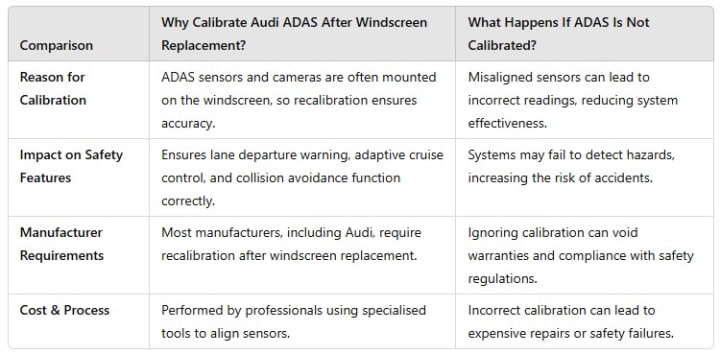
ADAS, or Advanced Driver Assistance Systems, are the brains behind your car's safety features. For instance, lane departure alerts, adaptive cruise control, and automatic emergency braking are available. These rely on sensors, cameras, and radar, usually integrated into your windscreen. Calibration adequately aligns the sensors after a windscreen replacement or repair to "see" the road correctly. It's like getting your eyes tested after a minor tumbleover; you must ensure it's all still in the correct position.
Why calibrate Audi ADAS after windscreen replacement?
Audis, as highly engineered as they are, rely heavily on ADAS. When replacing a windscreen, a millimetre out will disrupt these systems. Imagine a camera designed to detect lane markings being off-balance. That slight change can result in incorrect readings, potentially triggering a false alarm or, worse still, missing a real danger. These systems are vital in Sydney's congested traffic and narrow streets. It's not so much about being compliant; it's about having peace of mind.
Does windscreen damage affect ADAS systems?
Yes. Even a tiny chip or crack can impair ADAS functionality, particularly in the sensor view. The sensors only operate within a specific range of accuracy. Wherever there's a distortion on the glass, it can disrupt their ability to read information. With the recent influx of autumn storms, several Sydney drivers have discovered excess road debris and windscreen chips on their vehicles. A relatively innocent stone chip is a potential safety hazard.
How often calibrate Audi ADAS systems?
There is no set time, but calibration is required after:
- Windscreen replacement.
- Any ADAS system repairs.
- Suspension or steering realignments.
- Any high-speed impact or collision.
- As recommended by your Audi service manual.
With the hard bumps and knocks of Sydney roads, it is sensible to have your ADAS checked regularly, especially if you've noticed any unusual behaviour from your car's safety systems.
What tools are used for ADAS calibration?
Specialist diagnostic tools and equipment are required for calibration. These are:
- Target boards: Boards are positioned precisely where they need to be, with particular patterns for camera calibration.
- Diagnostic scanners: Software that talks to the computer in your car to scan sensor data and make adjustments.
- Laser alignment tools: Employed to get the sensors perfectly placed.
These are not something your typical backyard mechanic has in his arsenal. You require a trained technician with the proper equipment and expertise.
Can I calibrate ADAS myself?
In short, no. ADAS calibration is a complex process that demands expertise and precision. Attempting it yourself could lead to serious safety issues. Think of it like trying to perform surgery after watching a YouTube video; it's just not a good idea. Leave it to the pros, mate.
What happens if ADAS is not calibrated?
Without proper calibration, your ADAS systems may:
- Provide inaccurate warnings.
- Fail to detect hazards.
- Lead to defective automatic braking or steering.
- Risk your safety.
This is not a matter of a warning light on your dashboard; it's about the potential for a terrible crash. With conditions on the roads in Sydney shifting instantly, you cannot risk leaving anything to chance.
Case study
In my latest case study of ADAS calibration and windscreen safety on Audi, I witnessed the significance of accuracy firsthand. A Sydney glass expert for cars operated on an Audi vehicle that required windscreen replacement and ADAS calibration. Their talented experts, supported by extensive experience, ensured the new glass met OEM standards. Impressive was that they employed top-quality materials, which goes a long way in sensor accuracy. Additionally, their mobile service provided unmatched convenience, which meant the calibration could be performed on the client's site without disturbing their schedule. Systems such as lane-keeping assist and emergency braking will fail without correct calibration, creating extreme safety hazards. This instance further emphasised the need to select competent professionals for Audi windscreen replacement, as any minute difference in ADAS calibration will jeopardise vehicle safety. For Audi drivers, ensuring correct calibration after replacement is not a choice—it's necessary for safe driving.
Conclusion
In the frenetic pace of Sydney life, your Audi ADAS systems are your silent safety companions. Ensuring they are correctly calibrated after an Audi windscreen replacement is not a courtesy; it's necessary. It's a matter of staying safe for yourself, your passengers, and other drivers on the road. So, next time you need an Audi windscreen replacement, remember that calibration is crucial to getting you back safely on the road. Don't gamble.
About the Creator
Keep reading
More stories from Kimberly Goth and writers in Wheel and other communities.
What To Expect During A Windscreen Replacement
If you've just experienced one of those freak accidents or spotted a crack in your windscreen, take comfort in knowing you are not alone. Windscreens are almost an easy mark for any form of damage, and while the prospects of finding a replacement may sound intimidating, quick and affordable windscreen repairs make the process smoother than you could have ever imagined.
By Kimberly Gothabout a year ago in Wheel
The Ultimate Checklist Before Selling Your Car to a Wrecker
If your car has reached the end of its life or has serious damage, selling it to a wrecker can be a fast and convenient solution. Many car owners assume wreckers only provide scrap value, but professional wreckers often pay based on the condition and reusable parts of your vehicle.
By Alec Johnson4 days ago in Wheel
Why BMW Still Builds Inline-Six Engines When Others Don’t
For decades, most car manufacturers have moved toward smaller four-cylinder engines or compact V6 designs. They’re easier to package in modern cars, cheaper to build, and often simpler to fit into tight engine bays. Yet BMW continues to invest heavily in inline-six engines. From classic engines like the M54 to modern units such as the B58 and S58, the straight-six remains central to the brand’s identity. The reason isn’t nostalgia, it’s engineering.
By MT Auto Parts – BMW Specialists from the UK2 days ago in Wheel


Comments
There are no comments for this story
Be the first to respond and start the conversation.