
A Better Way to Research New Cars
Why I Built My Own Car Review Ratings System
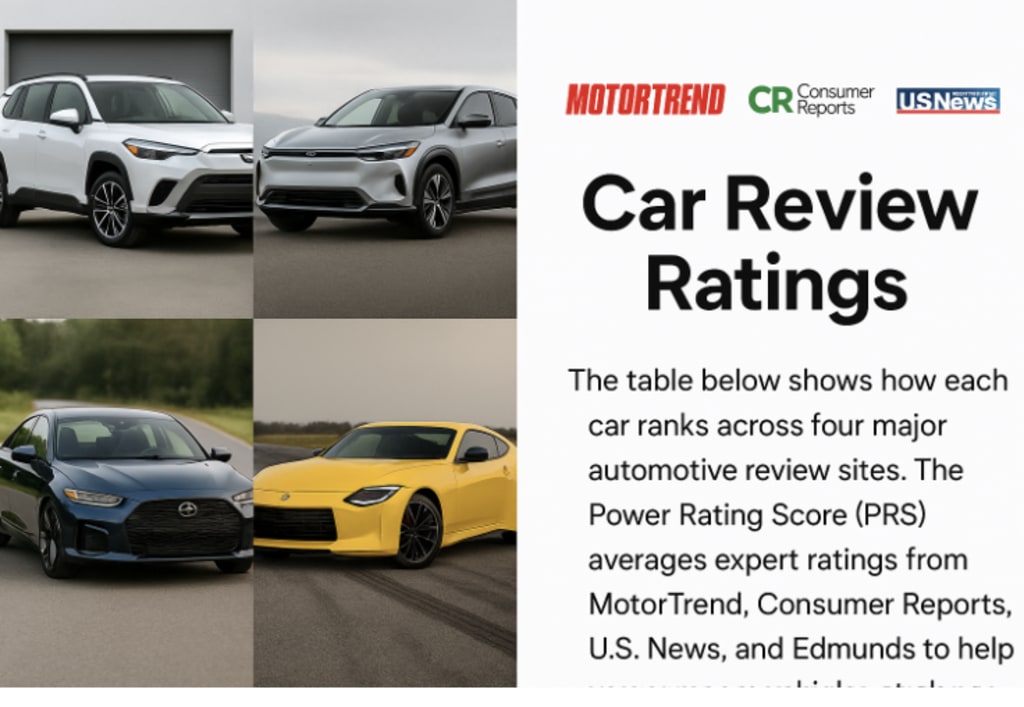
When I shop for a new car I probably do what most people do: I read everything. MotorTrend. Edmunds. U.S. News. Consumer Reports. Forums. Owner reviews. I usually have a heart-felt favorite and wonder why they can't all just agree.
Next thing you know I begin trying to determine with a calculator the combined favorite. But here's the deal:
The same car can be loved by one outlet and barely tolerated by another. One site calls it “Best in Class.” Another quietly downgrades it for reliability. One says it’s exciting. Another says it’s boring.
So which one is right?
That question is what led me to build the Car Review Ratings system on CarLeaseTips.com. Instead of picking one authority and calling it the truth, I decided to average the experts and let the numbers speak.
Why one review source isn’t enough
I’ve never been comfortable letting a single publication decide what’s “best.”
Consumer Reports is excellent at what it does: reliability data, owner surveys, and long-term durability. If you plan to keep a car for ten years, that matters a lot. But they don’t really tell you how a car feels to drive.
MotorTrend focuses on performance, engineering, and driving experience. Edmunds looks at ownership costs, comfort, technology, and day-to-day usability. U.S. News leans into safety, resale value, and mainstream appeal.
None of them are wrong. They’re just measuring different things.
So instead of pretending one voice is the truth, I built something simpler: what do they all think, on average?
That became the Power Rating Score.
A lesson I learned the hard way
Years ago I was shopping for a new lease. Every review site told me the same thing: get a Honda Accord or a Toyota Camry.
So I drove the Accord. It was fine. Reliable. Well built. But it left me completely cold.
Then I drove a Pontiac G6 from the same dealership. It wasn’t the darling of the automotive press. It didn’t top Consumer Reports. It didn’t win comparison tests. But I liked it. It had features I wanted, it drove the way I enjoyed, and the lease deal was far better.
I leased it and loved that car for three years.
That experience changed how I look at ratings. They’re useful, but only when you see the whole picture.
What the Power Rating Score does
On my Car Review Ratings page, every vehicle pulls scores from four major outlets: MotorTrend, Consumer Reports, U.S. News, and Edmunds.
Those scores get converted to a common 10-point scale and averaged into one number, the Power Rating Score.
That single number lets you see which cars are loved by everyone, which ones are controversial, and which ones are strong in some areas but weak in others.
If a car scores high across all four sources, that’s not hype. That’s broad agreement.
If it scores high with MotorTrend but low with Consumer Reports, you’re probably looking at something fun to drive but potentially expensive to own.
That is exactly the kind of information shoppers actually need.
Why this matters
Today’s car market is more confusing than ever. We have EVs, hybrids, turbo engines, massive screens, subscription features, and huge reliability differences between brands. Review sites often talk past each other because they’re grading on different criteria.
By averaging their scores, the Power Rating Score cuts through that noise. It doesn’t tell you what to buy. It tells you where to look.
This was built for real shoppers
I didn’t build this system to win SEO points. I built it because I actually lease, buy, and drive these cars.
I wanted a fast way to see which vehicles experts broadly agree are good, and then combine that with price, lease deals, features, and my own preferences.
That’s how real car decisions get made.
The bottom line
No car is perfect. No review outlet is infallible. But when four of the biggest names in automotive journalism all rate a car highly, that means something.
The Power Rating Score simply makes that visible.
And for anyone trying to make sense of today’s crowded, confusing car market, that clarity is invaluable.
About the Creator
Keep reading
More stories from writers in Wheel and other communities.
The Lunar Check-In: Engineering the First Five-Star Stay in the Stars
The silent, silver plains of the Moon—once the exclusive playground of Cold War pioneers and robotic rovers—are about to get a lot more hospitable. We aren’t just talking about research outposts or "survival pods" anymore. We are talking about high-thread-count sheets, panoramic views of the "Earth-rise," and the logistical miracle of hospitality at 1/6th gravity. The dream of the Lunar Hotel is no longer confined to the pages of 1950s pulp fiction; it is currently being drafted on the CAD programs of the world’s most ambitious aerospace firms.
By yusuf selho4 days ago in Wheel




Comments
There are no comments for this story
Be the first to respond and start the conversation.