
What You Need to Know About Living in France Before Moving
Thinking of moving to France? Discover the pros and cons of life in France, cost of living, best cities for expats, and how to get a long-stay visitor visa.

Many expats choose France to improve their quality of life — from visa-free travel across Europe, relaxing on world-class beaches, and exploring a rich culinary heritage, to eventually qualifying for permanent residency or citizenship.
This guide covers the pros and cons of living in France, plus a detailed overview of how to obtain a long-stay visitor visa (visa de long séjour “Visiteur”).
Why France Appeals to Expats
France consistently ranks among the top countries for quality of life in the OECD’s Better Life Index, earning high marks for safety, healthcare, and social support.
Foreign residents benefit from:
- Access to high-quality public healthcare
- Strong human rights protections
- Safe, walkable cities
The right to open bank accounts, travel visa-free within the Schengen Area, study at European universities, and access public health insurance
One of the most common residence permits in France for financially independent individuals is the visitor visa (Visiteur) — a long-stay visa that allows you to live in France for up to one year (renewable annually).
To qualify, you must:
- Show proof of a stable income of at least €1,800/month or €21,600/year
- Rent or purchase property in France
- Hold valid health insurance
The visa does not grant the right to work or run a business, but after five years of continuous residence, you may be eligible for permanent residency.
9 Benefits of Living in France
- Visa-Free Travel. Residents can travel freely across the 29 Schengen countries for up to 90 days in any 180-day period. With this freedom, a weekend in Spain, a ski trip to Austria, or wine-tasting in Italy becomes part of everyday life.
- A Business-Friendly Environment. France has the highest small-business survival rate in Europe. Entrepreneurs benefit from start-up visas, grants, and tax incentives. Self-employment registration as an auto-entrepreneur takes around 10 days, with simplified tax rates — especially favorable for those under 26.
- Strong Social Support. Residents may qualify for family, education, and housing benefits, as well as free French language courses (Cours de Français pour les Étrangers). Legal aid and taxpayer support are widely available.
- A Solid Pension System. Non-citizen residents who meet contribution requirements can receive a French pension. Minimum pension (2024): €1,100/month, with plans to raise it to €1,200 by 2030.
- Quality Education. Public schooling (ages 3–16) is free, and France boasts 12 universities in Europe’s top 200. Foreign students are admitted on the same terms as locals, though tuition for non-EU students is typically €2,770/year (bachelor’s) or €3,770/year (master’s).
- World-Class Food & Wine. From Michelin-starred dining to your local bakery’s morning croissant, France is a paradise for food lovers. Its centuries-old wine tradition means you’re never far from a vineyard.
- Rich Cultural Life. With 53 UNESCO World Heritage Sites, countless museums, theaters, and festivals, France offers year-round cultural immersion — from the Louvre’s masterpieces to the Festival of Lights in Lyon.
- Diverse Landscapes. Mediterranean beaches, Alpine ski resorts, Loire Valley châteaux, and Parisian boulevards — all within a few hours’ travel.
- Excellent Transport Links. France’s high-speed rail network and well-connected airports make domestic and European travel fast and affordable.
Potential Downsides
- Bureaucracy — From opening a bank account to getting internet installed, paperwork can be time-consuming.
- Healthcare Wait Times — While quality is high, access can be slow, especially in rural areas.
- High Taxes — Progressive income tax rates reach up to 45%.
- Limited Opening Hours — Many shops close midday and on Sundays.
- Housing Costs in Major Cities — Especially high in Paris.
Best Cities for Expats
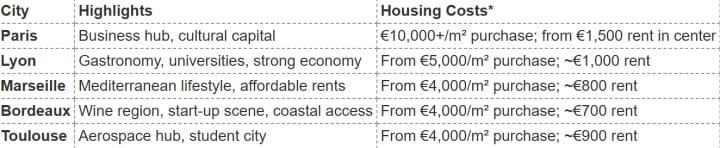
Cost of Living
France’s cost of living is similar to Germany or Belgium, but varies widely by region.
- Groceries: €400–€800/month per person
- Dining Out: Coffee €3–4; bistro lunch €8–10; fine dining €75–100/person
- Healthcare: Public insurance costs ~19% of salary (shared with employer); additional coverage (mutuelle) recommended
- Transport: Monthly public transport pass €50–€86 depending on city; fuel ~€1.98/litre
- Entertainment: Cinema €13; museum €5–15; gym €30–40/month
Integration & Adaptation Tips
- Learn French — It’s key to daily life and social integration.
- Immerse Yourself in the Culture — Festivals, local cuisine, and traditions are great entry points.
- Get Your Tax Number & Health Insurance — Shows commitment to being part of the community.
- Understand Your Rights & Obligations — Avoid legal or administrative issues.
- Support Your Children’s Integration — School activities help them (and you) build connections.
How to Obtain a French Visitor Visa
Visitor Visa (Visiteur) — A long-stay visa (type D) for financially independent individuals.
Requirements:
- Proof of income: min. €1,800/month (€21,600/year)
- Accommodation in France (min. 9 m²/person)
- Health insurance with €30,000+ coverage
Process Overview:
- Secure Housing — Buy or rent before applying.
- Prepare Documents — Translate and notarize where necessary.
- Submit Application — Through your local French consulate.
- Arrive in France & Register — Declare your arrival online within three months.
- Processing typically takes about five months from preparation to approval.
Key Takeaways
- France offers high living standards, world-class healthcare, and rich cultural opportunities.
- While bureaucracy and taxes can be challenging, benefits like free travel, education, and social protections attract thousands of expats each year.
- The visitor visa is a viable route for non-working, financially independent individuals to settle in France and eventually seek permanent residency.
About the Creator
Keep reading
More stories from Susan Scava and writers in Wander and other communities.
Baggage Problems at Airports: How to Avoid Losing Your Luggage During Your Travels
Air travel is often seen as an exciting way to explore the world, but baggage issues like lost or delayed baggage can quickly turn an otherwise enjoyable trip into a stressful one. Whether it’s a mix-up at the baggage carousel or a more serious issue, missing your belongings can put a damper on the excitement of your trip. One of the best ways to avoid these issues is to use VIP assistance services, such as https://skyvipservices.com/airport/los-angeles-lax-klax-us. These experts provide personalized baggage management, ensuring that your luggage is tracked, managed, and properly handled from start to finish.
By Susan Scava9 months ago in Wander
Heat Wave Fuels Massive Wildfire in Australia
Australia is facing yet another environmental emergency as a relentless heat wave fuels massive wildfires across several states. With temperatures climbing far beyond seasonal averages, dry winds sweeping across parched land, and vegetation turning into tinder, the conditions have created a perfect storm for catastrophic bushfires.
By Aqib Hussainabout 21 hours ago in Wander




Comments
There are no comments for this story
Be the first to respond and start the conversation.