
What Vietnamese cuisine will surprise you
Sometimes, to truly understand a country, you need to try its food. After all, new flavors are not only pleasing, but also allow you to see the life of the locals from a different angle. Yes, familiar food is always around, but by trying something new, you can discover completely unexpected things. So, if you want to get to know Vietnam better, don't miss the chance to try its cuisine.


Vietnamese cuisine is something amazing. I was personally amazed by the variety of flavors and textures that can be found literally at every corner. To be honest, I am absolutely delighted, although I haven't had time to try everything yet. With each new dish I discover something completely new and interesting.
Phở Bò

Why is Pho Bo so popular? It's its simplicity and depth of flavor at the same time. Imagine: rich broth, fragrant coriander, tender beef and rice noodles. All this together creates a unique flavor that you want to feel again and again. And the secret of this soup lies in the long boiling of the broth and fresh ingredients.
Pho Bo is often called “Vietnamese ramen” because of its similarity to Japanese soup. It can be found on every corner, from street stalls to fine restaurants. Vietnamese people love Pho Bo for its rich flavor, aroma and ability to warm up in cold weather. In addition, this soup is very nutritious and gives you a boost of energy for the whole day.
On average, a bowl of Pho Bo at a local hawker stall will cost between VND20,000 and VND40,000 (about US$0.8 - 1.6)
Bánh Mì

“Banh mi” is not just a food, it is a symbol of Vietnamese street food. This sandwich can be found on almost every corner and is very popular among locals and tourists alike. The secret of its success lies in the simple yet delicious combination of ingredients: crusty bread, juicy filling and colorful sauces. Bánh Mì is quick, delicious and very convenient.”
Why is Bánh Mì more than just a sandwich? Because it's history, culture, flavor, experience and affordability, all in one little sandwich. Bánh Mì is the result of blending Vietnamese and French culinary traditions. The French brought the baguette and the Vietnamese filled it with their unique ingredients and spices. The dish has become a symbol of Vietnam's colonial past and is now one of the country's most popular street foods.
You can buy this sandwich at local hawker stalls in Vietnam for just 20,000 - 40,000 VND (about 0.8 - 1.6 US DOLLARS)
Gỏi Cuốn
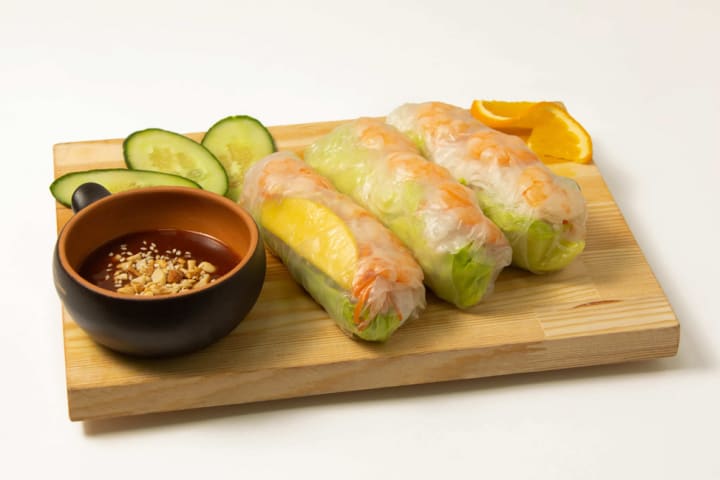
Goi Cuon is the result of culinary fusion. These delicate rice paper rolls that are filled with juicy vegetables, flavorful herbs and tender meat or seafood. The idea of rice paper rolls came from China, and Vietnam's French colonial past enriched the dish with new ingredients and culinary techniques.
Usually, you get 2-3 goi cuon rolls for 20,000 - 30,000 VND (about 0.8 - 1.2 USD) at local Vietnamese stalls. But this can vary a bit depending on the size of the rolls and the particular establishment.
To make goi kuon at home, you will need rice paper that needs to be soaked in warm water for a while. Then on it lay out a filling of boiled shrimp, noodles, fresh vegetables and herbs. After that the roll is carefully rolled up and served with a sauce based on fish sauce, lime and chili.
Bánh Bao

Banh bao is something like Vietnamese patties, except that they are steamed instead of fried. The filling can be very different - from the classic combination of meat and mushrooms to vegetarian variants.
Banh bao have their origins in Chinese cuisine. In China, such steamed buns are called bao zi. They were a popular dish centuries ago. Gradually, influenced by local ingredients and culinary preferences, bao zi was modified to become banh bao. Vietnamese chefs added their unique touches, creating a dish that has blended perfectly into the local gastronomic culture.
Where to try the most delicious banh bao?
- Street vendors: The most authentic way to try banh bao is to buy them from street vendors. They travel around the cities on bikes, alerting everyone with their signature shout of “Banh bao!”. Their buns are always fresh and hot.
- Markets: In the local markets, you'll find many banh bao vendors. Here you can try different variations of the filling and compare the flavor from different sellers.
- Cafes and restaurants: Many Vietnamese cafes and restaurants offer banh bao on their menu. This is a great option if you want to try banh bao in a more relaxed environment.
They are quite inexpensive - about 15-20 thousand VND per piece (about 0.6 - 0.8 USD)
Chè

Che is a Vietnamese dessert made from a variety of ingredients. The base is usually legumes (e.g. red beans, mung dal), which are boiled until soft and added to a sweet syrup. Other ingredients are then added to this mixture: fruits (mango, lychee, longan), jelly pieces, coconut cream, ice, and more. Each region of Vietnam has its own unique chè recipes, so you can discover something new every time you try a new dessert.
How do you make chè? Cooking Chè is quite simple. The main ingredients are boiled, mixed and cooled. Then all the ingredients are combined in a bowl and served. Due to the variety of ingredients, chè can be either very sweet or refreshing.
The price of Chè in local stalls is usually very affordable, around 10-20 thousand VND per serving (about 0.4 - 0.8 USD), making Chè a great option to try something new and refresh yourself on a hot day.
____________________________________________________
Thank you for reading this article to the end! If you have any topics that interest you in Vietnam, write in the comments - I'd be happy to talk about them.
I would also appreciate your donation to me as the author if you feel it is necessary. See you soon
About the Creator
Sergio Sokolov
A guide to living in the heart of Asia! Secrets of local culture, life hacks, observations and tips from a seasoned expat. Join and discover Vietnam with me! 🚀✨
Keep reading
More stories from Sergio Sokolov and writers in Wander and other communities.
Top 10 mistakes newcomers make in Vietnam
In no way do I want this article to be taken as a denigration of Vietnamese peculiarities. I just want to share what an unprepared person like me might encounter a few months ago. After living in Vietnam for an extended period of time, one begins to get used to and even appreciate moments that may have seemed strange at first.
By Sergio Sokolov2 years ago in Wander
Another Walk Through Hulne Park, Alnwick
Introduction There are three walks in Hulne Park, and I have written aboutmy walks here before, but this is my wander in 2026. I now always choose Walk 1 because you get some of the best views on this one. It's the light blue oneon themap below.
By Mike Singleton 💜 Mikeydred 2 days ago in Wander




Comments
There are no comments for this story
Be the first to respond and start the conversation.