
What is the Downside of Fiberglass Rebar?
Key Challenges You Should Know Before Using Fiberglass Rebar in Construction Projects

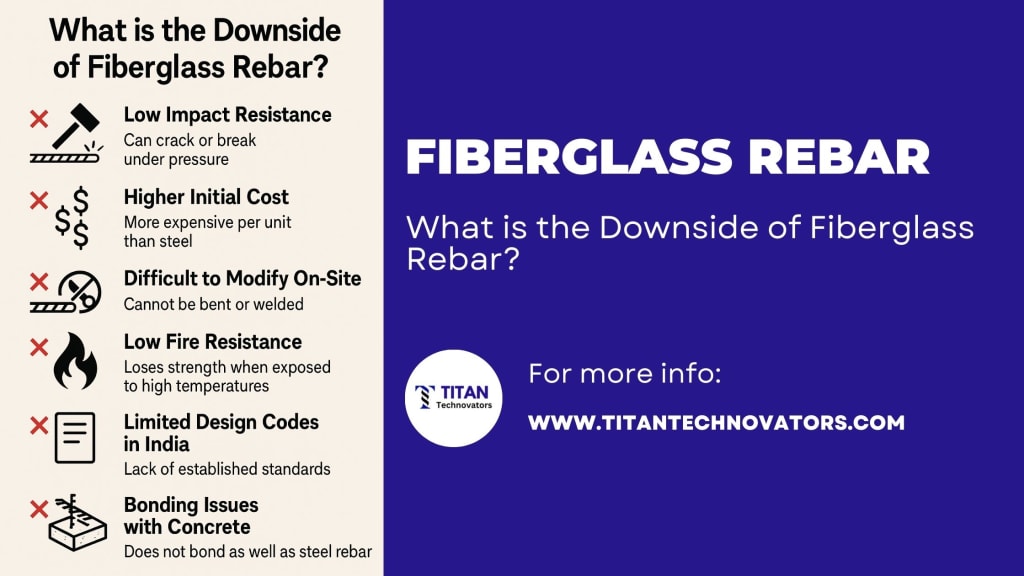
When we talk about construction in India, bhaiya, sasta aur tikau chahiye! is a common phrase. We all want our buildings to be strong, affordable, and long-lasting. For decades, steel rebar has been the default choice in reinforcing concrete. But now, Fiberglass rebar—also called GFRP (Glass Fiber Reinforced Polymer)—is gaining popularity.
It’s lightweight, doesn’t rust, and offers high tensile strength. Sounds perfect, right?
But hold on—just like every coin has two sides, Fiberglass rebar also comes with its own set of downsides. Let’s dive into the lesser-talked-about aspects of this material so you can make an informed decision—especially if you're a builder, contractor, or even a curious homeowner planning to build your sapno ka ghar.
🧱 What is Fiberglass Rebar, Anyway?
Before we jump into its disadvantages, let’s understand what it is. Fiberglass rebar is made by combining glass fibers with a polymer resin. It’s used as a substitute for traditional steel rebar in concrete structures.
It’s non-corrosive, lighter than steel, and doesn’t conduct electricity—which is great for certain applications.
Want to know more about its technical side? You can check this detailed guide on Fiberglass Rebar.
But now, let’s talk about the not-so-great part.
❌ 1. Low Impact Resistance – Handle with Care!
Fiberglass rebar is brittle. Unlike steel, which bends under pressure, fiberglass can crack or break when mishandled. Imagine you're unloading the rebar at a construction site in Jaipur or Ahmedabad, and one slips from the truck—toot gaya toh gaya!
In Indian working conditions, where jugad is sometimes the method, handling fragile materials can be risky. Workers may not always have gloves or safety equipment, increasing the chances of damage during handling.
Pro Tip: You need to train your workers properly when using fiberglass rebar to avoid on-site breakage.
More on this issue is explained in this article from FRPZS – Disadvantages of Fiberglass Rebar.
💸 2. Higher Initial Cost – Mehenga Hai Boss!
Let’s be honest—we Indians love a good deal. Compared to steel, Fiberglass rebar is more expensive per unit. Although it might save money in the long run (thanks to lower maintenance), the initial investment is high.
So, for small contractors or gaon ke builders, using fiberglass rebar may feel like paise ki barbaadi, especially if they are working on tight budgets.
Indian Example: For a regular house in rural Rajasthan, choosing steel rebar is more cost-effective upfront.
If budget is a concern, you need to weigh the long-term savings vs. initial costs carefully.
For price comparisons, this Indian company Sanfield India offers local insights into fiberglass rebar pricing.
🏗️ 3. Difficult to Modify On-Site – No Karo Kat Flexibility
With steel, you can bend, cut, or weld it right on the construction site. Need a custom angle? Just grab a gas cutter or welding rod—kaam ho gaya.
But with fiberglass rebar, you can’t bend or weld it. It requires special tools for cutting and shaping. This lack of flexibility can be a big headache, especially on Indian sites where plans change faster than chai gets cold.
So unless your design is finalized and your crew is equipped with the right tools, Fiberglass rebar can be a pain to work with.
Read more about the working limitations of fiberglass rebar in this comparison article by Unicomposite.
🧯 4. Low Fire Resistance – Not Great for High-Heat Areas
India is a hot country. In cities like Nagpur, Delhi, or Jaipur, temperatures can soar above 45°C in summer. While fiberglass rebar doesn’t melt easily, it loses strength when exposed to high temperatures.
In case of a fire, steel rebar retains its structural integrity longer than fiberglass. This makes steel a safer choice in commercial or residential buildings where fire safety is critical.
If you're constructing a factory or a multi-story apartment, consult a structural engineer before choosing fiberglass.
⚖️ 5. Limited Design Codes in India – Confusion Ka Mamla
In the USA and Europe, there are well-established design codes for fiberglass rebar. But in India, the IS (Indian Standards) for GFRP rebar are still evolving. This can be confusing for civil engineers and architects.
When there's no clear guideline, people rely on guesswork or foreign standards—which may not be suitable for Indian climate or construction practices.
This lack of official standards makes approval from government authorities more difficult, especially in public infrastructure projects.
If you're interested in fiberglass products that are trying to meet Indian standards, check out Titan Technovators—an Indian company specializing in advanced composites.
🧪 6. Bonding Issues with Concrete – Slips Like Soap?
Another issue with fiberglass rebar is its bonding with concrete. While manufacturers have improved the surface texture to make it grippier, it still doesn’t bond as well as steel, especially under stress or cyclic loads.
In simple terms—steel grips concrete better, which is essential during earthquakes or heavy loads.
So in places like Gujarat or Himachal, which are earthquake-prone zones, engineers need to be extra cautious when using fiberglass rebar.
🔍 Summary: Pros vs. Cons (Indian Style!)
Feature Steel Rebar Fiberglass Rebar
Corrosion ❌ Rusts over time ✅ Rust-proof
Cost ✅ Cheaper upfront ❌ Expensive upfront
Handling ✅ Strong, bendable ❌ Brittle, rigid
Weight ❌ Heavy ✅ Light
Fire Resistance ✅ Withstands heat ❌ Weak in fire
Site Modification ✅ Easy ❌ Needs special tools
Code Availability (India) ✅ Well-defined ❌ Limited guidelines
Bond with Concrete ✅ Strong ❌ Weaker in some cases
🙋 So, Should You Use Fiberglass Rebar?
If you're building in coastal areas like Mumbai, Chennai, or Goa—where corrosion is a nightmare—then fiberglass rebar can be a smart choice. It’s also great for bridges, dams, and water tanks.
But if you're a small builder, or constructing in budget-sensitive areas, steel is still your best bet. The downsides of fiberglass rebar—like higher cost, brittleness, and lack of fire resistance—can outweigh the benefits in many typical Indian projects.
The best advice? Consult your engineer, consider your budget, and always weigh long-term benefits against short-term savings.
📚 External Resources for More Info
Here are some helpful resources if you want to dive deeper:
Composite-Tech – What is Fiberglass Rebar?
FRPZS – Disadvantages of Fiberglass Rebar
Unicomposite – Fiberglass vs Steel Rebar
Titan Technovators – Indian Manufacturer
If you're a contractor, engineer, or just someone curious about construction materials in India—I hope this article helped clear the air about the disadvantages of fiberglass rebar.
Chalo, ab jab koi bole GFRP ke baare mein, you can say—haan bhai, jaanta hoon!
About the Creator
Titan Technovators
Titan Technovators is a leading Gujarat-based manufacturer of GFRP rebars, offering lightweight, corrosion-resistant solutions for modern infrastructure with a focus on sustainability and innovation.
Keep reading
More stories from writers in Wander and other communities.
Worth the Wait: Puerto Viejo, Costa Rica
Beach bumming in a small Caribbean beach town sounded like a perfect way to end our 6-month trip through Mexico and Central America. Or so we thought. The foul, fishy stench of rotten seaweed hit our nostrils as we stepped from the cramped bus and looked out at a rather depressing, empty, and underwhelming black sand beach. It was pouring with rain, and we had to quickly fish out our ponchos. We thought, this couldn’t be it, could it?
By Sh*t Happens - Lost Girl Travel10 days ago in Wander
Lost in Translation: How Getting It Wrong in Asia Taught Me How to Travel Right
My first morning in Hanoi started with a sensory assault. I was sitting on a tiny blue plastic stool, knees touching my chin, watching a woman whisk an egg yolk into a cup of robusta coffee. The air smelled of charcoal smoke, cilantro, and exhaust fumes. It was chaotic, loud, and utterly mesmerizing.
By Eleni N. Markou7 days ago in Wander
Author’s Advice
If you would’ve asked me 20 years ago did I know I’d become a writer and an author, I would’ve said “nope, ain’t happening”. As fate would have it I did become an author and I can honestly say I’m loving it so far. It really does feel good to be a writer. I’ve learned a lot on this journey and I feel like with even me being as new to this world as I am, there’s some wisdom I need to share with every other aspiring author.
By Joe Patterson5 days ago in Journal
The Solitude of The Chupacabra
Many say that the Chupacabra is a rather recent and modern tale, a mangy coyote or rabied dog. Some point out that it’s just twisted evolution. But very few know the true backstory of the shapeshifter that led to the bloodsucking legend. And perhaps once you will come to know and understand more, you might “forget” a few cattle out to wander.
By Oneg In The Arctic2 days ago in Fiction




Comments