
Travel Better Through Challenging Yourself
Mobility will move you
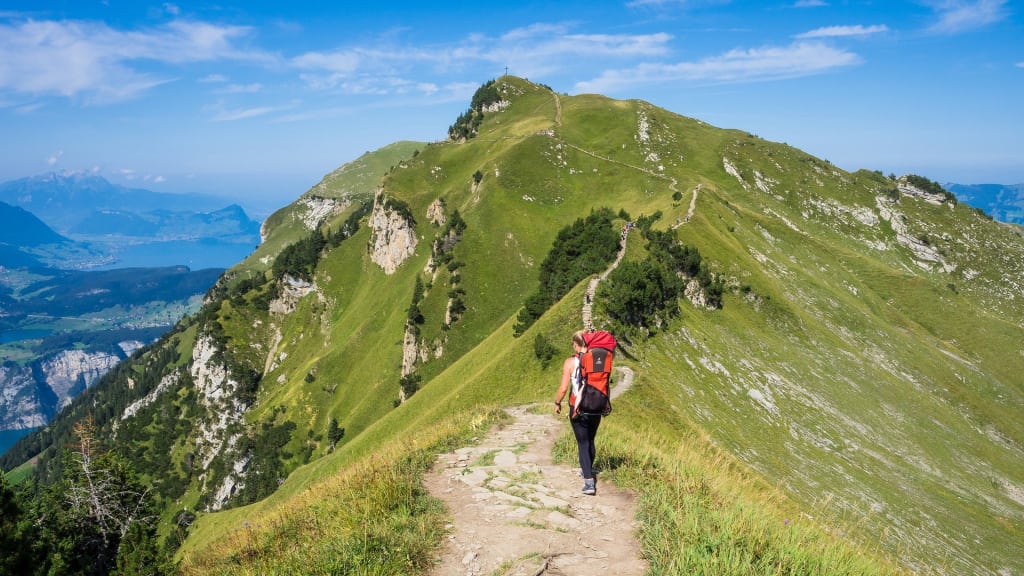
A woman with a red backpack going up a sinuous dirt mountain path, with more people higher above. The sides of the mountain are covered in grass and the clear blue sky is in the background.
Introduction
As a seasoned backpacker, I can tell you that traveling actively can substantially increase your enjoyment and satisfaction. Read on to find out how to apply the principles of active travel to your own trips.
The Meaning of “Challenging Yourself”
It’s meant as doing something that you feel is difficult while maintaining self-motivation and making a resolute physical effort to complete that task.
Criteria for selecting an activity that will challenge you
1. Something that you enjoy doing, or think that you would
2. Appropriate for your current level of fitness, and your health
3. Something that you can do repeatedly during your trip (make it a habit), or that you are planning to do once and expect will pose a more significant challenge to you
Plan To Be Active
The idea behind what I call active travel is that you want to add a layer of physicality to as many of your planned activities as you can.
Here are some examples:
#1: Carry a backpack with you at all times when you are out and about in a new country/city. Your backpack should contain, at a minimum, a bottle of water, and any other basic essentials that you feel you may need. Its total weight should probably be around 3-5 kg (~7-11 lbs) so that it’s both practical, and a reminder that you are moving a little more than your own bodyweight everywhere you go.
This serves two purposes: the first is that you will have the confidence to go out on your own for hours at a time while visiting places, and knowing that you still have your essentials with you. And the second is that this will slowly help increase your fitness level as you add up the hours during which you are carrying this very small weight around with you.
#2: Plan to walk a minimum number of kilometers each day. Start small, and increase the number as you become more fit. The first day you do this on your trip you may find that your legs, feet, or back are sore and tired from the physical effort, and you may even find yourself being out of breath, especially if this isn’t something that you are used to doing in your everyday life. That’s OK. Take it easy the next day, then try again. Over time you will undoubtedly improve at it and what used to be a difficult 5 Km will turn into an easy one.y
In my case, I choose to walk between 10 and 15 km per day when I am visiting a new city in a new country. To put this in perspective, I walk at a brisk pace and it takes me an average of 12 minutes to cover 1 km. So 5 Km equals an hour or so of walking. This is a very small part of a whole day and it’s fairly easy to accomplish.
This helps to build your endurance, improve your cardiovascular health, which in turn helps to lower your blood pressure, and generally makes you more alert than if you were simply riding around in cars or Tuk-Tuks all day letting (local) life pass you by and invariably missing out on exploring and discovering more new areas, foods, monuments, etc.
TIP: If just starting out and unsure of what your baseline number of kilometers should be, then simply include “one hour of walking” in your itinerary for that day and see how much distance you are able to cover at whatever pace you are comfortable with keeping up. The next time you do it, either increase your target distance to cover in one hour (slightly faster pace) or increase the amount of time you want to walk (at the same pace). It’s that easy! And, before you know it, you will find that you have built up more endurance and that you are more energetic throughout the day. And this will also you to see more and do more during your vacation!
For foodies like me: You will experience an added bonus from walking. I bet you can guess what it is. As one of the simplest and most effective forms of aerobic exercise, it makes it easy to expand more energy (aka burn more calories). So it’s a good idea to take the opportunity that a planned meal presents to walk over to that location whenever possible. You should also try to walk after your meal, albeit at a normal pace, not a brisk one, and it will help with your digestion, too. Both are good things when opting to indulge a little more than usual during a vacation…
#3: For those of you whose fitness routine already extends beyond regular walking when you are home: you can do something similar to what I did a few years ago while visiting the Batu Caves in Malaysia. There were small caves with shrines in them located at the top of a big mountain. To get there, it’s necessary to walk up a series of staircases, each containing about 17 steps along with a small landing area separating each, and totaling a little over 200 steps by the time you reach the top.
While at the bottom and looking up in the distance, I thought to myself that I was going to just walk up steadily without taking a break. But, after noticing that the stairs were not very crowded, and always looking to challenge myself, I decided that I was going to attempt to get to the top as quickly (and safely) as I could instead. I would run up the steps while taking as few breaks as possible. After drinking some water and taking a few deep breaths, I got on with it. And, after having stopped a few short times to either get around people or take a break, and with my legs starting to feel quite heavy in the last couple of staircases, I arrived. I took some time to catch my breath and looked over the horizon and down the staircases. What a great feeling of accomplishment! Those feelings are another big benefit of traveling actively. It is very rewarding knowing that you’ve “done it”.
As for the caves themselves, I felt there wasn’t that much to see at the top. However, to me, it was still worth the effort in the end because I challenged myself to do something that wasn’t easy and I did it, which made it a very memorable afternoon that I still remember clearly to this day. And, I walked away with a more rich story to tell.
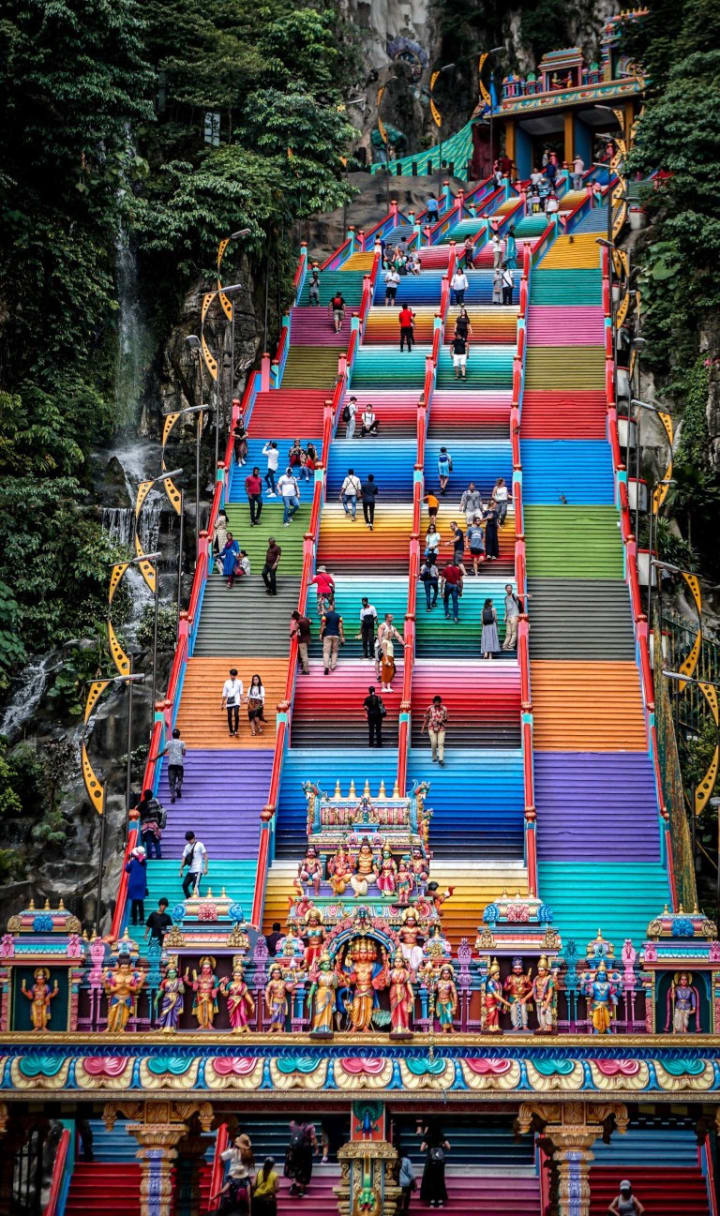
Batu Caves in Malaysia. 15 distinct staircases, aligned one after the other and going up at an approximately 45 degree angle, each painted in a different color, and ending up in a large cave at the top of a mountain. There are many people going up and down the steps. An ornate gate is at the bottom, with various statues painted in different colors as well.
#4: Book a special activity that will keep you active while also learning or doing something new. Three such activities that I’ve enjoyed in the past are 1) going on a walking tour, 2) going zip-lining where there was a sort of obstacle course to get through in-between the zips, and 3) going on a quad (ATV) tour. There’s something for everyone and you may be surprised at what you find once you start doing some research aimed at this sort of activity wherever you are going. Even resorts and cruise ships have pools that you can swim around, sometimes climbing walls that you can try bouldering on, and so forth.
#5: Make sure that there is a fitness room wherever you stay and that it includes some free weights or machines that you can work out with. Something beyond treadmills, step mills, and elliptical machines. Save the cardiovascular exercises for when you leave the hotel! And if you have no or little experience with using weights, you can simply pick up the lightest ones available such as 1, 2, or 3 kg, and use that to perform more repetitions. If that’s not an option, then certainly take the time to do a few push-ups immediately after you get out of bed. This will help you to wake up, get your blood flowing, and get your mind ready to focus on whatever you need to do next. Incidentally, if you’ve ever had a rough night of sleep and you’re struggling to wake up after you get out of bed, you can do some push-ups and it’ll help.
More benefits that come from active traveling
As you complete more physical activities throughout your daily schedule, chances are that by the time you get back to your hotel room at night and finish showering, you will feel more relaxed, less stressed, and have an overall better night of sleep than if you had gone about your day passively
You will create and retain more vivid memories of your trip. There’s something about applying a physical effort to complete a task you have set for yourself and which includes elements of curiosity and discovery like during a vacation outing — and it will remind you of where you were and what you were doing that day, at that time, and who was around
Once you’ve begun to form the habit of being physically active during your travels you will find that this mindset and approach starts to permeate throughout your life, whether at home or somewhere else, and you will continue to increasingly benefit from it over time
Conclusion
As you can see, planning for more active traveling doesn’t have to take much time. You can insert it wherever you see fit in your itinerary. There are some activities that do involve additional planning and expenses like the three that I’ve mentioned, but they are also ways to truly help make your vacation to be more unique to you, and your travel partners, if any. And if you happen to be traveling with a friend who likes to take on the same sort of challenges that you do, you will also find that some playful competitiveness arises from doing some of these things together!
About the Creator
Keep reading
More stories from Denis cristian and writers in Wander and other communities.
Pokhara Adventure Activities for 2026
Pokhara Adventure Activities for 2026 Pokhara is Nepal's best place for adventure activities. It sits next to Phewa Lake with beautiful views of the Annapurna mountains. This makes it perfect for exciting things in the sky and on the ground. The popular activities include Paragliding, Bungee Jumping, Ultralight flight and Atv adventure. All these are safe, fun, and not too expensive. This article covers details about every activity including prices, places, how long they take, safety rules, and how to mix them for a great trip.
By Pranjal Pandey2 days ago in Wander
The Ultimate Guide to Free Flight Upgrades That Work
Getting stuck in a cramped middle seat while watching other passengers enjoy spacious first-class cabins doesn't have to be your reality. Free flight upgrades are more achievable than most travelers think, and this guide shows you exactly how to score them consistently.
By LaMarion Zieglerabout 20 hours ago in Wander



Comments
There are no comments for this story
Be the first to respond and start the conversation.