
🌠This Summer, the Sky Comes Alive: Your Guide to the Magical Meteor Showers of 2025
From midnight sparkles to early dawn streaks, here’s everything you need to witness this celestial spectacle lighting up the night skies.
Introduction: A Celestial Show Worth Losing Sleep Over
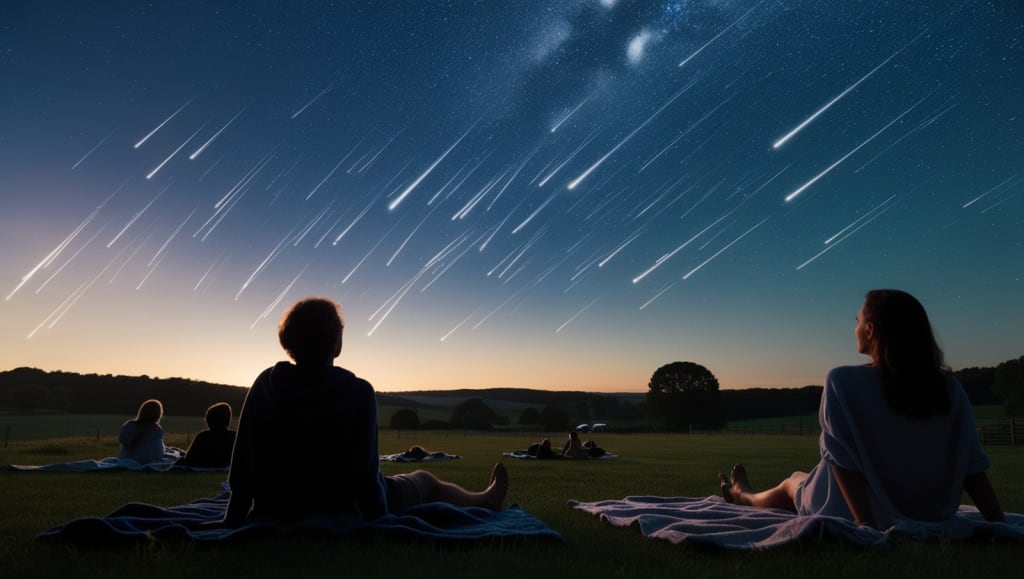
A meteor is one of nature's most beautiful sights, and you may have seen one if you've ever glanced up on a nice summer night and seen a sudden, brilliant flash streaking across the sky. A spectacular sequence of meteor showers, both occurring and upcoming, has been arranged by the cosmos for this summer. The meteor events of 2025 are certain to give spectacular images that you won't want to miss, regardless of whether you're an experienced sky watcher or just someone who appreciates being outside in nature.
You don't need a telescope or other expensive gear; all you need are your eyes, a clear sky, and a little willingness to stay up later than usual.
What Exactly Is a Meteor Shower?
Let us first grasp what we are seeing before we go on to talk about the best viewing times and locations. A meteor shower happens when the Earth crosses a trail of debris dumped by a comet. Burst into flames in our atmosphere, many of these small particles—many of them as small as a grain of sand—cause spectacular bursts of light at night. Though they are actually remnants of space burning up in our atmosphere, we refer to them as shooting stars.
Names are given to the constellations seeming to be the source of many meteor showers. While the Perseids seem to emanate from the constellation Perseus, the Delta Aquariids, for example, seem to come from the constellation Aquarius.
Major Meteor Showers You Can Catch This Summer
Here’s a look at the most prominent meteor showers lighting up the skies in mid to late summer:
1. Delta Aquariids (Peak: July 28–30)
- Rate: Up to 25 meteors per hour
- Best Time: After midnight and before dawn
- Viewing Tip: Find a dark sky spot far from city lights. These meteors tend to be faint but can leave beautiful, long trails.
The Delta Aquariids are already active and build up to a gentle peak by the end of July. While not as intense as some other showers, they offer a serene skywatching experience, especially in the Southern Hemisphere or southern U.S. states.
2. Perseids (Peak: August 11–13)
- Rate: 50 to 100 meteors per hour
- Best Time: Midnight to pre-dawn
- Viewing Tip: Lie on your back and let your eyes adjust to the dark for 20–30 minutes before expecting to see anything dramatic.
The Perseids are the real headliner of summer meteor watching. Known for their brightness and frequency, they’re often accompanied by fireballs—extra bright meteors that linger longer than most. This year, a waning crescent moon means dark skies—perfect conditions for viewing.
3. Alpha Capricornids (Peak: July 30)
- Rate: About 5 meteors per hour
- Best Time: Early evening to midnight
- Viewing Tip: What this shower lacks in quantity, it makes up for in quality. Expect slow, dramatic fireballs.
Though not as prolific as the Perseids or Delta Aquariids, Alpha Capricornids have a reputation for unexpectedly dazzling observers with occasional bright bursts across the sky. It's a great warm-up act for the Perseid main event in August.
Where and How to Watch
You won’t require a telescope, binoculars, or an observatory on a mountain. A bit of preparation is all that’s necessary:
- Choose a location away from lights: Steer clear of urban brightness. National parks, open fields, or coastal areas work best.
- Allow time for your eyes to adjust: Your eyes need around 20 minutes to become accustomed to the darkness.
- Relax and gaze upward: Instead of focusing on one section of the sky, remember that meteors can show up anywhere.
- Look at the weather forecast: Overcast conditions can obstruct your view completely. Consider using an app such as Clear Outside or Weather Underground.
- Pack essentials: Bringing a blanket, a comfortable chair, snacks, and insect repellent can enhance your experience of watching the stars.
The Emotional and Spiritual Side of Meteor Showers
Observing trails of old cosmic dust racing through the sky feels truly humbling. This experience goes beyond simply being an astronomical event; it’s a moment filled with wonder that links us to something grander. Whether you find yourself lying alone, lost in thought, or enjoying the evening sky with loved ones, these instances ignite feelings of curiosity, hope, and amazement.
For some, shooting stars are a chance to make wishes. Others interpret them as signs of transformation or change. Regardless of their significance for you, one thing is clear: watching a meteor shower highlights our small position within a magnificent, expansive universe.
Tips for Capturing the Moment
Consider these simple tips if you want to capture some images (and who doesn't):
- Set up a tripod and select long exposure mode on your camera or phone (for around 10–30 seconds).
- Employ a wide angle lens to increase your chances of photographing a meteor.
- Avoid camera shake by means of a remote shutter or the timer function.
- Do not just focus on taking photographs; also savor the experience.
Final Thoughts: Look Up, Slow Down, Be Amazed
In a world dominated by screens, noise, and deadlines, meteor showers offer a rare gift—a reason to pause and look up. These natural fireworks are free, breathtaking, and happening right above us. All you have to do is show up.
So grab your blanket, head out to that dark patch of earth, and lose yourself in the beauty of a sky streaked with fire. Whether you catch one meteor or a hundred, the memory of that moment—the stillness, the awe, the flicker of stardust—will linger long after the stars have faded.
Now You Know What to Look For. Are You Ready to Watch the Sky Come Alive? 🌠
Let this be the summer you remember not for the noise, but for the silence between the streaks of falling stars.
About the Creator
Keep reading
More stories from Shahjahan Kabir Khan and writers in Wander and other communities.
The Secret Side of Paris: 9 Places Locals Don’t Want Tourists to Find
When people think of Paris, images of the Eiffel Tower, the Mona Lisa, or enjoying coffee in a Montmartre café usually come to mind. While these attractions are stunning to see, they are also crowded with tourists, souvenir shops, and people taking selfies.\
By Shahjahan Kabir Khan7 months ago in Wander
Eating in Morocco With Food Allergies by Morocco Family Vacation
Traveling with food allergies is stressful no matter where you go. Traveling with kids who have food allergies can feel overwhelming. When we planned our family trip to Morocco, this was the part that worried me the most. I kept asking myself the same questions: Would people understand allergies? Would language be a barrier? Would I be constantly on edge at every meal?
By Ariel Cohenabout 21 hours ago in Wander


Comments
There are no comments for this story
Be the first to respond and start the conversation.