
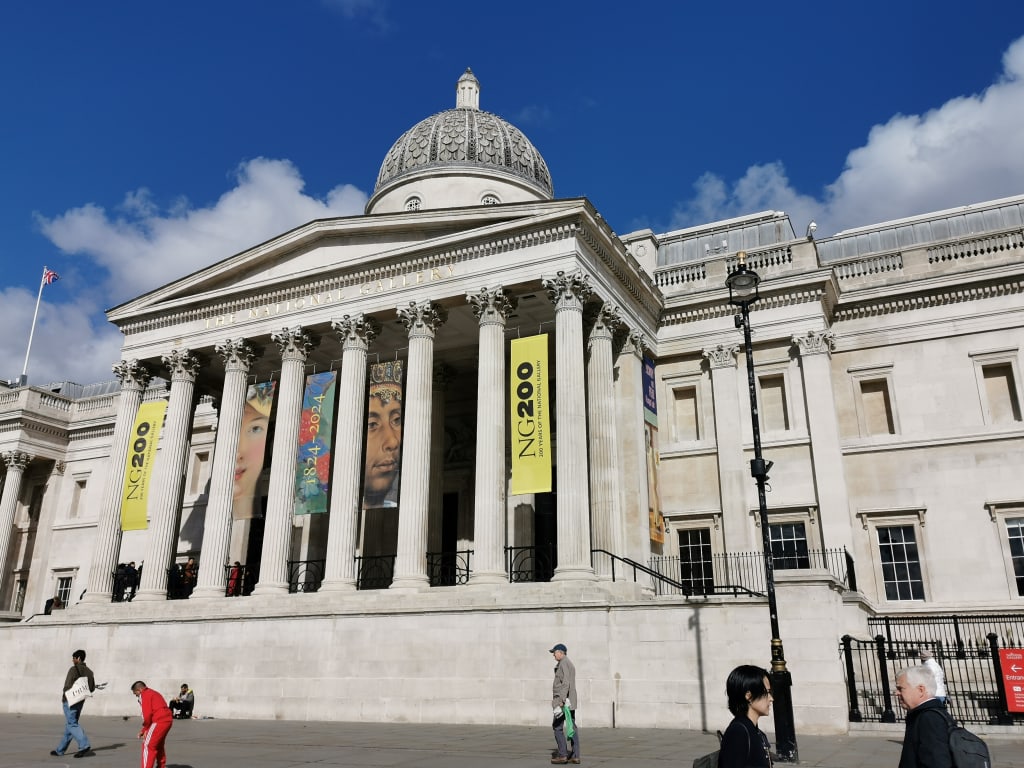
The National Gallery is an institution. Most London kids go to the Gallery with paper and pencil in hand for an afternoon drawing. I have very fond memories of my time at the Gallery. I remember crouching down on the floor with my friends, trying to capture the Monet Waterlily painting.

I took pride as I took my picture home, and my one big fan, my mum, was most impressed. We were oblivious to the crowds of people enjoying the paintings, too. Hopefully, we didn't disturb their peace too much.
The main entrance is impressive, and it fits the place very well. I booked tickets beforehand, and they are free. If you don't book tickets, you can still get in but must queue up. I miss the days when you could walk in. Now, everybody seems to have ticketed and timed entry since lockdown.
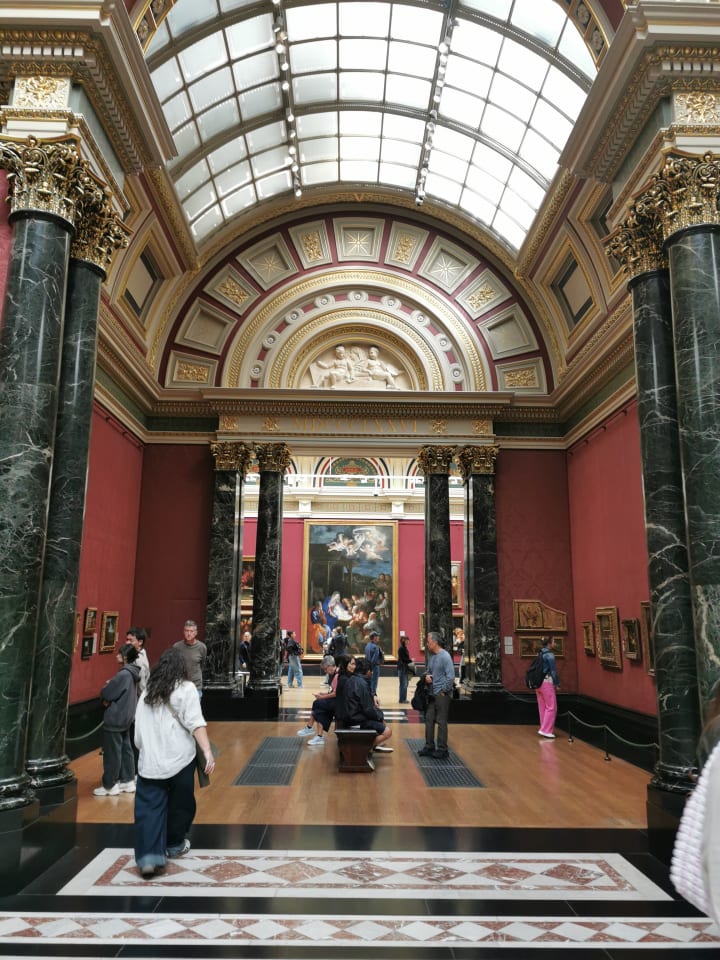
Let me tell you a bit more about the National Gallery.

History
Established in 1824, the British Government bought 38 paintings from the banker John Julius Angerstein, a banker and art collector. Why did the Government buy the paintings from the banker? This was in response to concerns that Britain lacked a national art collection, unlike other European nations.

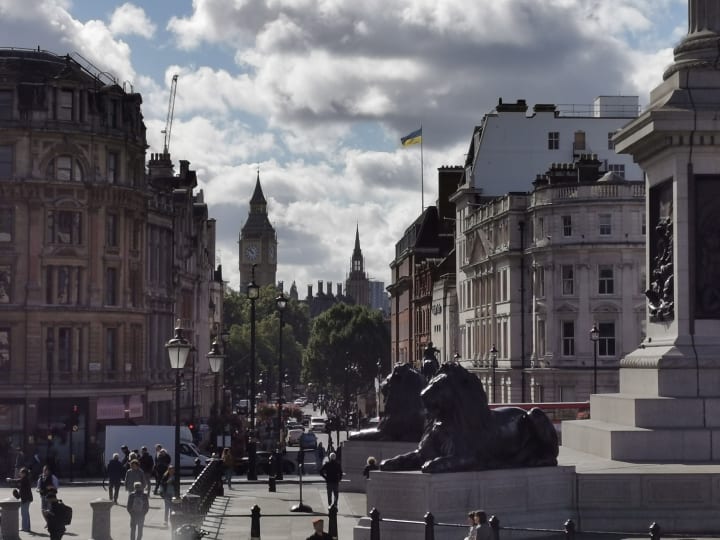
The location is ideal because it's situated in Trafalgar Square. The area was chosen for its central position, accessible to the wealthy West End and poorer East End of London. The Gallery houses a vast collection of over 2,300 paintings dating from the mid-13th Century to the early 20th Century. It includes masterpieces by renowned artists such as Van Gogh, da Vinci, Rembrandt, Monet, and Turner.
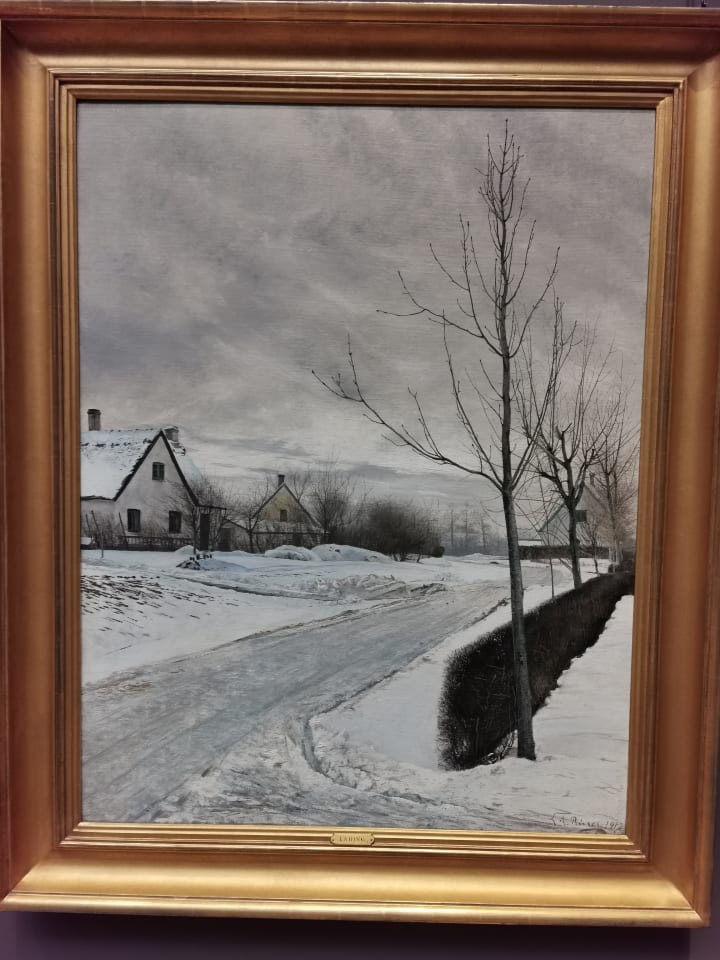
Free Entry

I like a freebie, especially regarding art and culture, because I believe such places should be accessible to all. As a result, the National Gallery is considered one of the world's most visited art museums and is a significant cultural institution in the UK. The collection was expanded in the 19th Century through
through purchases and donations. Notable acquisitions included works by Titian, Veronese, and Canaletto.

Architecture
The current building, designed by William Wilkins, was completed in 1838, with later additions. The Sainsbury Wing, opened in 1991, provided space for early Renaissance art. With the rise of technology, digital initiatives and educational programs have expanded the Gallery's reach.
Did you know…
✅During WWII, the collection was evacuated to Wales for safekeeping.
✅The empty Gallery was used for lunchtime concerts to boost morale.
✅The collection returned, and the Gallery underwent significant restoration.
✅New wings were added to accommodate the growing collection.
✅15,000 to 20,000 visitors per day, though this number can fluctuate depending on the time of year, special exhibitions, and events.
Other Quirky Facts
❇️The Empty Frame Tradition - During WWII, the Gallery kept an empty frame hanging on its walls, symbolising the art taken for safekeeping. After the war, Winston Churchill requested one painting be returned monthly for public morale.
❇️The Gallery's 'Hole in the Wall' - There is a hidden bricked-up window in Room 32, known as the "hole in the wall," which gives a glimpse of the Gallery's history before renovations changed its structure.
❇️Home to Da Vinci's Cartoon - The National Gallery holds a unique piece by Leonardo da Vinci called The Virgin and Child with St. Anne and St. John the Baptist—but it's not a finished painting; it's a "cartoon" or large preliminary drawing.
❇️Ghostly Encounters - Some visitors claim to have seen the ghost of former director Sir Charles Eastlake wandering the halls of the Gallery at night.
❇️A Famous Pigeon Incident - A giant pigeon once flew into the Gallery's Sainsbury Wing in 2007, causing chaos before it was safely escorted out.
❇️One Painting Controversy - Botticelli's painting Venus and Mars once caused a scandal due to its suggestive themes. Some felt it was too risqué for public display.
Gallery Fatigue
I don't know about you, but Gallery fatigue is real. I usually start flagging after the two-hour mark, but I had Gallery fatigue in less than 90 minutes on this occasion. So, a pit stop in the National Gallery cafe was welcomed. I went at the tail end of the peak season, but it felt busy. I understand that during the height of summer, the numbers can exceed 20,000 visitors per day.
Rotating Exhibitions
The National Gallery is constantly rotating exhibitions, and when I last visited, I was lucky enough to catch a unique collection featuring some lesser-known works by Turner. I did the customary Impressionist room, too.
The Gallery frequently hosts temporary exhibits alongside its permanent collection, offering new insights into artists' lives, styles, and influences. From Renaissance masterpieces to Impressionist icons, the diversity of the displayed paintings is staggering.
Parting Comments
What's on at any moment is worth checking out beforehand—especially if you're after something specific. Often, you'll find exhibits tied to significant anniversaries or landmark events in art history, so it's always good to keep an eye on the calendar.
No matter what's on, a day at the National Gallery is constantly enriching and reflective, and it remains one of London's cultural treasures. Whether you're a seasoned art enthusiast or a curious first-time visitor, there's always something to captivate you.
Thank you for your attention.
Best wishes as always
Tabby
About the Creator
Tabby London
The London I've been discovering is usually off the well-beaten track.I love the nooks and crannies and walking along the streets steeped in centuries worth of history. I'm fond of Zone 1 because that's where it all began centuries ago.
Keep reading
More stories from Tabby London and writers in Wander and other communities.



Comments
There are no comments for this story
Be the first to respond and start the conversation.