
The contemporary temple of Apollo
Far from ancient Greece, northern Brutalism endures

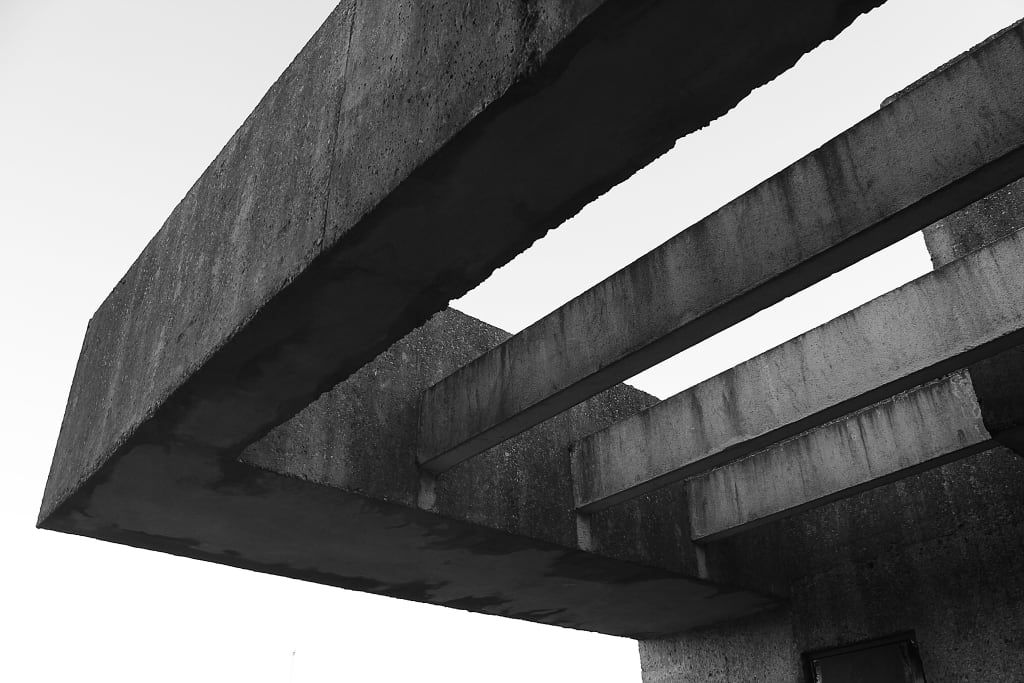
In the heart of a County Durham housing estate, the Apollo Pavilion is rare example of uncompromising public art. Since its unveiling in 1969, Victor Pasmore’s piece of brutalist constructivist design has prompted much head-scratching. Is it architecture? Sculpture? Both? Neither? Do the stark concrete outlines enhance Peterlee’s Sunny Blunts estate, or is it simply an eyesore? Is it the kind of artwork beloved only of those who don’t have to live with it, or does it have a role to play in its community more than 50 years after it was built.
But perhaps the most impressive detail is the fact that now, decades after Apollo was built, it’s still a talking point. In an age when the majority of public architecture seems to strive towards a kind of flat-pack invisibility, this is truly a relic of a recent bygone age.
Brutalist design, a powerful movement in post-war architecture, remains divisive. Further north, Gala Fairydean’s Netherdale football ground divides opinions more effectively than any offside call. London’s South Bank complex was derided as a “carbuncle” by no less a critic than the future King Charles III. Yet, across the city, the Barbican’s ‘streets in the sky’ are much cherished both as an arts complex and a place to live.

Apollo was built amid sky-high ambition. Directly referencing the moon landings (yes, that Apollo inspired the name), it was intended as a statement artwork at a time when Britain’s new towns were intended to redefine the way people lived. Gone were smoky, cramped inner cities; now we were looking at accommodation set in landscaped terrain. Open space, open water, a convenient parade of local shops and a bus route to the town centre. A brave new world, at least while the dream endured.
Aesthetically, Apollo’s stark concrete blocks, thrown together to resemble an abortive (and anachronistic) game of Tetris, challenge the viewer. When it was built, the surrounding houses had flat roofs. Those cuboid forms interacted more naturally with Pasmore’s vision. Today, most of those home have been modified, pitched roofs are the norm, and much of the effect is lost. There’s a separate argument about the wisdom of designing flat-roofed homes in the rainy Northeast of England, of course.
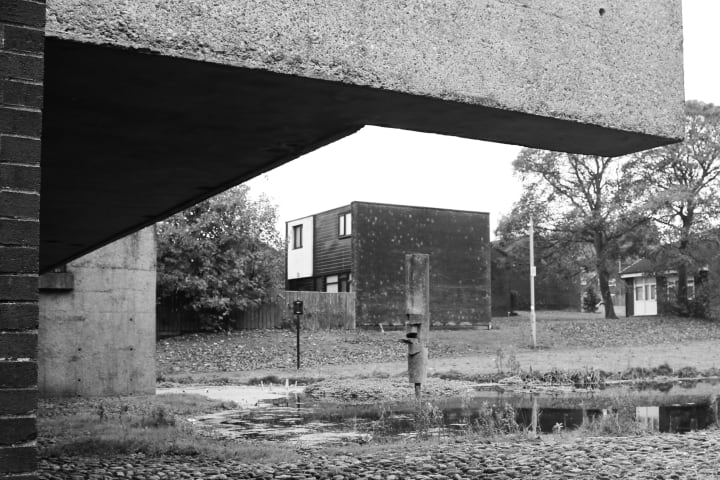
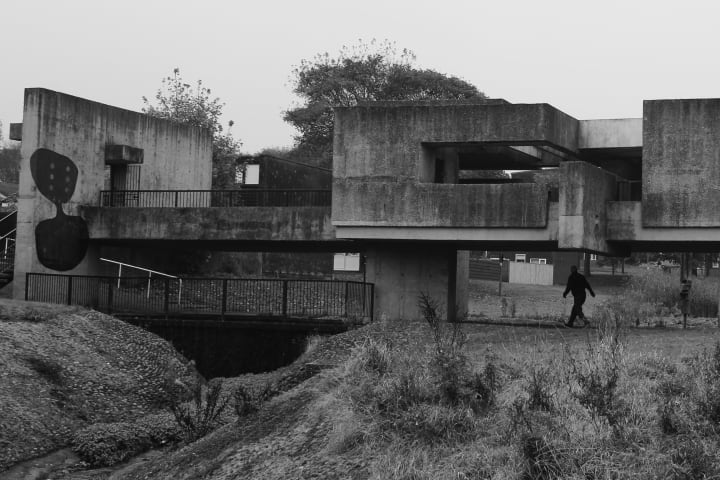
But it’s more than a striking shape. Bridging an artificial lake, Apollo is a structure that visitors can clamber over and explore. It’s not quite a footbridge – access is from one side only, and it’s possible to cross the water at ground level – but it’s not exactly a conventional sculpture, up on its plinth away from its audience. That’s part of its success but also became part of its problem.
Lack of funding and lack of political will resulted in lack of maintenance. Sky-high ambition was grounded in the prosaic quotidian. With the pavilion seemingly neglected, vandalism, graffiti and anti-social behaviour filled the void. There was vocal opposition among the immediate neighbours, implacable opponents calling for the whole thing to be blown up.
Pasmore himself was unabashed. On a return visit in 1982, he welcomed the graffiti, seeing in it evidence of “a dialogue with that very community who had ironically rejected it and were calling for its demolition”.

But even at the time, when Apollo was almost a symbol of a remote metropolitan elite dumping unlovely art on ordinary people who wanted nothing of it, there were local voices in support of the structure. It took time, and plenty of debate, before Grade II* listed status was secured in 2009. That prompted a renovation and, by the 50th anniversary in 2019 Apollo was reimagined as an art installation and, potentially, a calling card for Peterlee Newtown’s architectural experiments. A successful display as part of the biennial Lumiere festival helped to cement its position as a space where interesting things can happen, smoothing over some of the uncertainty around its future.
Not that the debate is over. However, it is being recast in more nuanced terms. A December performance at the pavilion – ultimately postponed due to storm Darragh – was set to include a sound installation built on interviews from two of Apollo’s neighbours who were determined that it should stay and thrive. Local musicians have also drawn inspiration: amid the frantic post-punk thrash of Fast Blood’s repertoire, Sunny Blunts stands out as an evocative change of pace (as mentioned in one of last year’s playlists); the video is an unexpected elegy to Peterlee the oddly picturesque.
And maybe that’s the key change. So long in the landscape, Apollo has mellowed and matured. As it matures, so the reaction to it settles. Now that the future has caught up with the futuristic, perhaps we can start to celebrate its quirks rather than fearing them.
About the Creator
Andy Potts
Community focused sports fan from Northeast England. Tends to root for the little guy. Look out for Talking Northeast, my new project coming soon.
Reader insights
Nice work
Very well written. Keep up the good work!
Top insight
Eye opening
Niche topic & fresh perspectives
Keep reading
More stories from Andy Potts and writers in Wander and other communities.
Worth the Wait: Puerto Viejo, Costa Rica
Beach bumming in a small Caribbean beach town sounded like a perfect way to end our 6-month trip through Mexico and Central America. Or so we thought. The foul, fishy stench of rotten seaweed hit our nostrils as we stepped from the cramped bus and looked out at a rather depressing, empty, and underwhelming black sand beach. It was pouring with rain, and we had to quickly fish out our ponchos. We thought, this couldn’t be it, could it?
By Sh*t Happens - Lost Girl Travel4 days ago in Wander
Guard Your Battery
Why are some people so attractive just by standing there? It’s not because they are "likable," but because they don’t need everyone to like them. I realized later that truly charismatic people allow themselves to be criticized, but they never criticize themselves. They never try to please the world; instead, the world stops to watch them.
By Emily Chan - Life and love sharing7 days ago in Poets




Comments (2)
That is brutalism , excellent article, though Preston Bus Station while being brutalist is also impressive
I'm an American who absolutely loves interacting with British and Australian people-- anyone who speaks English. I had never heard of this artwork. I had never heard of the brutalist movement. I found this eye-opening in every way. When you first mentioned Apollo, I thought of the Greek god and was surprised this had anything to do with the space race. It's fascinating how you explain this history of this structure. I love that the architect had no problem with the graffiti. I would almost urge you to change your pictures, take one from the bottom to use for the main pic at the top, to draw readers in. I didn't fully realize how unique this structure was until I saw the bottom two pictures. But your way of presenting this makes for revelations at the end. Great story, Sir! ⚡💙⚡