
The Challenge
"Writing is perhaps the greatest of human inventions, binding together people who never knew each other, citizens of distant epochs. Books break the shackles of time. A book is proof that humans are capable of working magic."

It had been difficult to imagine, given my own struggles, that the city of Paris was once the geographical axis around which all of world literature had revolved. In some cafés, the locals (usually the café owners themselves) liked to claim that if one sat in the right spots in the Café de Flore or wherever else, they could practically feel the presence of the great writers and, I suppose, absorb the remaining dregs of their artistic residue. I once joked to Amelia, my wife, if the authors of canon themselves had heard the same tired pitches about the mystical properties of old places, that if they spent enough money in some dreary timeworn club they would begin to hear the scratching of Robespierre’s pen and be infected with the revolutionary spirit. No, for throughout the entirety of my Amelia and I’s month-long novelist’s getaway in Paris, no cafés ever managed to do me better than an excellent cup of coffee, though I’ll admit they provided me with those in spades.
With the allegedly supernatural abilities of French history failing to present themselves, all that remained was to get stuck into writing the good old fashioned way. It had worked for my previous novels, after all. And yet, after almost three and a half weeks of labouring, I began to feel like the whole trip was going to be fruitless. I had endless ideas to begin with, some of which weren’t even half bad. One by one, however, they fell through. Each had their own problems. A partially-autobiographical narrative about self-formation, from the perspective of a burgeoning adolescent? Too artistic. A story about a town under attack from a cannibal biker gang? Too commercial. This was too Steven King, that too Cormac McCarthy, and the rest were just… plain bad, and so on it continued until my working holiday was almost at an end. It was around the end of the second week that I began to retreat from novels entirely, at Amelia’s suggestion, instead focusing on smaller projects like short stories, in an increasingly frantic attempt to find any spark of inspiration at all, an endeavour as equally futile as the last.
My wife, who had finally published her first fantasy epic the previous year (a smash hit) was having no such difficulties. She had already sunk her teeth deep into a new project, one which, in an inspired fashion typical of her, featured no humanoid species at all. Instead, it told the story of a great war between two animal factions, for which she had chosen the Boars and the Deer as leaders. Unamused by my title suggestion ('From Tusk Til Fawn') she promptly expelled me from our hotel room, leaving me to wander the city alone late one afternoon.
Having already exhausted the Champs-Élysées and the other tourist spots of their charm over the course of my stay, I closed my eyes and let my legs carry me away to unknown lands. At first they brought me through the beating heart of the city centre, but before long they had taken me deep into the backstreets, where the bustling life of the city seemed to be a distant memory recalled only now and again in the occasional background ambience. It was here, in a forgotten Parisian alleyway, that I discovered Le Petit Trésor. I wish that I had made note of the address, as in the many times since that day in which I tried to make my way back to the bookstore, I have never been able to find it.
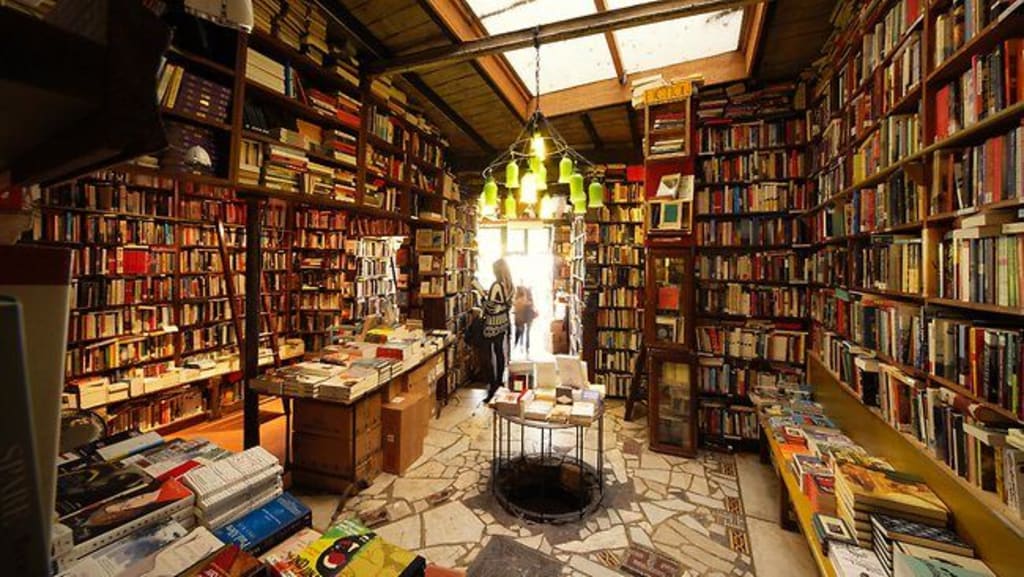
The sun had just embarked on its final daily arc as I pushed open the peeling double-doors and entered into the old shop, flooding it with the sunset’s harsh orange glow. I was, before anything else, immediately struck by the store’s scent, an enveloping musty scent. It was an aroma familiar to any reader of books printed long before their time. Classic. Remembered. Respected. There was little I could do upon first entering but instinctively pause, close my eyes, and inhale deeply. Opening my eyes again after a moment, I was struck a second time. What a collection! Bookshelves arched up to a ceiling far taller than what could have been expected from the unassuming exterior. The room was lined with the shelves which stretched almost endlessly from wall to wall, each filled with books from every author, genre or time period one could care to imagine. And yet what shocked me more than the room I had entered was the modest archway on the other side of it, leading to a corridor through which I could see several other rooms of comparable size before the passageway curved out of sight entirely.
The doors quietly swung shut behind me, barring the sun and allowing the store to become relit by the far cosier, softer lights which hung from the ceiling. It felt as if the books pulled me towards them with a magnetic attraction. For a seemingly endless amount of time I circled the room, traipsing my fingers along the spines of the books, my neck bent at a ninety-degree angle to catalogue them as I went. So vast was the collection that one could have, with only a slight shift in perspective, reimagined Trésor as a museum of literature, instead of a marketplace for it. It was almost profound, being in a single room which seemed to concentrate the entire historical unity of the literary medium. It became overwhelming, dizzying, as I began to walk faster and read more quickly, in a desperate attempt to drink in as much as I could.
It was at this moment, in which I had evolved into a state of what can only be described as hysteria, that she spoke. She was a tiny, wizened woman of what must have been around eighty, leaning against the corner on the corridor’s exit for support. Her long grey hair was worn freely, much of it resting on the shoulders of her cardigan or getting tangled up in her black scarf. She seemed amused, as if I were a much-anticipated court jester there for that night’s round of entertainment.
“You’re a writer, then,” she asserted. It wasn’t a question. I abruptly paused my circling of the room, realising I was out of breath.
“Yes,” I managed to pant out in barely adequate French, “how did you know?”
“Oh my, dear,” she chuckled, “I’ve met as many authors as there are books in my store. At this point I can tell just at… a glance.” She winked in my direction, and began to shuffle towards the far side of the room, towards a bookshelf labelled ‘Classics.’ “You all have the same look in your eyes. It’s really something, isn’t it? There’s not a bookstore in all of Paris like it. Or in all the world for that matter.”
“It’s amazing, your collection,” I confessed, “but surely there are plenty of others like it in the world?”
She reached her destination, and began to run her fingers over the books in front of her, gazing up absently to the ceiling. I puzzled over her action for a moment, before I realised that she was completely blind. She was searching for something. Eventually she settled on a book, the only one which, I noticed, was without any distinguishing text printed on the spine. A thin smile spread across her face, as she tugged a little black notebook out from the shelf, one lacking any decoration or design whatsoever. Unlike all the surrounding books, each of which clearly had experienced many years of history in their own right, the notebook was brand new and, for all I knew, could have been made yesterday.
“Not in all the world,” she insisted again. “Want to know why?” She began her shuffle anew, this time directly towards me.
“Why?” I felt somehow that she must be right, but for what reason I couldn’t possibly have said. She arrived half a metre in front of me, uncomfortably close, clasping the black notebook in her wrinkled hands.
“Because no other store has a single book in the world quite like this one.” She held the book up to me, aiming its bottom directly at my face. I took it gently into my own hands and she let her arms fall down to her side. Opening the notebook and flicking through, I realised the pages were empty. As far as I could tell, there was absolutely nothing remarkable about the it at all.
“I don’t understand.”
“Of course you don’t,” she giggled. “But you will. The notebook that you are holding is, well… to put it simply: magic. You see, as I said, I’ve met many writers over the years. Some of them were the very greats, the ones whose books you yourself were admiring a moment ago, though they weren’t so great at that time. The young Ernst, Francis Scott, Jean-Paul, so many… Do you know what changed, how they became the masters? I gave each and every one of them a little black notebook, just like this one. Every story, poem, philosophical treatise, or whatever else that’s first written down in this notebook will become a masterpiece, and will bring acclaim and wealth to its author. Any goal the author wants their writing to accomplish, it will. That’s the gift it holds. That it holds now, for you.”
I was stunned. Speechless, with absolutely no clue of what to make of what I’d just heard, I tried to make some overtures towards payment for the notebook, but she wouldn’t hear of it. She simply turned her back to me and walked down the curved corridor. “No need for that,” she said. “What it brings the store is a reward in of itself.” I left Le Petit Trésor in a trance and began to wander home. I mean, it’s absolutely ridiculous, I kept telling myself, what a silly old woman. But my stomach seemed to disagree. I stroked notebook’s cover and the spine compulsively as I walked back to my hotel, barely noticing the bustle of the city re-entering into my sensory realm. I collapsed into bed as soon as I got back to the room, Amelia sitting on her side, a spot from which I imagine she hadn’t moved since I’d left.
“Productive afternoon?” she asked, turned away from her laptop to face me. I managed a slight nod, with an accompanying hum. “Cute notebook. I didn’t think black was quite your style,” she teased, winking, “but it suits you.”
“Oh… thanks,” I returned weakly, not really feeling up for a match of verbal tennis. “It’s not bad, is it?” I flicked through the pages of the notebook again, looking for any distinguishing sign or clue that could tell me what I wanted to know.
Amelia suddenly leapt into a kneeling position in bed. “Oh! Actually, while you were gone, I found something I think you might like,” she said, turning her laptop towards me. “I had a bit of an idea. I know you’ve been having trouble writing, so I had a look around online. You know those competitions online, where they give you a prize if you write the best short story? Well I found one that might be fun, and there’s a prompt and everything so you don’t have to rack your brain so hard for a concept!” She grabbed a pen from her bedside table, thrusting it into my hands, then snatched my notebook from me, opening it to the first blank page before returning it.
“Alright, sure, I’ll give it a shot, nothing to lose by trying,” I answered, looking down at the empty page, thinking. “What’s the prize?”
“Twenty-thousand dollars,” she grinned. "Now wouldn’t that be nice?”
“Yes, yes it would,” I grinned back, as I turned to the laptop and began to read the prompt.
About the Creator
Matthew Mercer
Just an Australian writer trying to get back into it after a long time not writing!
Keep reading
More stories from writers in Wander and other communities.
Seattle Nightlife Report: Pony
Mid-winter Friday night. Early but already so dark. The days are getting longer but 6 PM is still pitch black. “Firepit!” You declare things after just a few seconds of solemn thought – not a request or suggestion, not a demand. Last week you walked around saying, “Hot tub?” to anyone who would listen. Or one afternoon you pointed at two men holding hands as they crossed 12th Avenue, looked me in the eyes and said, “Boyfriends.”
By Joe Nasta | Seattle foodie poet17 days ago in Wander
another article about Miami 305
It was a fantastic flight, and everything went well, and I had a couple of adult beverages. I was so excited when we took off; it was fantastic. We landed at Miami International Airport, and the flight was smooth. Our captain and flight crew did a great job making sure our flight went well and without any problems. From the plane, I tried to take pictures of Miami as we approached. It was wonderful to see Miami, Mia 305, but even more fantastic. Driving around Miami with my cousin and godmother, I saw a picture of my friend Willy Chirino on a bus stop. In Miami, I felt right at home, and that was the first time I've ever felt like that on a holiday, and going to Miami was one of the most memorable vacations of my life.
By Revista Mikoa day ago in Wander
The Devil's Triangle
The sails ruffled in the breeze as we cruised along. The Sea Breeze was a mid-size catamaran that sailed out of Royal Naval Dockyard in Bermuda. We had booked this trip weeks in advance and were now looking at our Captain, Spike and two boat hands. Paddy and Wilson seemed like nice guys, joking around with the passengers and telling us some stories about Bermuda that only locals would know. Their island accents sounded almost British but they were pleasant to listen to.
By Barbara Gode Wiles5 days ago in Fiction



Comments
There are no comments for this story
Be the first to respond and start the conversation.