
The Buried History of LA's Oldest Tourist Trap
By Tom Molz

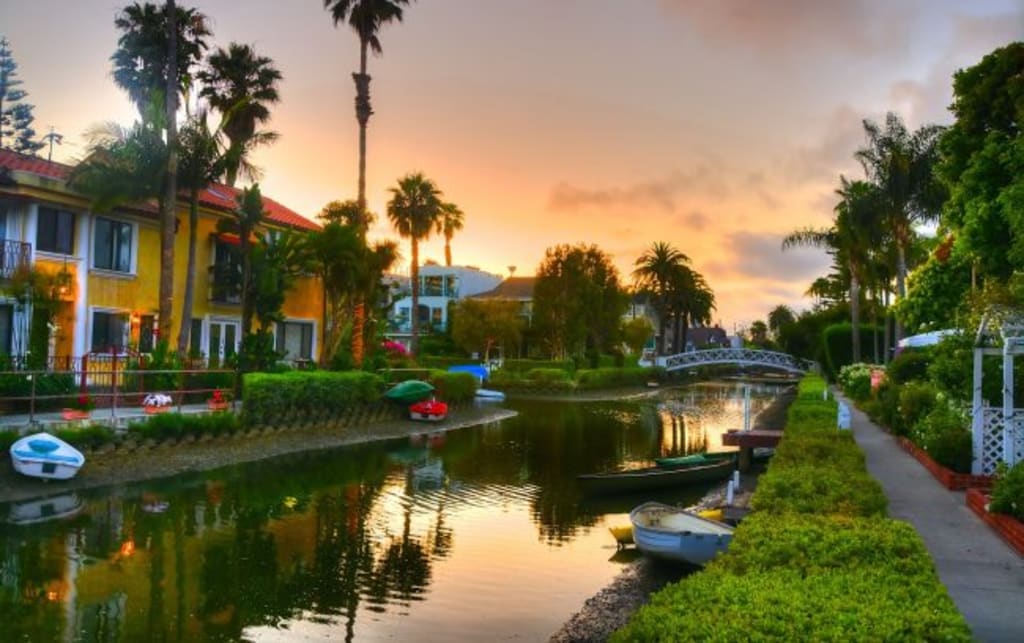
The Venice Canals, and, by extension, the surrounding area of Venice, are a testament to the deception inherent in the inauthentic tourism traps throughout Los Angeles. Home to the most instagrammed house in the world and located adjacent to Venice Beach, the Venice Canals are arguably one of the most popular tourist destinations throughout the entire city. Rows of houses, each with their own unique architectural style, and footbridges connecting footpaths adorned with shrubbery makes the location’s beauty undeniable. There is a majestic aura to the awe-inspiring sights of the Venice Canals similar to what one may feel approaching the Eiffel Tower. These beachside waterways, however, more closely resemble the cheap knock-off Eiffel Tower in Las Vegas than the original thing.
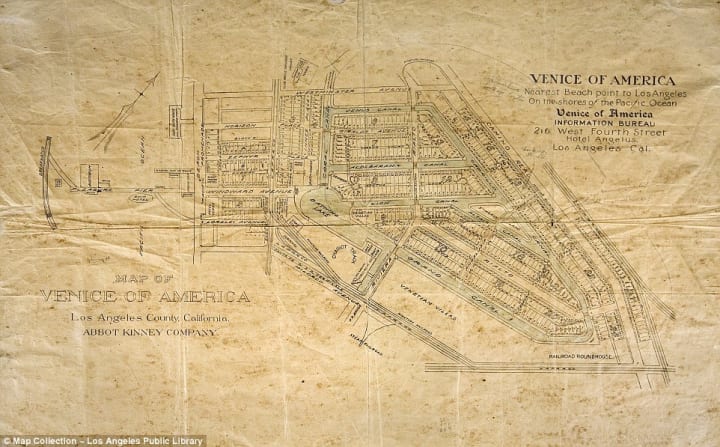
From the very beginning, the Venice Canals were intended as a replica of a pre-existing cultural landmark. Developer and conservationist Abbot Kinney had envisioned a project known as “Venice of America”, a series of interconnected canal systems that he hoped would evoke an aesthetic reminiscent of Venice, Italy. An ambitious idea with impressive results, the canals officially opened on July 4, 1905. There is no mistaking that they were an incredible success in their early years, in every sense of the word.
The clear blue waters of the canals snaked between rows of quaint snow white houses topped off with auburn roofs. Footpaths were directed between the two and were abundant with lush green grass and palm trees towering above. Open squares and parks rested next to the calming waters for anyone who wished to unwind. Shops, hotels, and apartments in charming Mediterranean architecture were also available in the denser corners of the canals. It was not long before the area exploded with life as people were drawn to the surprisingly successful Venetian mini-city. However, the “old world charm” that Kinney was using to lure tourists and interested residents was nothing but a cheap mask.
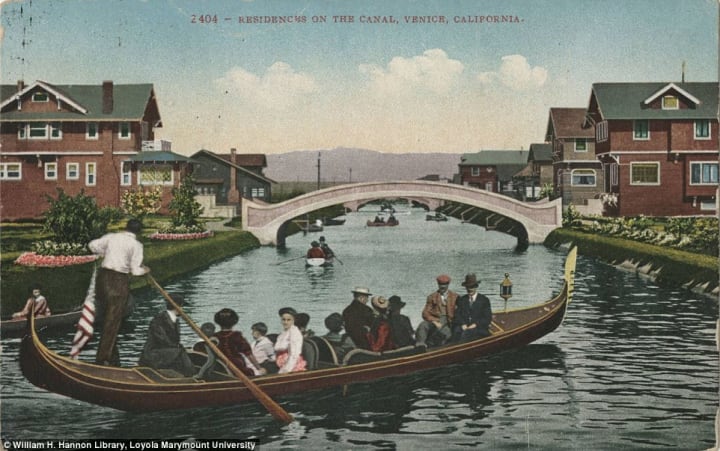
The successful launch was only the beginning. Kinney’s early plans for the canal system included using it as a practical mode of transportation through the city. In yet another attempt to elicit Venice, Italy’s charm, Kinney ensured that even this water-based conveyance system would keep its passengers immersed in his knock-off Italian world. His persistence for constant cultural immersion evokes thoughts of Disney’s Epcot Center, another popular tourist trap benefitting from the inaccurate (and at times fetishist) representation of foreign cultures.
In order to include the transportation in his immersion, Kinney hired Italian gondoliers to escort passengers in gondolas. To go a step further, he made sure said gondoliers would sing in Italian for the duration of the trip. Much like Disneyland’s lifelike animatronics were used to heighten false realities for its visitors, these gondoliers were simply another imported prop to further help fabricate this picturesque yet inauthentic world.
Over time, Kinney’s plans escalated even further and he devised a plan to turn the Venice area into a Chautauqua resort, an adult education movement made popular throughout the early 20th century across America. Admittedly, this idea had some genuine merit behind it. A Chautauqua resort lacked any strong connection to the overall theme of evoking Italian culture. This could perhaps be a course correction and an attempt to begin building a unique American culture in a state that was desperately searching for one. He had even hired the most popular actress of the time, Sarah Bernhardt, to perform in a theater overlooking the ocean. Alas, Kinney had been able to foresee the growing success of Santa Monica which was leading the way for beachside entertainment only a few miles north. The resort and the hopes of it being the spark to ignite a new cultural fire on the west coast were both abandoned.
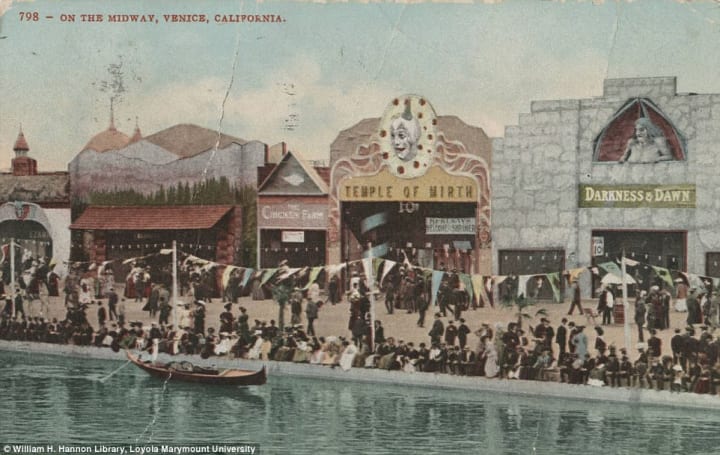
In retaliation to Santa Monica’s mounting success over his own development, Kinney, ever the thief, devised another copycat project that was sure to dominate. Drawing “inspiration” from Coney Island, Kinney dropped the adult education venue in lieu of a brand new carnival-esque attraction spot. The new project would build off of the previously existing success with a lavish new addition: the original Ferris Wheel from the 1893 Chicago World’s Fair. Time and again Kinney proves that his development projects lack a creative identity of their own.
One wonders why he would bother going to such excessive lengths to rebrand existing successes in order to boost the area’s popularity when he had all the opportunity in the world to learn from the Wheel’s success and work towards drawing in tourists with a unique creation of his own. Kinney had the chance to construct a development project with the grandeur and detail of his canals but in the spirit of the risky yet promising Chautauqua resorts. Disappointingly, he again chose the easy route of copying another by mirroring an east coast success and including the Ferris Wheel, a structure as out of place here as canals are in a city dominated by the automobile.
What is perhaps most commonly misunderstood about the canals and their history is that the original systems that Kinney had developed are no longer accessible. In 1920, at the age of 70, developer Abbot Kinney had passed away. It was around this same time that the canals were beginning to get heavily polluted due to poor drainage. Additionally, the neighborhood of Venice was losing a great deal of investment. These problems persisted for the better part of the decade until a solution had finally presented itself that would have lasting effects. Los Angeles, in search of a beach town, annexed Venice and helped it back on its feet...momentarily.
Angeleno city leaders were unimpressed with the location when they acquired it and immediately set out to undo all the work Kinney had done. With the rising popularity of the automobile in Los Angeles, the canals were beginning to become an obstacle and nuisance to drivers. That, coupled with the aforementioned drainage issues in the canals, led city leaders to dismantle Venice of America. Residents attempted to resist the changes but were ultimately unheard and ignored. What had once been a relaxed beachside town was paved over and replaced by a lackluster suburban neighborhood. That which Kinney had invested so much time and money into now rests beneath said community.
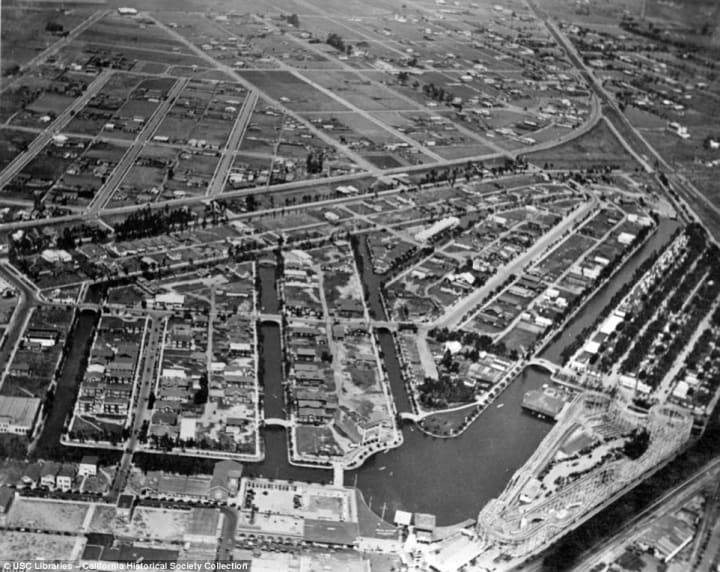
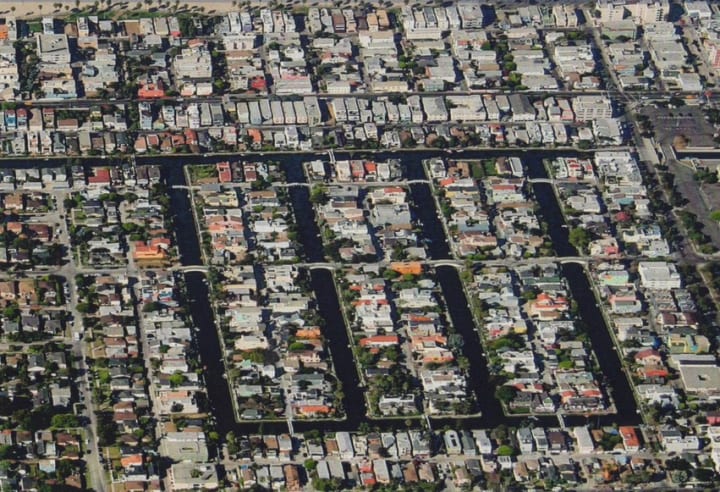
The canals that remain today are known as the Short Line canals, a second set of canals built in 1905 to the south of Kinney’s project in order to capitalize on their success. They, and much of the Venice area, were subject to neglect throughout most of the 20th century. The footpaths were deteriorating rapidly, houses were unkempt, the water was quickly polluted, and gondolas were replaced by poorly constructed wooden rafts. The site was in such disarray it had been nicknamed “Slum by the Sea”. Los Angeles razed hundreds of Venetian buildings in the 1950s, the final nail in the coffin for the remnants of Kinney’s project.
It was not until 1992 that a plan to rehabilitate the existing waterways was approved. In 1993 the restoration was complete and the finished product is what remains today. Kinney’s original waterways were paved over and their individual names were changed when becoming a traffic circle. Only the Grand Canal, the largest of the canals, retained its original name and became the Grand Avenue. The true history of Kinney’s Venice of America is buried and forgotten like a lost civilization.
Though it may be advertised to tourists across the world as Los Angeles’ “Venice Canals”, the canal system alive today was in fact built as a replica of developer Abbot Kinney’s “Venice of America” which, in itself, was a recreation of the original Italian waterways. Kinney leaves behind a legacy of thievery and appropriation. This surely had a great influence on projects such as problematic city planner Christine Sterling’s China City, a project that focused more on creating a theme park out of a culture than an honest and respectful cultural experience. Sterling, also known under the moniker of the “Mother of Olvera Street”, is likewise notorious for fabricating Mexican heritage in order to form a new tourist spot.
Kinney failed to recognize his opportunity to embrace the cultural background of Southern California and build a richly unique experience from that. Instead, he chose to steal a cultural landmark that had developed in and with its country of origin over hundreds of years. Upon noting the irony of Kinney’s “Venice Canals” being forgotten and its name usurped by their own copycat, one thing becomes increasingly clear: Kinney’s story reflects upon the themes of revisionist and plagiarized history most often associated with Los Angeles.
About the Creator
Worth the Wait: Puerto Viejo, Costa Rica
Beach bumming in a small Caribbean beach town sounded like a perfect way to end our 6-month trip through Mexico and Central America. Or so we thought. The foul, fishy stench of rotten seaweed hit our nostrils as we stepped from the cramped bus and looked out at a rather depressing, empty, and underwhelming black sand beach. It was pouring with rain, and we had to quickly fish out our ponchos. We thought, this couldn’t be it, could it?
By Sh*t Happens - Lost Girl Travel10 days ago in Wander
Why Ella Promises a Truly Memorable Holiday
Sri Lanka is a gorgeous island paradise with a lot to offer in terms of amazing landscapes, fun activities, as well as a variety of flavours. A place you can enjoy all of these is Ella, one of Sri Lanka’s most loved hill country destinations, known for fresh air, scenic views, and a wide range of activities. This article explains how choosing Ella for your next trip promises a fun experience filled with nature, culture, and great memories.
By Daphne Olga5 days ago in Wander



Comments
There are no comments for this story
Be the first to respond and start the conversation.