
The Black Journal of Luang Prabang
Chance Encounters and Lost History

The ferry began its familiar docking ritual into Tha Chang, the historic “Elephant Terminal” that sits adjacent to Bangkok’s Grand Palace. The smell of exhaust fumes from the rickety vessel’s gas engine mixed with the waft of street food stalls emerging from the nearby alleyway. My morning boat ride down the Chao Praya River, the River of Kings, was a veritable feast for the eyes. Wealthy condominiums of Thailand’s Nouveau Riche sat next to 100-year old wooden stilt homes that look ready to collapse into the water at any moment. Temples from various periods of Thailand’s history line the river, revealing its long and glorious history as the Kingdom of Siam. After a month of PhD field research in Thailand, I had yet to grow tired of these sights.
At the beckoning of the portman, the crowd hustled to alight from the ferry. Careful to time the oscillating gap between boat and pier, I propelled myself onto the wooden deck and made my way shoulder-to-shoulder amongst the other passengers, ascending to the exit. Immediately, the dizzying array of street food drowned out the ferry’s fumes. Deep-fried battered bananas—the primary culprit for my 5lb weight gain since coming to the Land of Smiles—gigantic woks frying all sorts of noodle dishes, fresh fruit stalls that make American fruit aisles bland abominations; the variety of colors and aromas was overwhelming to the senses.
Leaving the alleyway, I turned left onto Maharat Road, famous for the sale of amulets. Syncretized into Thai Buddhism is a very strong belief in folk magic. Amulets are purported to contain relics of various famous monks and bring fortune or protection to the holder. I planned to buy one before I left as a memento of my time in Thailand and casually perused the amulets on offer as I walked by. The amulet stalls were nestled amongst a host of vendors selling various kinds of religious paraphernalia, from Buddha statues to candles and flower wreaths.
Today, however, I noticed a stall I had not seen before. It was a peculiar kind of stall selling dusty old notebooks of all shapes and sizes. In my broken Thai I asked what they were. The vendor replied that they had come from neighboring Laos, rescued from the country’s aristocracy before the communists took over. Each one would transfer the wealth of the individual onto me, he emphasized, sensing a gullible foreigner. But I was fascinated for quite a different reason than the one he was trying to sell me on. As a doctoral student in history, I couldn’t believe my ears. In fact, I didn’t believe them. I had been trained to be skeptical about all sources. This seemed too far-fetched. But I lingered because I wanted to believe him.
If they were real, did this man really not fathom the social value of his wares, let alone the possible monetary value that he could get from the Thai national museum not a half mile away? I began looking through the pages. It certainly was written in Lao, though the cursive handwriting made it difficult to read. I decided to buy one to investigate further. A black, hand-sewn leather-bound book of medium thickness that had some sort of fastener stood out to me. Who did this belong to? What secrets did it hold?
The notebook was definitely a journal, each entry being dated. I skipped to the last entry hoping it would reveal something about the fate of the owner. It was dated December 1, 1975. I had to check the small reference library I had bought with me to Thailand, but I quickly confirmed that this was the day before the communist victory. My heart raced. With a Lao dictionary in one hand, I began to translate the entry.
“My heart aches that I will no longer see baan saykham, the home of my family inheritance. I will miss the mango trees of my youth, but I miss Phon and the children more. I have done my duty to my country and I feel that I can do no more. The cause is lost and tomorrow I leave to join my family, if they too have been fortunate enough to escape.”
The palpitations were almost audible. Did he, whoever he was, make it out of the country in time? How about his family? Where was his home? What happened to it and all his possessions? None of those answers would come in this last entry, but the last sentence caught my attention:
“Bpa phai pratoo yai fang sai dtai kwai”
Translated literally it means: Bamboo forest, large door, left side, under the Buffalo. It made no sense in the context of the rest of the entry, and almost seemed like a secret message for some purpose. All my scholarly curiosities and research instincts kicked in. I was determined to find out who the owner of the journal was and what this mysterious sentence could mean.
I took to the Internet. I searched baan saykham, but the online content in Lao was too scarce to return much, just a couple of blog posts of people called Saykham. I searched in English instead. Baan saykham also didn’t return anything, nor did “house saykham”, which is the most direct translation. So I pulled up Google maps and searched for saykham and the names of cities in Laos. I started with the capital Vientiane, but there was nothing. The second city, Luang Prabang, provided a glimmer of hope: Villa Saykham, a hotel. The pictures looked like the kind of place the owner of my black, leather bound journal could live, somebody with wealth and influence. The Villa was a colonial style home tucked in a backstreet of the city. I made immediate plans to fly there.
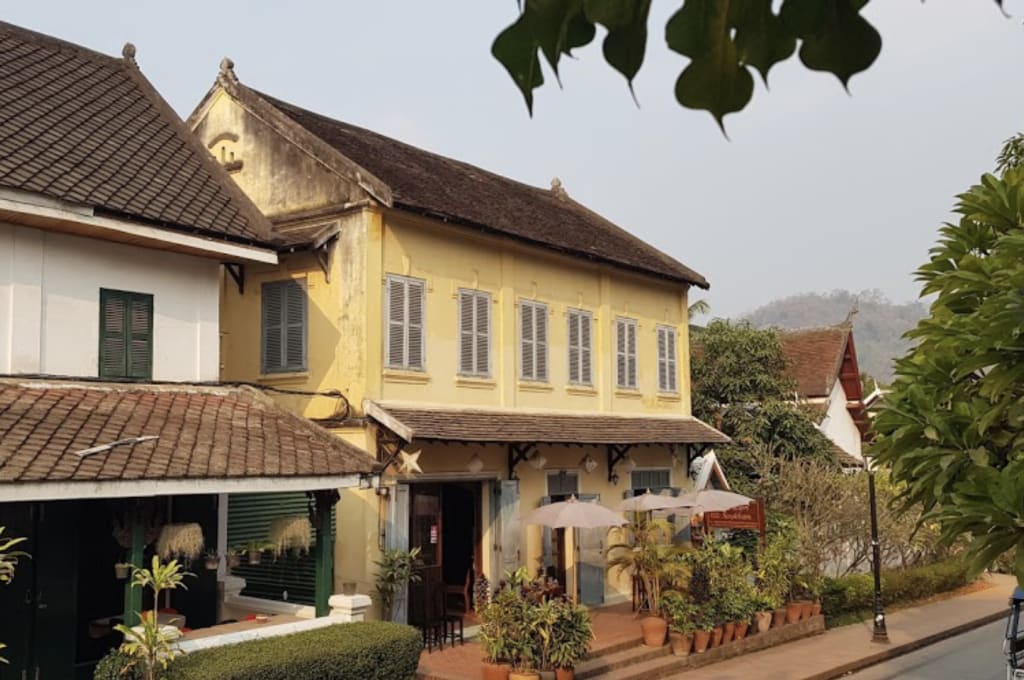
Three days later I was on a budget flight to Luang Prabang. Villa Saykham was full given the short notice, but I booked a place at a nearby guest house. Luang Prabang is a picturesque, little city. A UNESCO World Heritage site, much of its ancient and colonial architecture remains intact. Traffic is almost non-existent, a welcome respite from Bangkok. My history nerd brain immediately imagined how Europeans coming here in the 19th century would have felt—a small kingdom hidden away in the jungles of Mainland Southeast Asia. After checking in, I headed immediately over to Villa Saykham, ten minutes from my hotel. It was remarkably well-preserved, painted fresh in canary yellow. The lobby displayed a brief history of the building: it belonged to a minor Prince of Luang Prabang who had abandoned it when the communists took over the city. I snapped a photo of the history and wandered across the street to a Papaya salad restaurant, a top recommendation on TripAdvisor.
It was some of the best Lao food I have ever tasted, and as I sat there the sun began to set and I felt about as relaxed as I could remember. As I peered across the road, I noticed a small Buddhist temple, Wat Pa Phai, the Bamboo Forest Temple. Bamboo forest was the first word in that curious last sentence. Could this be what it was referring to? It was virtually next door to Villa Saykham. It had to be. My heart raced. I ventured inside the complex, looking for a large door. The temple was a very different style from Bangkok temples and the wooden structure’s paint had faded over time. The front of the temple had three doors, the middle of which was larger than the other two. It was red in color and adorned with patterns in gold relief. I searched carefully but found no Buffalo. Feeling tired and with light quickly disappearing I decided to leave, but before doing so I walked around the temple. Curiously, there was a single door on the back side too, larger than front door. Typical of Thai-Lao murals, it depicted locals in their everyday life interacting with Thai Buddhism in various ways. Animals, from elephants to chickens, adorned the door, and eventually I found the buffalos on the left side. Under one buffalo was a sala, a building found in nearly all temple complexes, mostly used for sitting and escaping the scorching sun. I wandered over to the sala, but it was already too dark to do any kind of searching. I decided to return as soon as the sun rose to continue my quest.
As I walked along the dim back streets of the city, the calm I had previously felt turned to discomfort. At first I couldn’t be sure, but after a couple of minutes I was certain: I was being followed. The winding streets allowed me to test my theory. I took random turns to try and lose my pursuer, but every time I turned around he was getting closer. I began jogging. The pursuer jogged. Now I was getting scared. I outright sprinted, seeing the well-lit main road a couple hundred feet ahead. But the uneven sidewalk had other ideas and I tumbled to the floor, badly scraping my face. Out of the corner of my eye I saw a hand coming toward me. I flinched and awaited the pain I thought was sure to come.
“Let me help you up”, came a voice.
“Don’t hurt me.” I exclaimed in panic. But no beating ensued. Instead, through my squinting eyes I saw the same hand, and this time the kind face it was connected to.
“You’re much younger than me. I’m sure it is you who would do the beating!” laughed the stranger. “I had a hard enough time keeping up with you. Who jogs in hot season in tropical Southeast Asia?”
“What do you want from me?” I asked.
“Just a coffee. There’s a great place just around the corner.” Too afraid to say no, I followed him to the coffee shop. We sat and ordered.
“I grew up in that neighborhood,” he began.
“Villa Saykham?” I replied.
“So you must know about my buried treasure,” the old man smiled. “I knew it. Every day for the last decade I have waited at the restaurant across the road, waiting for somebody that knew to come. When you spent so much time examining the doors I grew suspicious. So I walked over and saw you looking at the mural on the back door. When you went to the sala immediately after I knew you were the one.”
“I don’t have your treasure.” I protested, still afraid. What was this treasure? How much was it worth? Would he be willing to kill me over it?
He looked at me in disbelief, waiting for some kind of explanation for my behavior.
“I have your journal.” I explained.
With a look of ecstasy in his face, he jumped forward in excitement. “And the others? Do you have them all?”
“The others?”
“The other journals?”
Two days later we were sitting at a coffee shop near the Elephant Terminal in Bangkok. My new friend had purchased the remainder of journals from the street vendor.
“About 80% of them are here,” the old man smiled with a tear in his eye.
He handed me a gift.
“Some things are beyond value. Memories. Honesty. But I never believed value had no meaning. The communists forced me to stay, but they couldn’t force my beliefs.”
Inside the package was a substantial amount of money, $20,000, a king's ransom for a poor PhD student.
“I couldn’t,” I began, but he was already walking away, eventually fading into the crowd.
I got up from the table and walked toward the Elephant Terminal. I stopped at an amulet stall.
“I’ll have that one.”
As I boarded the ferry, the food-stall aromas gave way to boat engine fumes. But I hardly noticed. Nor did I pay much attention to the river scenes that had so captivated me the past month. All I could think about was Luang Prabang and a dissertation on the fate of Laos’ political elites.
About the Creator
Joel Selway
Historical fiction set in Asia.
Keep reading
More stories from writers in Wander and other communities.
Seattle Nightlife Report: Pony
Mid-winter Friday night. Early but already so dark. The days are getting longer but 6 PM is still pitch black. “Firepit!” You declare things after just a few seconds of solemn thought – not a request or suggestion, not a demand. Last week you walked around saying, “Hot tub?” to anyone who would listen. Or one afternoon you pointed at two men holding hands as they crossed 12th Avenue, looked me in the eyes and said, “Boyfriends.”
By Joe Nasta | Seattle foodie poet19 days ago in Wander
Stories Before a Wedding, or The Happily Ever After of Cinderella
Cinderella had always dreamt of marrying a prince. She had dreamt of nothing else since she was a small girl. Now, however, as the Prince’s wife of three days, she had to admit that the reality was not as she had dreamt it to be.
By Dionearia Red6 days ago in Fiction
Public Announcement Challenge Winners
For the Public Announcement Challenge, writers were asked to work inside voices built for control. These were notices, warnings, and updates meant to inform rather than confess. The strongest entries committed to that form and didn't break from it. Corporate memos, formal government alerts, and internal policy language were held consistently, allowing emotion, fear, grief, or humor to surface indirectly through pressure rather than declaration. The following poems recognize the voice of authority, and let human feeling slip through despite all its rules and restraint.
By Vocal Curation Team4 days ago in Resources

Comments
There are no comments for this story
Be the first to respond and start the conversation.