
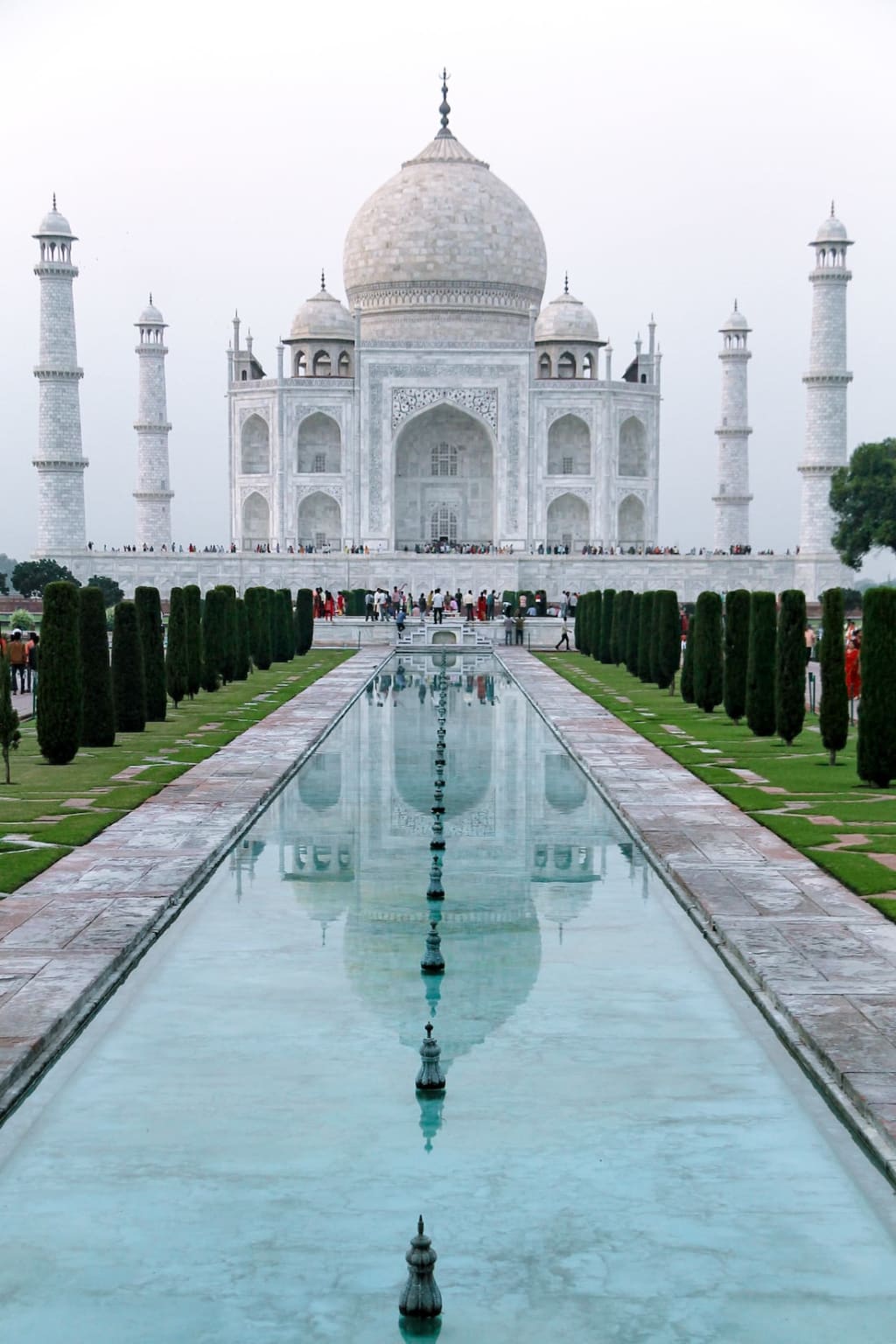
The Taj Mahal is a white marble mausoleum located in Agra, India. It was built by the Mughal emperor Shah Jahan in memory of his third wife, Mumtaz Mahal, who died during the birth of their 14th child in 1631. The Taj Mahal is widely considered to be one of the most beautiful buildings in the world and is a UNESCO World Heritage Site.
The construction of the Taj Mahal began in 1632 and was completed in 1653. The mausoleum is located on the southern bank of the Yamuna River in Agra and is set amidst formal gardens. The Taj Mahal is a symmetrical building with an arch-shaped doorway topped by a large dome and finial. Four smaller domes surround the main dome, and slender minarets at the corners of the base enhance the illusion of height.
The interior of the Taj Mahal is as elaborate as the exterior, with a large central chamber that houses the cenotaphs (empty tombs) of Shah Jahan and Mumtaz Mahal. The cenotaphs are decorated with intricate inlay work in precious stones. The walls of the chamber are adorned with inlaid decorations of flowers and calligraphy. The atmosphere inside the mausoleum is dimly lit, enhancing the inlaid decorations.
The Taj Mahal is a major tourist destination and attracts millions of visitors each year. It is open to visitors every day except Friday. it is also considered as one of the Seven Wonders of the World.
It's widely famous for it's intricate marble carvings and impressive architecture, considered as a symbol of love and devotion, the monument has become synonymous with Agra, the city where it is located.
In addition to its architectural and aesthetic appeal, the Taj Mahal also holds significant historical and cultural value. The mausoleum represents the pinnacle of Mughal architecture, which developed during the reign of the Mughal emperors in India between the 16th and 19th centuries. The Mughals were of Mongol origin and they brought with them a unique architectural style that blended elements of Islamic, Persian, and Indian architecture.
The construction of the Taj Mahal is estimated to have cost the equivalent of around $827 million in today's currency, and employed thousands of artisans and craftsmen, including skilled calligraphers, stonecutters, and embroidery workers.
The Taj Mahal complex also includes several other buildings such as the mosque and the guest house, which are situated to the left and right of the mausoleum. These buildings were constructed to reflect the symmetry of the main structure, and their designs also incorporate elements of Mughal architecture.
In recent years, the Indian government has taken steps to preserve the Taj Mahal and the surrounding environment. Measures have been taken to reduce pollution levels, and restrictions have been placed on the number of daily visitors to the site. Despite these efforts, the Taj Mahal continues to face threats from pollution and overcrowding, and it's important to maintain the preservation and conservation effort in order to keep the monument intact for future generations to admire and appreciate.
Also, it is the most visited tourist attraction in India, and many people come to Agra specifically to see the Taj Mahal. In addition to the mausoleum itself, visitors can also explore the surrounding gardens, shop for souvenirs at the local bazaars, and learn more about the history and culture of the Mughal Empire.
In addition to its architectural and historical significance, the Taj Mahal also holds significant cultural and symbolic meaning. It is widely considered to be a symbol of love and devotion, as it was built by an emperor as a tribute to his late wife. The love story of Shah Jahan and Mumtaz Mahal is well-known, and it is said that Shah Jahan was so heartbroken at her death that he decided to build the most beautiful monument in the world in her memory.
The Taj Mahal is also an important symbol of the Mughal Empire and its art, culture, and architecture. It is considered to be the best example of Mughal architecture and has served as an inspiration for many subsequent buildings in India and around the world. The use of white marble and intricate inlay work with precious stones, the geometric and symmetric design, the usage of Islamic calligraphy all showcase the Mughal's style.
The Taj Mahal is also an important religious site for both Muslims and Hindus, and it is believed to possess spiritual and healing powers. Many people come to the Taj Mahal to pray and offer their wishes and the dome of the mausoleum is often seen as symbolizing the vault of heaven.
The Taj Mahal is not just a monument, but it is a symbol of love, loss, grief, devotion, beauty, cultural and architectural achievement, art, and spirituality, all embodied in one place. This is the reason why it is so universally admired and continues to be a source of inspiration and wonder for people from all over the world.
About the Creator
Keep reading
More stories from writers in Wander and other communities.
The Feel of Nagasaki
My sleep schedule is fixed! I went to bed at 23:00 on Sunday and woke up at 7:00 rested and energised. Unfortunately, I had a little cat sleeping on me who refused to be moved meaning I still had to lie in bed for half an hour until she allowed me to get up to shower.
By Max Brooksabout 14 hours ago in Wander
Moonlight and Marble: My Unforgettable Journey to the Taj Mahal
How Visiting the Taj Mahal Turned My Trip Into a Romantic Adventure Through India’s Most Iconic Monument --- There are places in the world that don’t just look beautiful—they feel like a dream. The Taj Mahal is one of those places.
By Ahmed aldeabella5 days ago in Wander
The Path to Salvation
The late autumn evening air filled the monk's lungs, but it wasn't the season that chilled his bones. The heavy-handed presence of evil he had sensed upon entering the woods surrounding this mountain village had not bothered to conceal itself from him.
By Made in DNA4 days ago in Fiction



Comments
There are no comments for this story
Be the first to respond and start the conversation.