
Stepping Back In Time - 17th Century Vibes
Elder Street
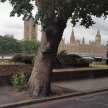

London might be a fast changing City, but there are streets in Spitalfields that transport you back into time, back to the Huguenot’s time. I always feel a different vibe as a I walk along these streets.
Let me tell you about Elder Street

Elder Street was laid out in the early 18th century to accommodate the fast expansion of Spitalfields. What caused this rapid pace of development? The the arrival of Huguenot refugees who were fleeing religious persecution in France after the Revocation of the Edict of Nantes in 1685.

They transformed the area into a thriving silk trade because these Protestant silk weavers brought their expertise to London. The street itself began to take shape around 1720, with many of its houses built under 61-year leases granted by Sir Isaac Tillard, a key landowner in the area.
The Georgian Houses have a very distinct design. They are usually three stories plus a basement and mansard garret. They feature large windows on upper floors to maximize light for silk weaving. Today the street might be a prosperous one, but back them in the 1740s and 1750s, it was a working-class community.
19th Century Decline and Diversity
As the silk industry declined in the 19th century, hit by competition from abroad and changing trade policies, Spitalfields—and Elder Street—fell into poverty. The Huguenot prosperity faded, and the area became a slum.
By the Victorian era, Elder Street’s grand houses were subdivided, often housing multiple families in cramped conditions. There was extreme deprivation, with families so poor they couldn’t afford to bury their dead, leaving bodies to decay in corners—a stark contrast to the street’s earlier elegance.
This period also saw new waves of immigrants, including Irish fleeing the potato famine and Jewish refugees escaping Eastern European pogroms. Elder Street’s demographic shifted, mirroring Spitalfields’ growing diversity.
The once-specialised weavers’ homes became overcrowded tenements, and the area gained a reputation for hardship, further darkened by its proximity to the Jack the Ripper murders in nearby Whitechapel.
20th Century - Dereliction and Revival
By the early 20th century, Elder Street was largely derelict. The silk trade was a distant memory, and the houses fell into disrepair. In the 1970s, the street was nearly empty, a quiet backwater amid the bustle of nearby markets like Petticoat Lane.
There were Campaigns to save Spitalfields’ Georgian heritage and their efforts paid off. A couple of houses on street was granted Grade II listed status.
Gentrification
Like many Londoners, we’ve seen much of London transform before our eyes. The same happened in Spitalfields.
Elder Street’s houses were restored, their Georgian features—cobblestone surfaces, iron railings, and fine doorways—revived by groups like the Spitalfields Trust.
The area is so close to the City of London and it’s gleeming towers, plus it’s attracted a new wave of people have been coming such as artists, professionals, and later tech workers, especially as Shoreditch’s “Silicon Roundabout” emerged nearby.

Parting Comments
If you find yourself in this neighbourhood, take the side streets from Commercial Road. Why? You’ll step back in time very quickly. You’ll notice how different the architecture is and the beautiful brick work. I like looking at the different coloured doors and imagining the history behind them.
4 Princelet Street. I’ve visited the inside of 4 Princelet Street and it’s a very well preserved Huguenot House.
Visiting 4 Princelet Street was a taster, and I’m hoping to book my ticket to see the inside of another Huguenot House in Folgate Street. I’ll let you know when I get around to this little gem of a place.
If you want to read more, click on the following link
https://tabbylondon.com/blog/f/4-princelet-street---spitalfields
Thank you for your attention as always.
Best wishes
Tabby

About the Creator
Tabby London
The London I've been discovering is usually off the well-beaten track.I love the nooks and crannies and walking along the streets steeped in centuries worth of history. I'm fond of Zone 1 because that's where it all began centuries ago.
Keep reading
More stories from Tabby London and writers in Wander and other communities.
The Latino Vibe At Kew
I popped down to Kew Gardens to see the much hyped ‘Orchid Festival’ which ran from February to 2nd of March. As a member, we had preferred morning slots. I wasn’t expecting to see a queue when I did turn up at the allotted time. We waited patiently for fifteen minutes before we were allowed in after security bag checks.
By Tabby London12 months ago in Wander
How To Choose The Best Ramadan Umrah Package
Ramadan is almost here, and many Muslims wish to perform Umrah in this sacred month. Why? Because of the immense rewards, Umrah in Ramadan is equal to performing Hajj. During the holy month, the rewards of good deeds and acts multiply, and what better than performing Umrah, one of the greatest acts of worship.
By Abdul Rahim Khan5 days ago in Wander
The Kelpies and The Falkirk Wheel
The Kelpies The Kelpies A few years ago I was driving up the M9 towards Dollar in Scotland, it was dark and raining and suddenly I nearly crashed the car when I saw two huge hundred-foot-high horses' heads to my left-hand side. I had to pull over. I am not sure if I tried to take a photograph but I was dumbfounded.
By Mike Singleton 💜 Mikeydred 4 days ago in Wander




Comments
There are no comments for this story
Be the first to respond and start the conversation.