
Spiritual and Healing Uses of Mala Beads
How their energy affects us

My Fascination With Malas
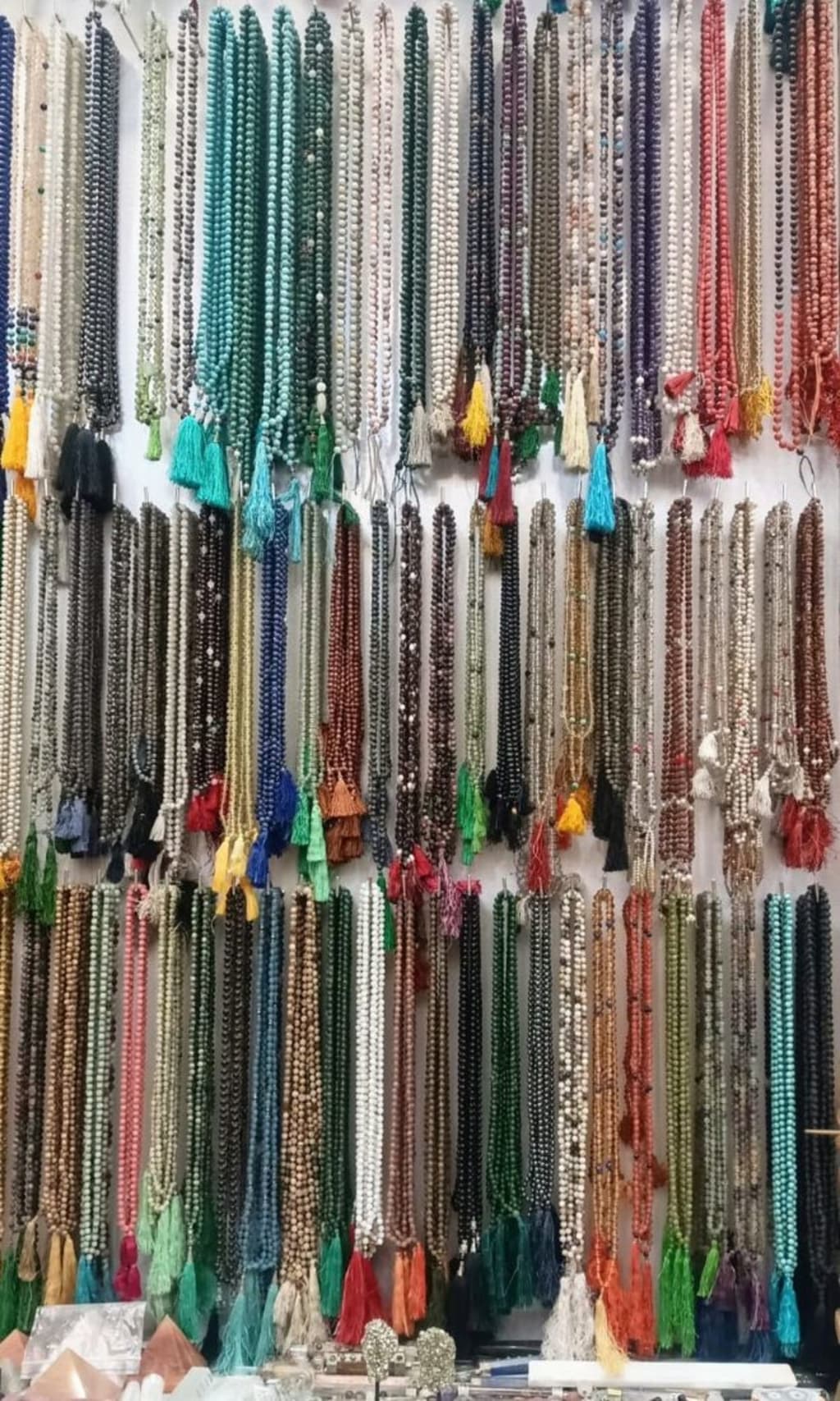
Everything I learned and came to cherish about malas was from the owner of the above shop, Neelkanth¹ Gems.
Any lover of stones or jewelry can't escape being mesmerized upon a first glimpse through the door. Thousands of colored strands of every conceivable stone, seed, and metal drip enticingly in magnificent array.
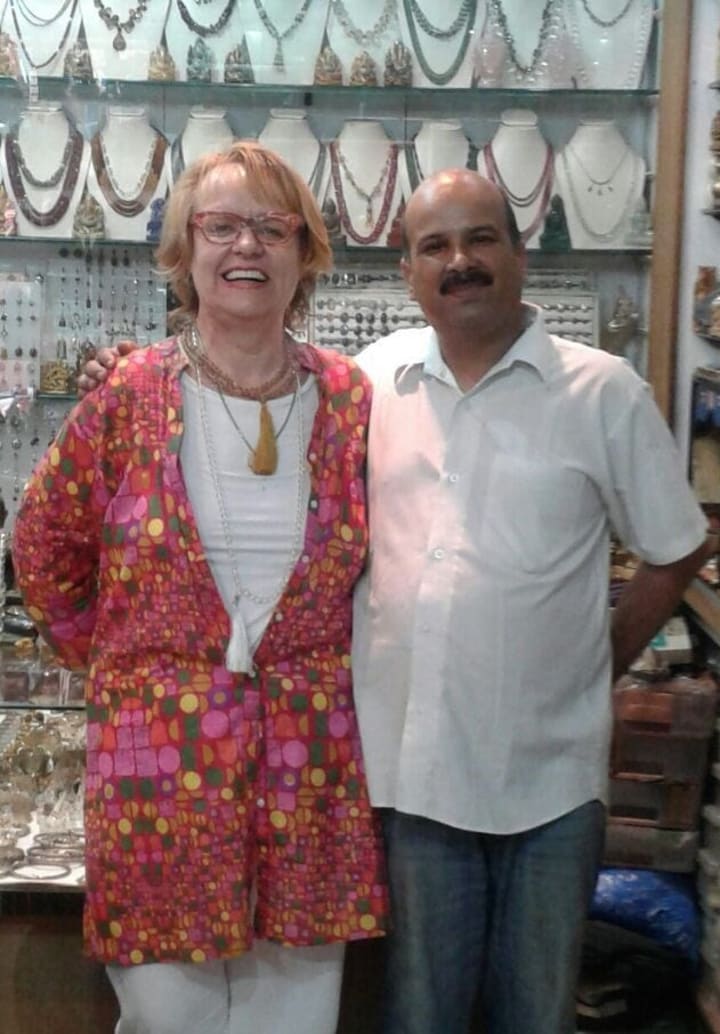
The establishment is owned by Sanjeev, who became my dear Indian "brother" after innumerable visits over several years. Both a certified gemologist and admitted decades-long rock hound, he's forgotten more about stones than the other local shopkeeps and vendors ever knew.
History
Mala beads are believed to have originated in India more than 3,000 years ago. Their use is rooted in both Hinduism and Buddhism.
A mala string has 108 beads. The largest bead in the center is called a guru. When wearing a mala, the guru with an attached tassel typically hangs on the chest. In India, however, occasionally, people wore them reversed with the tassel dropped down their backs.

Frequently used in spiritual or religious practices, a customary practice is to twirl the beads or chant mantras while fingering them during meditation. A mala used thusly should not be worn but maintained exclusively for one's sacred practice.
Tibetan street vendors in McCleod Ganj, India --the residence of His Holiness the Dalai Lama of the Gelug Tibetan Buddhist lineage--rotate the beads through their fingers all day long as an aspect of their deep devotional practice.²
Monks, sadhus, and devotees of certain traditions or religions, including Buddhism, Hinduism, Jainism, and Sikhism use or wear them.³ Traditional Roman Catholic rosary beads, also comprised of 108 beads, are used to keep track of their prayers. Prayer beads, called misbaha or subha, of 100 beads are used in Islam.⁴
Off to India
The siren's lure that enticed me for years had intensified. Though weary of the consumptive, self-absorbed United States culture, it took me a few years to heed the tug, rearrange life, and prepare for departure.
My comfortable, middle-class Western lifestyle had permitted ample societal milestones and perceived successes. I'd accumulated numerous resume-enhancing accomplishments-- advanced degrees, managerial and partnership positions, challenging careers, published peer-reviewed articles, and fascinating experiences.
I'd benefitted from extraordinary mentors, brilliant colleagues, precious friends, and a supportive family. I was inordinately grateful for and loved it all.
Nevertheless, something - an indescribable something - was lacking. An unsettled longing. A nudging discontent. An undefined ennui. It surfaced prominently in my forties.
Having taught yoga for nearly three decades by that juncture, the allure of India, the birthplace of the sacred 5,000-year-old practice, had beckoned for years. Heading there to find that elusive "something" seemed the perfect antidote for my malaise.
The sage Indian philosopher Jiddu Krishnamurti, who spent the majority of his final years in California, advised seekers, "Go if you choose, but you won't find God in India."
I was unaware of that counsel before embarking on my first journey. But it wouldn't have mattered. A monumental decision had been reached. After years of introspection, study, and contemplation, I was off to India, like millions before me and since.
My quest
For how long, I had no idea. Where I might travel or land, I had not a clue. What I might discover, I had no inkling. With whom I might study, I knew not. I was off if for no sounder explanation than to "get India out of my system," as Manoj, my well-educated, San Diego resident but Mumbai-born friend, advised after listening to my yammering fantasies for two years.
I downsized. My house and car were sold. Brimming closets and stuffed cabinets of the typical decades-worth of underused, over-collected, and unneeded detritus were unloaded.
My safety net -- if and when I returned -- was thirteen boxes (the number was insignificant; it was what remained) of meaningful belongings, a smattering of household items, family mementos, favorite books, and special artwork.
There was no planned itinerary. I would follow my heart. Listen to my inner counsel. Follow wherever the Universe and Mother India directed.
I began in the South, meandered through the central part of the county, and finished in the North. Five months through eleven states.
Rishikesh
My final landing place was the magical city of Rishikesh on the banks of the Ganges River, which is sacred to Hindus.
Perhaps the significance of my last stop was predestined for a reason. Although I adored all of India, it was this locale that captured my soul and forever snagged a piece of my heart. Subsequent trips would take me back thrice more for extended stays. Rishikesh became my home away from home for more than a decade.
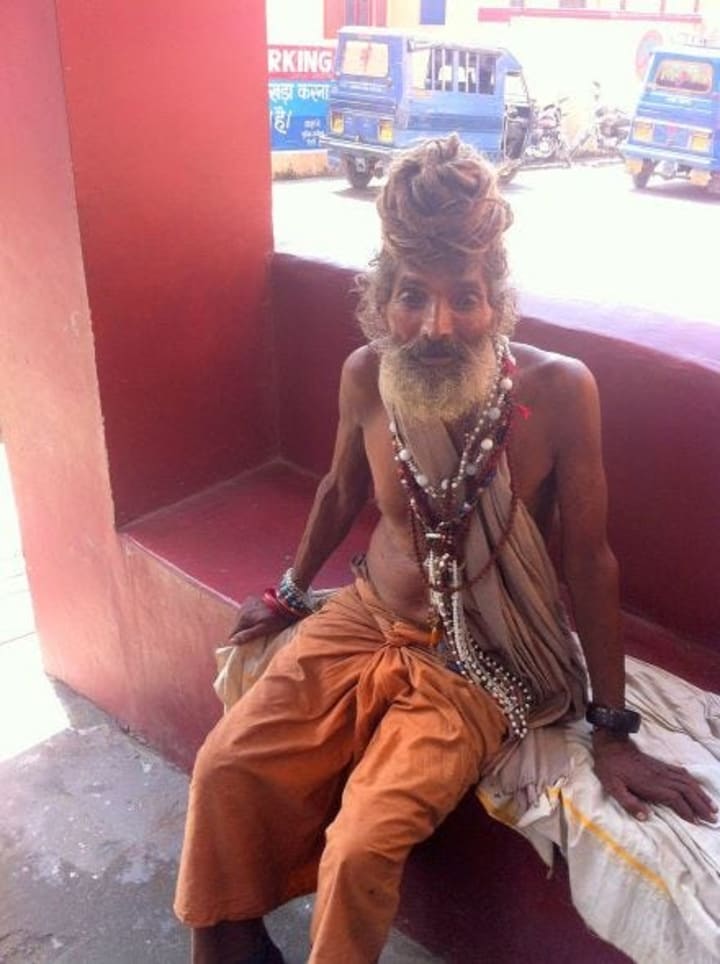
A pilgrimage city swaddled by the Himalayan foothills on the banks of the Ganga, Rishikesh was populated by sadhus, saints, and rishis for eons, long before The Beatles and other 1960s rockers made it a famous tourist destination by their visits to the Maharishi of Transcendental Meditation ("TM") renown.
Unlike today's popular "gurus" and successful media mavens, the real deals were, and remain, tucked away in the caves or forests of the Himalayas. The last thing the authentic ones seek are followers, devotees, or funds.
Swami Sivananda
The town's majordomo is Swami Sivananda, a realized saint who left his body decades ago. A former medical doctor of the highest Hindu Brahmin caste, he walked away from his duties as a physician, ended up in Rishikesh, attained enlightenment, and remained there for the rest of his life.
Over time, his original humble cowshed ashram along the river bank expanded and evolved into today's functioning monastery, boys' school, and refuge for devotees and seekers.
Sivananda's beatific countenance graces not only the ashram and bookstores but also shop doors, locals' altars, and stands throughout the city. He is revered by locals and devotees from across the globe.
I devoured books, tracts, and oral stories about as many of India's holy men and women as I could, whether or not previously known to me. I was familiar with Swami Sivananda because one of the instructors in my yoga teachers' training course had been a monk of the Sivananda lineage. (Both genders of mendicants are called monks, unlike the designations of nuns and monks in most others).
Spiritual Connection to Malas
Through my study about Sivananda, I learned he always either wore or carried a mala in his pocket to keep him connected to the Divine. As I contemplated the idea, the more it resonated with me, and I began wearing a mala regularly.
In my meanderings, I discovered Neelkanth Gems, located on Ram Jula Road a few minutes from my abode, and became friendly with the always cheerful, smiling owner. Never once during seven years was Sanjeev not smiling widely.
Healing Properties
Healing and energy enhancement from crystals, minerals, and stones from Mother Earth have been an aspect of indigenous peoples around the world for millennia. Those attuned to the energy of rocks and minerals maintain that specific healing properties relate to certain stones.
In Traditional Chinese Medicine ("TCM"), healing stones are used to promote the movement of qi (chi), the positive life force or energy of our bodies. My Qigong Grandmaster, with whom I studied, trained, and consulted as a patient, has massive healing quartz crystals in his Los Angeles office where he treats patients.
In my investigation,⁵ I gleaned that often there were several similar claimed healing benefits of specific stones, such as clarity, calmness, awareness, and spiritual enhancement.
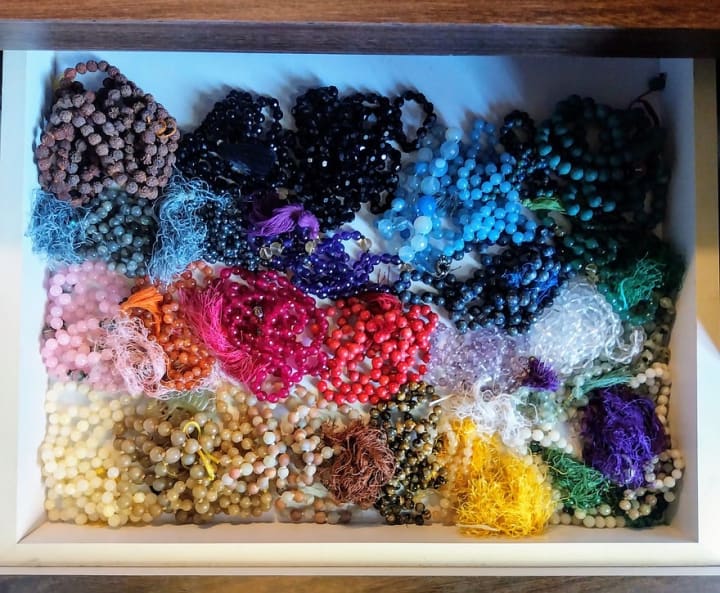
Happy to be the recipient of all purported benefits, and wired with an adequate quota of shopping DNA, I decided to use the same approach I had for decades when buying art - purchase what appealed to me. I ended up with a collection of a couple dozen stones, accumulating malas to match anything in my wardrobe.
Proponents who subscribe to the healing properties of rocks maintain that they bring harmony to the energy field of the body.⁵ I realized from my study about the healing aspects that the purported benefits are often similar for various stones.
Hence, I decided to use the same approach used for decades when buying art - purchase what appealed to me. And, in female mode, I ended up with more than a dozen gemstones that matched all of my wardrobe.
Rudraksha beads
From time immemorial, the brown rudrakshas have been believed to hold healing and protective powers. It was claimed those with a blessing from Lord Shiva had the opportunity to wear them.

As in all Hindu mythology, there is a complicated story about the genesis of the rudraksha tree and its fruit, the dry seed used in malas. The meaning of rudraksha is the eyes of Rudra (Shiva) and his tears (aksha).⁶
Because of his vast supply, Sanjeev sold them to many sadhus and swamis. I observed numerous transactions as they carefully examined his inventory and chose a specific bead, which wasn't inexpensive. The seeds have different 'faces' or numbers of facets and are sought for specific purposes.⁷
Malas in My Daily Life
For thirteen years, I've been wearing at least one mala every day. Both the reminder of a connection to the Divine and potential healing and protective properties comfort my soul.
Footnotes:
1. Neelkanth is one of at least 1,000 (probably more) names for Lord Shiva. It is an important one. Why?
According to Hindu mythology, the gods and the demons were fighting for supremacy, and they decided to churn the ocean of milk to obtain the nectar of immortality. During the churning process, several things emerged from the ocean, including poison or "halahala."
The poison was so potent that it could destroy the entire world, and both the gods and the demons were terrified. They immediately sought the help of Lord Shiva, who agreed to swallow the poison to save the world. Lord Shiva drank the poison and held it in his throat, which turned blue due to its poisonous nature. Thus, Lord Shiva came to be known as "Neelkanth," which means "blue throat" in Sanskrit.
https://www.templeduniya.com/why-shiva-is-called-neelkanth
2. The Tibetans I was fortunate to meet in India "walked their walk" more than any other group I have experienced. Their lives, in all respects, revolved around their Buddhist traditions and beliefs.
3. Many sadhus, India's roaming holy men and women, priests, and monks wore the traditional rudrasksha malas.
4. https://www.britannica.com/topic/subhah.
5. Resources to identify gemstones and explore their healing powers:
✔ The Crystal Bible (The Crystal Bible Series), https://a.co/d/fpOHbLn. An excellent primer for identifying stones and their healing properties.
✔ https://www.webmd.com › balance Mala Beads: Benefits and More - WebMD. Use of mala beads for stress reduction and relaxation.
✔ Gemstones of the World: Newly Revised Fifth Edition, https://a.co/d/d3wKxRL. Good for identifying gems and minerals. No discussion regarding healing properties.
6. https://timesofindia.indiatimes.com/life-style/relationships/love-sex/significance-of-rudraksh-how-to-use-their-power-as-per-numerology/photostory/89624741.cms
7. https://en.wikipedia.org/wiki/Rudraksha#cite_note-:1-4
Your time is valuable! I'm honored that you've chosen to spend it here. Victoria 🙏😎
© Victoria Kjos. All Rights Reserved. 2024.
About the Creator
Victoria Kjos
I love thinking. I respect thinking. I respect thinkers. Writing, for me, is thinking on paper. I shall think here. My meanderings as a vagabond, seeker, and lifelong student. I'm deeply honored if you choose to read any of those thoughts.
Keep reading
More stories from Victoria Kjos and writers in Wander and other communities.
The Very Best Travel Bag…Ever
Mea Culpa I eschew what's claimed in the title - the "best" or advice that people "should do or adopt this." To violate such self-imposed rules indicates how much I really, really, really love this bag. (With apologies to the writing pros for the "really" abuse, but it's really a terrific bag!)
By Victoria Kjos 2 years ago in Wander
Worth the Wait: Puerto Viejo, Costa Rica
Beach bumming in a small Caribbean beach town sounded like a perfect way to end our 6-month trip through Mexico and Central America. Or so we thought. The foul, fishy stench of rotten seaweed hit our nostrils as we stepped from the cramped bus and looked out at a rather depressing, empty, and underwhelming black sand beach. It was pouring with rain, and we had to quickly fish out our ponchos. We thought, this couldn’t be it, could it?
By Sh*t Happens - Lost Girl Travel10 days ago in Wander
Why Wadduwa Beach Is Sri Lanka’s Must-Visit Serene Escape in 2026
Wadduwa Beach is a hidden treasure on the southwest coast of Sri Lanka. While many travellers rush to the busy shores of Galle or Bentota, Wadduwa offers a rare sense of peace. In 2026, it has become the go-to spot for those wanting to escape the noise and find a quiet slice of paradise.
By Daphne Olga6 days ago in Wander




Comments
There are no comments for this story
Be the first to respond and start the conversation.