

It was at the back of her grandmother’s closet that she found the old cedar chest. The rusty, iron hinges looked Medieval though they were probably made in Pittsburgh in the 1800’s. She opened the heavy lid which made a terrible squeal. There were compartments inside, decorated with pretty, patterned paper, and in the top section was the usual accumulation of memories: handmade baby clothes with crocheted lace; a stuffed bear with one missing eye; a broken Hummel; black and white family pictures that never made it into the many albums she would find underneath; and a little, black book -- a Moleskine journal, its pages filled with her tiny, immaculate cursive.
She opened the weathered cover:
The giant centipedes dangle from the top of the cave like brightly colored baubles on a Christmas tree. They are longer than my forearm, about as thick, and they are carnivores with venom toxic enough to kill a small child, which our guide, a shirtless man in a beaded headband, tells us happened to one of the children from his tribe. “Mebêngôkre,” he says as he thumps his chest.
Everything here wants to kill you, from the centipedes to the phoneutria, which literally translates to murderess, the most venomous spider in the world, the Amazon is no place for the tenderhearted. I fear here is where I belong.
Like Audubon, there were detailed drawings of both arthropods, and tucked between the pages were watercolor paintings of them, their colors exploding in a way she’d never seen with watercolor, typically an ethereal medium.
The pages were a journey through time, a journey through a woman she thought she knew, but standing here in her closet with a chest full of Moleskine memories, she wasn’t so sure. She’d only ever known her grandmother to be a secretary, a mom, a wife, someone who cooked goulash on Sundays after church, which she never attended, and it was never asked why. She’d never heard of adventures in the Amazon, though she did recall a trip her grandparents took to Hawaii, the only vacation she could ever recall them taking.
She kept reading.
They live at the edge of the world, along the banks of the Amazon. Mebêngôkre, “those who live on the water.” The elder wears a brightly colored crown made from the feathers of a hyacinth macaw, the largest of all flying parrots on the planet, bigger than you’d imagine, and a blue more vivid than lapis or the sky at blue hour.
Tucked between the pages was another watercolor, the hyacinth macaw, so real she thought it might fly away.
The men wear a disc of sorts in their lips, and I must admit I find myself staring when they eat, wondering how on earth they manage, which they do, of course, and have for hundreds of years. I’m told by my guide that as babies, the lip is cut, and a ceramic plate inserted. As the baby grows, the plate is replaced by a bigger one. The larger the lip, the more beautiful. Who am I to say?
Behind the painting of the macaw was one of the tribe’s chief, his indigo crown a halo. The rendering was vivid, alive. His eyes glimmered with a joyous secret, one she wished she knew.
The women cover themselves with patterns of black ink, designs that celebrate insects and bring them closer to the universe’s center, where they believe God exists. Maybe they are right, not just about God, but everything. The simplicity of life. The un- complication of humanity. No phones. No roads. No schools or jobs or leering bosses who press against you in the elevator. This is living. Under the trees, under the clockwork of stars, with nothing but the present day before you.
“Mother,” a pre-teen called from the other room, which diverted her attention away from the page.
“I’m bored,” Penelope said as she came to the doorway and slumped against the frame.
I am, too, she wanted to say.
Bored of this life. Bored of being a mom. A wife. Bored of making dinner and doing the laundry and dishes and shopping and errands and carpool and scout leader and class cookie maker and vomit cleaner and shit doer and all the other dehumanizing things a mom does that’s basically servitude. Yeah, honey, I’m bored, too.
But she didn’t say it. She knew it was wrong to even think it.
What kind of person thinks it?
She turned her thoughts to something her grandfather told her long ago. She was nine years old and lived with him at the time. She wanted to go to the skating rink with her friends. The answer was no. She didn’t like it; was bratty about it. Didn’t drop it. Wouldn’t drop it.
Sass, sass, sass, I’m sure, she thought to herself.
Her grandfather did one of those villain slow-turns with a crooked finger outstretched. “You know what your problem is, missy?” He shook his arthritic pointer in the air, as if punctuating each word. “You. are. un. grate. ful.”
Her mind returned to the pages in her hands. Was she ungrateful? Was it ungrateful to want something other than servitude for your life? Was it ungrateful to dream about unexplored, faraway places or a life of equality or breaking glass ceilings? Why was it wrong that she wanted more? She loved her family, to be true, but she’d never been able to get rid of that little black hole that started in her belly the minute she said, “ I do.”
Over the years of folding laundry, ironing, mowing, parent/teacher conferences, sleepovers and business dinners with boring bosses, it grew. Like a tumor, it widened and deepened until every day felt like she was standing on the edge of it, looking down into the darkness, longing to jump into its cold embrace.
“I’ll be outside waiting,” Penelope chirped as she thundered down the hall.
“Well, I guess I better just hop to it then, huh, missy?” She yelled back.
Penelope froze. Turned around. For a moment, she was sure Penelope would erupt, as she oftentimes had, the fire of teenage rebellion beginning to catch flame, but she didn’t. Her face softened, melted even, into tears. “I’m sorry, Mom, I’m just getting all sad seeing pictures of Nana everywhere. I mean, what the fuck, why do we love people if they’re just gonna go and die anyway?”
She hadn’t thought about Penelope’s grief. She’d only been consumed with her own, but in that fragile moment, that rare millisecond of real honesty that ever passes between two people, she knew why she did everything, and she knew she could also ask for more. They didn’t work in opposition.
“Come here,” she said to Penelope, patting the carpet at her side. “I want to read you something.”
Penelope padded back down the hallway and sat next to her. She turned the page in the Moleskine journal and shared an adventure they would soon traverse themselves - a gift from Nana’s will, twenty thousand dollars in savings bonds. She would put most of it aside, college for Penelope, or at least a fraction of it, but she would splurge on a once in a lifetime mother/daughter adventure without any regret.
They spent the entire summer retracing Nana’s footsteps. Penelope had been on a plane numerous times, but this was her first international voyage, and it was the first time she thought her plane would crash.
Caracas, Venezuela, their starting point, sits in the valley of the Venezuelan Coastal Mountains, and when you fly into the city, it seems as though you are flying straight into the mountain. It’s only at the very last moment, when your stomach has flipped and you’re sure you will die, that the plane turns suddenly, going straight up. Your stomach flips again.
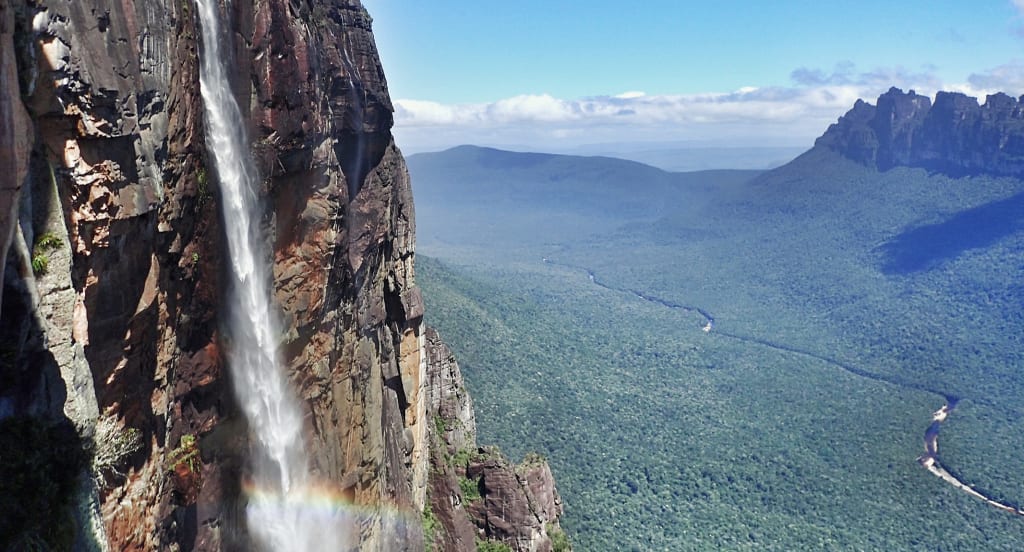
They left Caracas as quickly as they came, for it wasn’t the city that beckoned them across continents, it was the land, the oldest place on Earth, where Pangea first cracked open and spit out the world as we know it. They were en route to the most beautiful place either of them had ever seen, Angel Falls, the tallest waterfall in the world, 20 times taller than Niagara, that spilled from a tepui, an enormous tabletop mountain, a swirl of gold, copper and bronze Precambrian quartz arenite sandstone that erupts from the jungle like a glimmering god. In fact, tepui means “house of the gods,” and the tepui of Angel Falls, called Auyán, translates to “the Devil’s house” in Pemon, the indigenous people who live nearby. They won’t even look at it, for to view it, means certain death.
If only it meant death to the traffickers who pillage the area for gold and lumber.
They started out for Angel Falls from Canaima, the closest village, which is nothing more than a series of thatched huts. There, they were able to hire a guide to take them into the jungle and down the river.
The jungle was a dream world, a place where cooperation led to adaptation. The tarantula, usually a fierce predator, invites the spotted humming frog to cohabit her lair because the frog eats ants, a threat to the tarantula’s eggs. In turn, she offers the frog protection. The brazil nut tree grows because agoutis, snout-nosed rodents, plant seed pods for winter storage. Sometimes they get eaten, sometimes they grow into trees that feed the red and green macaws.
Every river, every village, every mile as laid forth in that little black book, they replicated with reverence. Much had changed; but something, most definitely, did not.
In the Amazon, everything still wants to kill you.
We were crossing the river in a hand-carved canoe, taking pictures of the birds in the overhanging canopy. Suddenly, our Mebêngôkre guide orders us to row.
“What?” I ask, confused by the urgency in his voice. “Jaguar,” he replies.
“Where?” I turn my head like the idiot tourist I am, instead of picking up the oars as ordered.
The jaguar slips into the water without the slightest splash, making a path straight towards us. The water moves out of his way, as if bending a knee to this great god. Adept swimmers, jaguars can swim up to 16 miles per hour. It feels like we are going nowhere. Time suspends. Colors converge and warp. I can no longer see anything but my own desperation and debilitating fear.
“Row,” the guide repeats with a growled whisper.
I pick up the oars, plunge them into the black water and row for my life.
Back at the village that evening, our guide recounts the tale to the others. They all grumble with acknowledgment. The jaguar has already taken a few from their tribe.
“Why don’t you kill that beast?” I ask. Penelope agrees.
The guide scowls, translates to the others. They moan with opposition. “This is his home. He has the right to live in it, too.”
The rest of the Mebêngôkre nod.
I go to bed that night wondering what else I’ve gotten wrong in life, what other dogmas I hold that cloud my judgement, justify my ignorances and biases, hold hostage my intellect and compassion. There is a simplicity to this way of life that seems sacred, something the rest of us miss by being tethered to technology and progress and the sting of indifference.
Cooperation leads to adaptation, I turn that thought over in my mind. Why were we incapable of that?
I pull my sleeping bag up and roll onto my side, right into the face of a giant centipede. Why is our natural instinct to kill? Before, I would have already had my hand retracted, but now, I just watch as it inches past me. It has no beef with me. No ill intent. No murder on its mind.
Just passing through.
It slips into the darkness just as I close my eyes.
About the Creator
Dex Decker
writer, filmmaker, naturalist, humanist
Keep reading
More stories from Dex Decker and writers in Wander and other communities.
Worth the Wait: Puerto Viejo, Costa Rica
Beach bumming in a small Caribbean beach town sounded like a perfect way to end our 6-month trip through Mexico and Central America. Or so we thought. The foul, fishy stench of rotten seaweed hit our nostrils as we stepped from the cramped bus and looked out at a rather depressing, empty, and underwhelming black sand beach. It was pouring with rain, and we had to quickly fish out our ponchos. We thought, this couldn’t be it, could it?
By Sh*t Happens - Lost Girl Travel7 days ago in Wander
What Hidden Costs Should You Know in Armenia Tour Packages?
Booking Armenia Tour Packages is one of the easiest ways to explore this beautiful Caucasus destination. Many travel packages include hotels, transfers, and sightseeing tours, making travel convenient and organized. However, travelers should also be aware that some hidden costs may not always be included in the initial price.
By Viacation Tourism3 days ago in Wander



Comments
There are no comments for this story
Be the first to respond and start the conversation.