
Medieval Town Hall in Wroclaw
The Largest and Most Beautiful in Europe
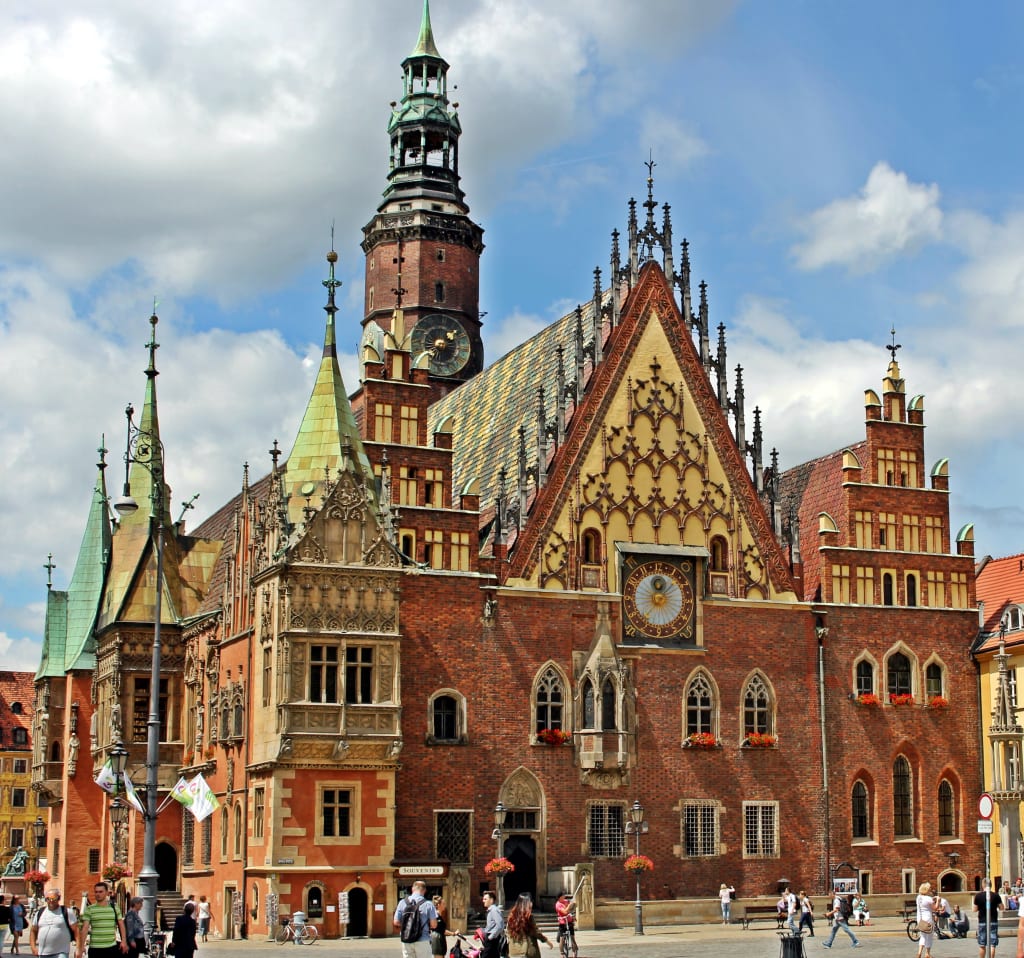
From the beginning of its existence, the town hall has witnessed many important historical events and is a representative place, where the authorities of Wroclaw took dignified guests. This tradition has survived to this day.
The walls of the town hall were hosted by the most important world leaders, monarchs, clergy, and artists. In its basement there is one of the oldest gastronomic establishments in Europe—the legendary Świdnicka Cellar.
The Old Town Hall in Wrocław is a monument of secular Gothic architecture unique on a European scale. It is a two-story, three-tier structure on a rectangular plane with a rectangular annex of the council and bench building, adjacent to the north facade, and a square tower.
Located in the city center, it was built in several construction stages over a period of about 250 years (from the end of the 13th century to the 16th century). He served as the seat of the municipal authorities and the Wrocław court, he served all residents of the city.
The oldest part of the town hall was built around 1299. This part, then known as consistorium (Latin place of assembly), is now almost completely absorbed by further construction stages. A free-standing consistorium consisted of a two-tier one-story ground-floor hall, covered with a ceiling and a tower adjoining the west.
After the city purchased from the descendants of the hereditary commune administrator, its rights increased significantly, and the city council's competences increased significantly. It was necessary to build a new seat of the councilor. In 1328-1333, a second, much smaller proetorium building was built (Latin: headquarters), which housed the Council and Bench Chamber. The building was closed from the north by a court yard with a pillory located on it.
In the years 1343-1357, further rooms were added from the court square: a one-pillar courtroom on the ground floor and a prince's hall on the first floor, serving as a chapel. The upper floor over the former consistorium and the praetorium was also added. Both buildings were covered with a common roof, the cellar was vaulted and the tower was raised. Around 1368, a clock was put in place, the bell of which has survived to this day. The entrance from the east is decorated with a representative portal. The final shape of the town hall was decided by a great reconstruction in the years 1470-1480, when the building was enlarged by almost half, adding new rooms from the south, and given a more representative character.
Three projections with richly decorated parts of the upper storey, in the form of bay windows, were added to the newly created southern route. The central and northern tracks were covered with a common, high roof and decorated with a richly decorated peak with pinnacles on the eastern side. The southern route and the north-eastern annexe were covered with separate, lower roofs, also decorated with decorative peaks from the east. In 1510, the elevation of the town hall was plastered and covered with painting decoration. Somewhat later, Renaissance portals were placed in the Court Room and the Council Chamber, and on October 18, 1536, on the Town Hall Tower—a new one, the coat of arms of Wroclaw. In 1548, the north-eastern annex was enlarged from the side of the courtyard. In 1559, the towers of the town hall were raised and covered with a Renaissance helmet. In 1580, a clock on the eastern façade was started.
From 1808, the interiors of the town hall were gradually degraded. The outdated building did not meet the requirements of modern administration and soon the city councilors moved to the nearby New Town Hall.
It was not until the end of the 19th century that the first maintenance works were carried out, among others: the pinnacles in the eastern façade were reconstructed, the west façade was decorated with fanciful pseudo-gothic openwork peaks. Inside, a new, impressive staircase was built. Further works were carried out in the 1930s. The Great Hall was restored to form a three-aisle, new floors were laid, the eastern façade was plastered. Also, the shopping halls surrounding the town hall were removed. During the fights for Wrocław in 1945, the town hall was severely damaged. His representative character has been restored to him by numerous post-war reconstructions and conservation.
On the Main Market Square itself and around it, numerous monuments are the most valuable treasures of national heritage. 11 streets pass from the market in all directions. Behind the south-western corner of the Main Market Square there is an auxiliary market called Solny Square
Currently, the City Museum of Wroclaw is located in the Old Town Hall.
About the Creator
Keep reading
More stories from Mariusz Wójcik and writers in Wander and other communities.
The driving force behind your YouTube channel is its growth and ever-growing subscriber base
What YouTube is probably knows every Internet user. Every beginner and more advanced YouTuber dreams of views of his channel and a constantly growing number of subscribers, realizing the fact that it is necessary to achieve success, including financially.
By Mariusz Wójcik3 years ago in Geeks
Worth the Wait: Puerto Viejo, Costa Rica
Beach bumming in a small Caribbean beach town sounded like a perfect way to end our 6-month trip through Mexico and Central America. Or so we thought. The foul, fishy stench of rotten seaweed hit our nostrils as we stepped from the cramped bus and looked out at a rather depressing, empty, and underwhelming black sand beach. It was pouring with rain, and we had to quickly fish out our ponchos. We thought, this couldn’t be it, could it?
By Sh*t Happens - Lost Girl Travel5 days ago in Wander
Lost in Translation: How Getting It Wrong in Asia Taught Me How to Travel Right
My first morning in Hanoi started with a sensory assault. I was sitting on a tiny blue plastic stool, knees touching my chin, watching a woman whisk an egg yolk into a cup of robusta coffee. The air smelled of charcoal smoke, cilantro, and exhaust fumes. It was chaotic, loud, and utterly mesmerizing.
By Eleni N. Markou2 days ago in Wander




Comments
There are no comments for this story
Be the first to respond and start the conversation.