

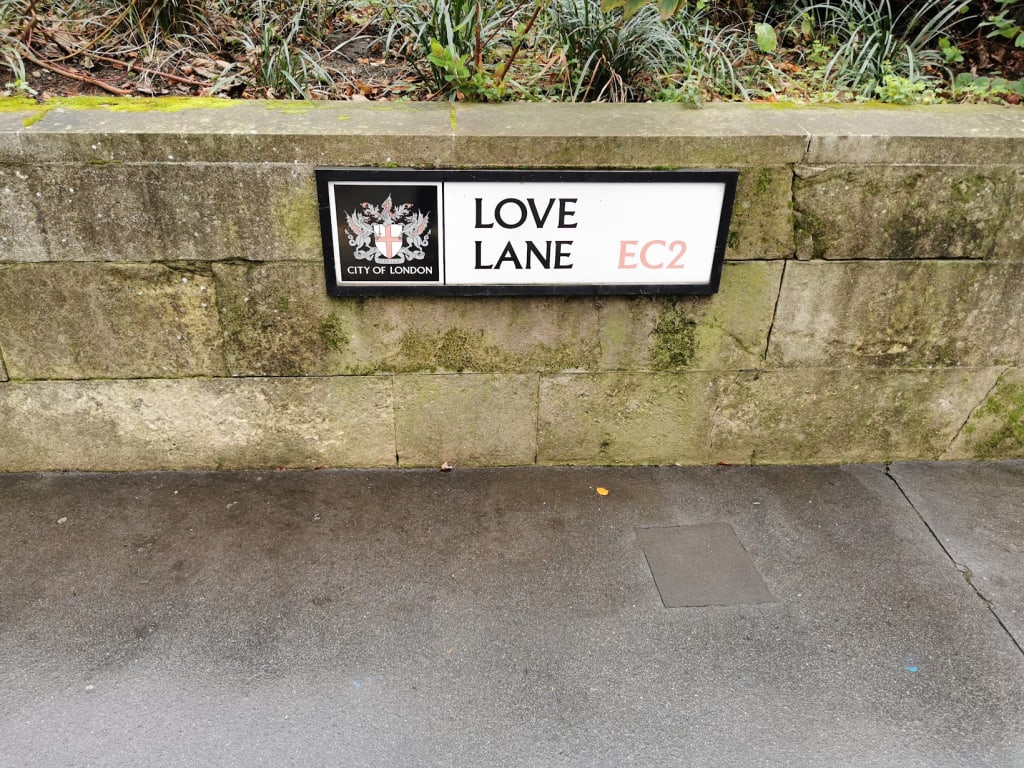
I remember when I first saw Love Lane and thought, "How sweet!" This was before I was interested in London. Once, I created Tabby London, and when I returned to the City, I decided to research street names. What I found was very interesting, to say the least.
Love Lane is a slap bang in the heart of the City. It runs west from Aldermanbury to Wood Street in Cripplegate Ward Within. Its history stretches back to the 14th century, with the earliest recorded mention appearing in 1336 as "Lovelane."
It’s depicted on Ralph Agas’s woodcut map of London from the 1560s (though labelled as "Lone Lane"), showing its presence in medieval times.
London’s Red Light District
The most famous account of its name comes from John Stow, a 16th-century historian, who wrote in his Survey of London (1598) that it was "so called of wantons" –wonton is a brutal name for prostitutes who frequented the area.
This suggests that Love Lane was once part of London’s less reputable underbelly, where illicit encounters occurred every day. This less-than-desirable association wasn’t unique. There are other London streets like Cock Lane, and former names like Gropecunt Lane (now lost) hint at a medieval openness about such activities.
Disputed Term
However, not all historians agree with Stow’s explanation. Some suggest the name might derive from a more innocent source, such as a landowner named Love or even a romantic spot for courting couples. In his A Dictionary of London (1918), Henry Harben notes the possibility of a connection to a person called Love but doesn’t dismiss Stow’s claim entirely.
Others, like Gertrude Rawlings, argue that many Love Lanes in London might reflect "innocent everyday romances" rather than a universal red-light reputation. Despite these debates, the prostitution theory remains the most widely cited origin for this particular lane.
Roman Remains
It’s not far from The London Wall. Archaeologists have unearthed Roman and Saxon remains around the area, indicating settlement long before its medieval origins.
The street survived the Great Fire of London in 1666, as it lay just north of the fire’s reach, and remains a narrow, quiet passage today, overshadowed by modern buildings but retaining a whisper of its colourful past.
Aldermanbury
The Aldermanbury Conduit was a vital piece of medieval infrastructure in the City of London. From 1471 until its removal in the 18th century, it provided free water to residents.
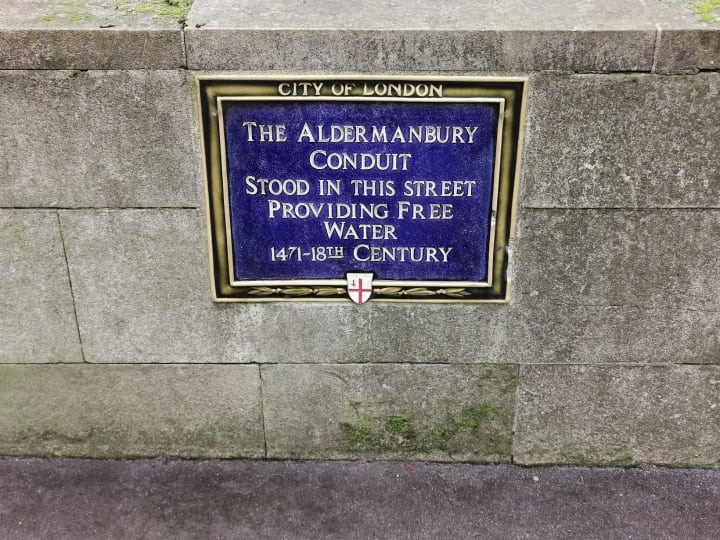
Located near St Mary Aldermanbury Church, close to the junction of Aldermanbury and Love Lane, it was initiated by Sir William Eastfield, a former Mayor of London. In his 1445 will, he directed that water be piped from Tyburn to supply the conduit, a project completed by his executors in 1471. This small building housing a reservoir was a massive achievement in early civic engineering, delivering fresh water to a fast-growing urban area.
Though it survived the Great Fire of 1666 and required rebuilding, it eventually fell out of use and was dismantled, leaving its legacy only in historical records and the faint traces of the area’s past. Today, its site lies quietly amid the modern City, a forgotten echo of London’s efforts to sustain its growing population centuries ago.
Modern Shadows
Standing there now, with one of the City’s significant investment banks looming nearby, it’s hard to imagine Love Lane’s raucous past. The suits hurrying past, eyes glued to phones, probably don’t spare a thought for the “wantons” or Roman ghosts beneath their feet.

That little garden, a patch of green amid the concrete, feels like a nod to the lane’s softer side—though I’d wager a few pauses to ponder its name. I didn’t either, at first. But once you start peeling back the layers, Love Lane reveals itself as a small personality of London: a blend of grit, mystery, and unexpected survival.
If you enjoyed reading this article and want to support my work, you can now buy me a coffee ☕️.
https://www.buymeacoffee.com/TabbyLondon
Thank you for your attention.
Best wishes
Tabby
About the Creator
Tabby London
The London I've been discovering is usually off the well-beaten track.I love the nooks and crannies and walking along the streets steeped in centuries worth of history. I'm fond of Zone 1 because that's where it all began centuries ago.
Keep reading
More stories from Tabby London and writers in Wander and other communities.
The Shard
Love it or Hate it, it's here to say. When it first started going up, like many Londoners, I was a little hesitant. However, having visited it countless times, I'm overwhelmed by the magnitude and the building's height, especially as you stand at the base of the building. No matter where you go in central London. You'll likely see it; I can even see it from my high street😅.
By Tabby London11 months ago in Wander
Escape the Australian Winter: Your Ultimate Sri Lanka Escape (June – August)
As the first frost settles over the suburbs of Melbourne and the winds pick up across Sydney Harbour, a collective longing for the sun begins to stir. While most Australians look toward the predictable resorts of Bali or Fiji, a more exotic, soul-stirring alternative awaits just across the Indian Ocean.
By Seth Marshal7 days ago in Wander




Comments
There are no comments for this story
Be the first to respond and start the conversation.