


If you’re walking along Bishopsgate and heading towards Monument, you can’t miss the striking exterior of Leadenhall Market. It is one of London’s most impressive and historically significant covered markets in London.
You’ll find it between Gracechurch Street, Leadenhall Street, and Cornhill. The market has been a commercial area for centuries. I like popping in now and again, especially if I have time because I enjoy walking down the little avenues and sidewalks to look at the shops.

Leadenhall
The name ‘Leadenhall’ is believed to derive from the Old English words "leaden," which refers to the metal lead, and "hall," which means a large building or gathering place. The name's origin dates back to the 14th century when the area was first developed as a market.
Another theory links the name to the trade of lead at the market. Lead was a common commodity traded in the medieval period so that the market could have been named after the material sold there. As the demand grew and evolved over the centuries, the name ‘Leadenhall’ became a defining part of the area, eventually being used for the entire surrounding district, including the iconic market building we know today.
History
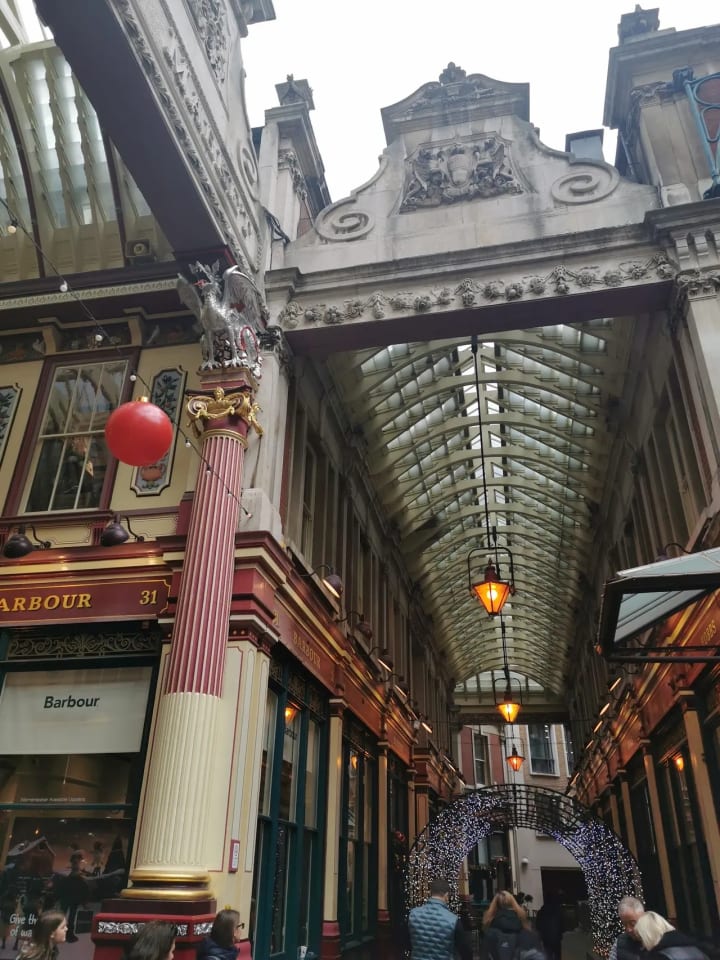
Its history spans back to the 14th century, with its first recorded mention in 1321 as a trading area for merchants, particularly in selling fish, poultry, and meat. However, the building we see today, with its grand Victorian architecture, was designed by Sir Horace Jones and completed in 1881.

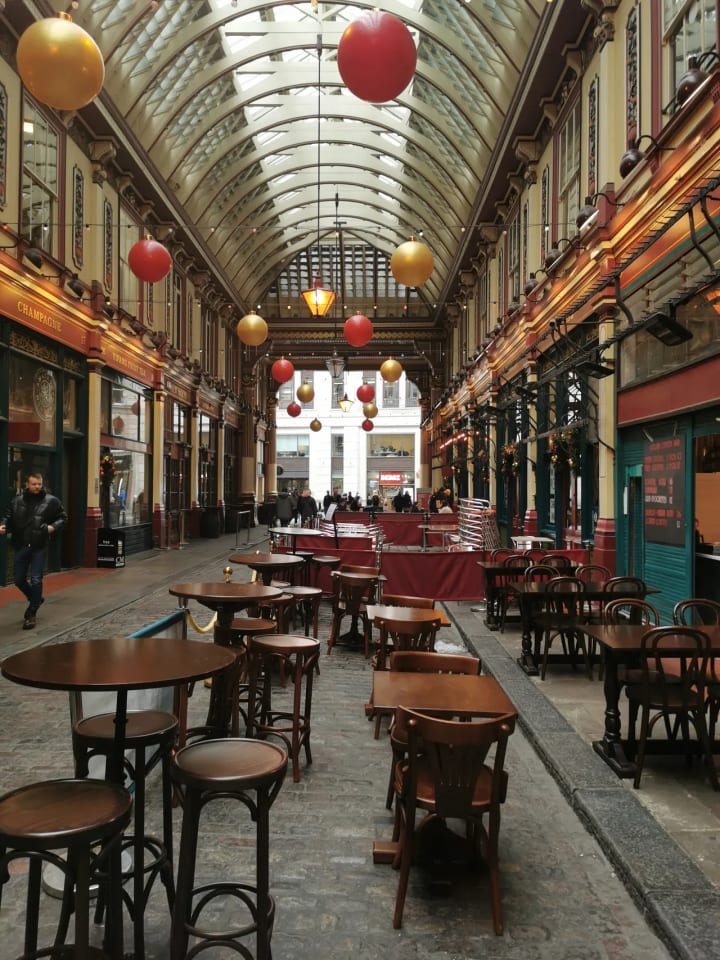
It has an eye-catching roof made of glass and iron and plenty of decorative details that enhance its appearance. The roof’s vaulted design allows natural light to flood the central space. It’s got a cobbled floor, and once you step inside, you’ll feel as if you’re stepping into history. The main area is a large courtyard with a number of high-end shops, but there’s something for everyone.


The Market Evolves
Previously, it operated as a centre for wholesale trade, with merchants selling fish, meat, and dairy to the local population. It quickly became one of the most crucial trading spaces in the City of London. By the 19th century, the market had expanded and became more organised, with the construction of the Victorian building breathing some fresh modern life into the vicinity.
You’ll see the area transformed around the market. One striking feature is the number of high-rise commercial office buildings that popped up in the 20th Century. The market continued to function as a wholesale area until the mid-20th century and gradually moved towards catering to retail customers with healthy disposable incomes. Many boutique shops, artisan shops, speciality stores, restaurants, cafes, and pubs exist.


Modern-Day
The market is open to the public daily, but it comes alive most during working hours when office workers from the surrounding buildings stop by for lunch or after-work drinks. Throughout the year, it also plays host to various events and seasonal markets.
It’s also a famous market because it is a filming location for movies and TV shows. It was used as Diagon Alley in *Harry Potter and the Philosopher's Stone* (2001), where the entrance to the wizarding world is depicted as a hidden alleyway within Leadenhall Market. Hence, you’ll see die-hard Harry Potter fans popping along occasionally to take pictures. It was also used in Tinker Taylor Soldier Spy.

Preservation and Heritage
Leadenhall Market is protected under the City of London’s planning regulations to preserve it for future generations. It is also a vital part of the City’s rich heritage and testimony to the city’s history from a medieval market town to a global financial capital.
Accessibility and Surroundings
The market is easily accessible from several nearby transport links, including the Leadenhall Market entrance just off Fenchurch Street Station, which connects to the Docklands Light Railway (DLR) and several underground lines. It is also within walking distance of major landmarks such as the Bank of England, St. Paul’s Cathedral, and the Tower of London. Nearby, you can find other famous sites like the Lloyd’s of London building and the modern glass skyscrapers of the financial district.
Events and Seasonal Markets
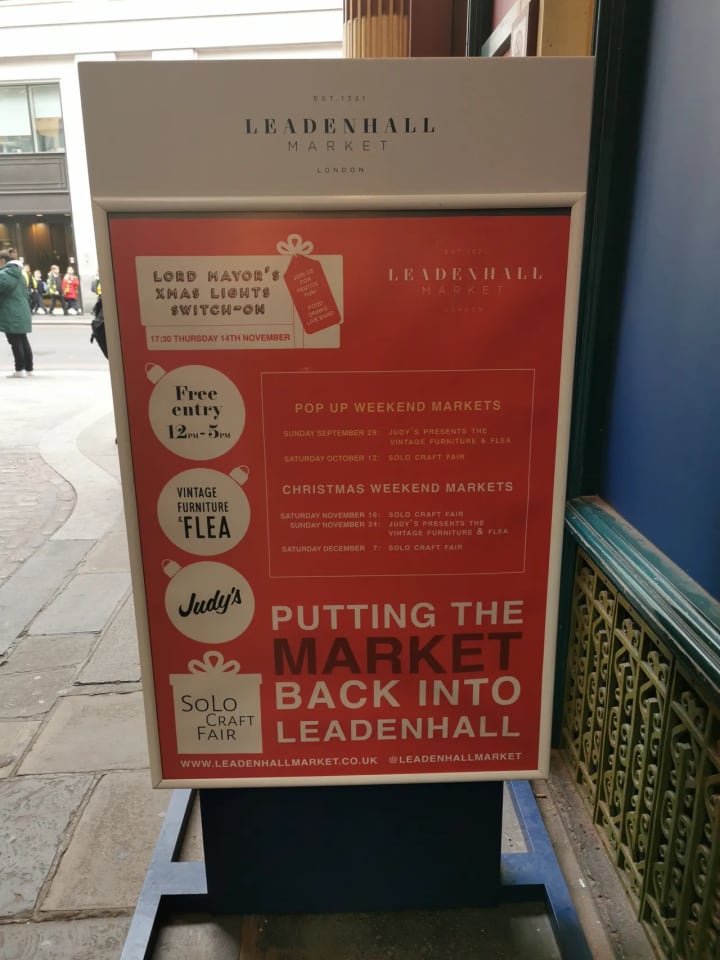
In addition to its daily function as a market, Leadenhall Market hosts special events throughout the year. These include Christmas markets, food festivals, and live performances, which contribute to the area’s lively atmosphere.
The market is trendy during the holiday season when decorated with festive lights and decorations, adding charm and drawing large crowds. The market’s combination of traditional elements and contemporary spaces makes it a versatile venue for various activities.
Parting Comments
Leadenhall Market is worth visiting because you’ll see history in an iconic market space. Plus, stepping away from the hustle and bustle of Bishopsgate is always lovely. It’s evolved to thrive in today’s fast-paced City of London, where the architecture keeps changing. The number of high-rise buildings around the market has dwarfed the building, but the architecture stands out whether you look at the front or the exterior.
Leadenhall Market is particularly popular with tourists looking for a blend of history, shopping, and food in one location. Its proximity to the River Thames and other historical sites in the City of London makes it an excellent stop during sightseeing in London.
Thank you for your attention
Best wishes
Tabby
For more information https://leadenhallmarket.co.uk

About the Creator
Tabby London
The London I've been discovering is usually off the well-beaten track.I love the nooks and crannies and walking along the streets steeped in centuries worth of history. I'm fond of Zone 1 because that's where it all began centuries ago.
Keep reading
More stories from Tabby London and writers in Wander and other communities.
Luncheon In Paris?
I love any excuse to go to Paris, even for the day. However, I’ve had a love-hate relationship with Paris for many years. I still get excited about going. Previously, I would love the journey, feel a bit ‘oh, okay’ and fall in love with the city after a couple of days. This went on with each trip. I’ve been countless times, so it’s not a one-off.
By Tabby Londonabout a year ago in Wander
The Kelpies and The Falkirk Wheel
The Kelpies The Kelpies A few years ago I was driving up the M9 towards Dollar in Scotland, it was dark and raining and suddenly I nearly crashed the car when I saw two huge hundred-foot-high horses' heads to my left-hand side. I had to pull over. I am not sure if I tried to take a photograph but I was dumbfounded.
By Mike Singleton 💜 Mikeydred 4 days ago in Wander
Pearl
1980 something. we all hung out at Pearl and you and i were nothing special, or so i thought. i mean we all danced, drenched in our own sweat, our own saline solution of fear, too many beers, shots, laughter, tears, fucks in the bathroom and i don't know when we began to be afraid. do you?
By ROCK aka Andrea Polla (Simmons)3 days ago in Fiction



Comments
There are no comments for this story
Be the first to respond and start the conversation.