
How to Splice Fiber: A Step-by-Step Guide for Clean, Reliable Connections
Fusion Splicer FFS-5000 Ultima
Introduction
Fiber splicing is at the heart of building and maintaining strong, efficient fiber optic networks. Whether you're deploying a new line or repairing an old one, mastering the splicing process ensures low signal loss and high reliability. In this guide, we’ll walk you through the complete splicing process using advanced equipment such as the Star Ultima Fusion Splicer.
What is Fiber Splicing?
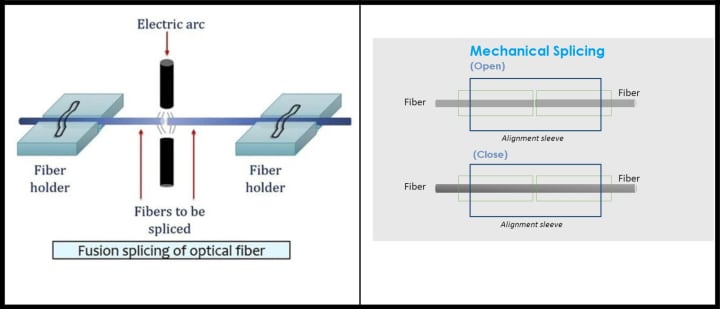
Fiber splicing is the process of joining two optical fibers together to ensure continuous data transmission. The two main types of splicing are:
- Fusion Splicing (melting fibers together)
- Mechanical Splicing (aligning and holding fibers with a connector)
Fusion splicing is preferred for its low signal loss and strong durability.
Essential Tools for Fiber Splicing
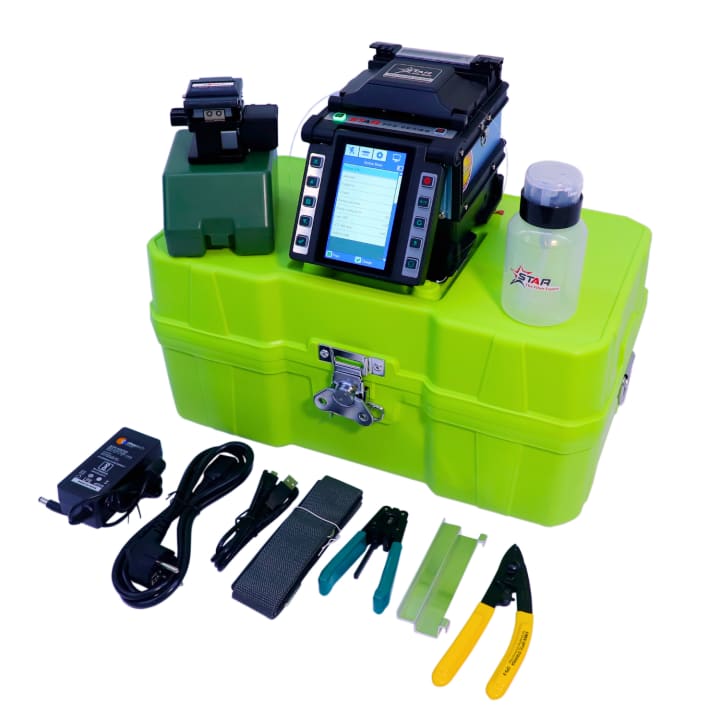
To ensure precise and efficient fiber optic splicing, the following tools are required:
Fusion Splicer – A high-precision device for joining fibers, such as the Star Ultima Fusion Splicer.
Fiber Cleaver – Used to create clean, 90-degree cleaves on optical fibers for optimal fusion results.
Stripping Tool – Removes the protective coating from the fiber without damaging the core.
Cleaning Materials – Includes IPA (isopropyl alcohol) and lint-free wipes to maintain fiber cleanliness.
Fiber Holders – Secure fibers in place during the splicing process.
Heat Shrink Sleeves – Protect the spliced area by reinforcing and insulating the joint.
Protective Gloves – Ensure safety while handling sharp fiber ends and chemicals.
Professional Fiber Splicing Process
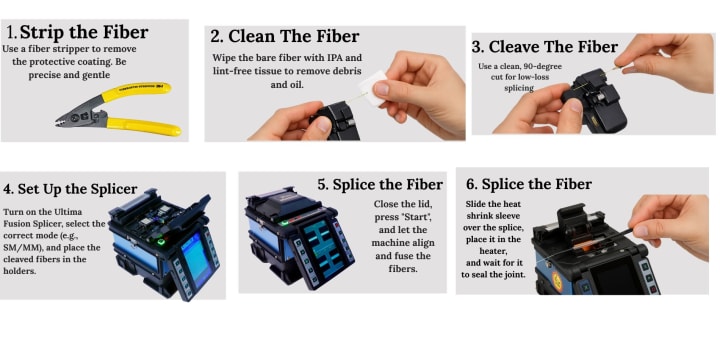
Achieve clean, reliable splices with precision. Follow these 7 critical steps:
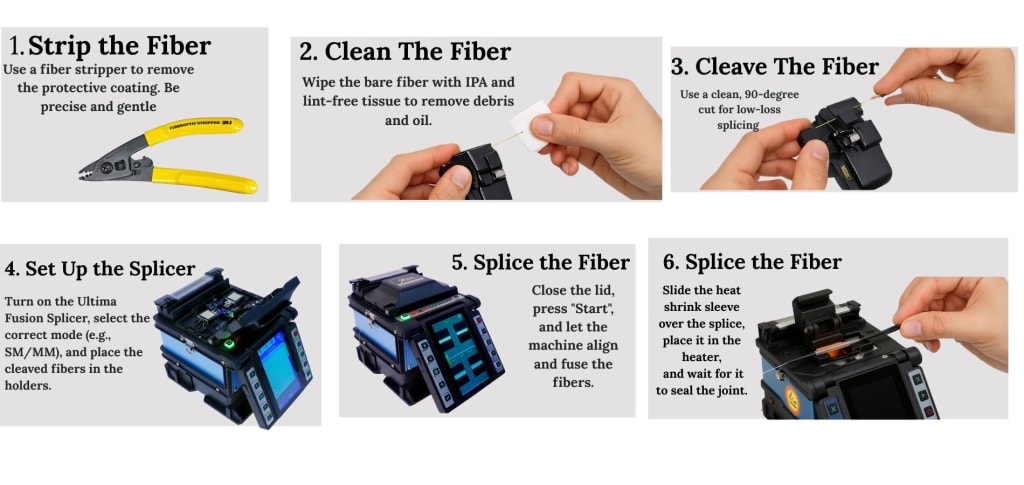
1. Strip the Fiber
🔹 Gently remove the outer coating using a precision fiber stripper.
✔️ Ensure the bare glass is undamaged and the stripped length is consistent.
2. Clean the Fiber
🔹 Use a lint-free tissue soaked in 99% IPA (isopropyl alcohol) to wipe the bare fiber.
✔️ Remove all debris, dust, and oils for optimal signal clarity.
3. Cleave the Fiber
🔹 Place the cleaned fiber into a precision cleaver and make a 90° cut.
✔️ A clean cleave is essential for low splice loss and core alignment.
4. Prepare the Fusion Splicer
🔹 Power on the Star Ultima Fusion Splicer, select the correct fiber mode (SM/MM), and load the fibers into the holders.
✔️ Ensure fiber ends are centered and properly aligned.
5. Perform the Splice
🔹 Close the lid and press “Start.” The splicer will align the fibers and fuse them using a calibrated arc.
✔️ Look for a smooth fusion arc and minimal splice loss (typically <0.05 dB).
6. Apply Heat Shrink Protection
🔹 Carefully slide a splice protection sleeve over the joint and place it in the built-in heater.
✔️ Allow the full heat cycle until the sleeve is tight and the joint is sealed.
7. Inspect the Splice
🔹 Use the splicer’s internal inspection mode or an external OTDR to verify splice quality.
✔️ Confirm alignment, loss level, and sleeve integrity.
Tips for Better Fiber Splicing
Keep Your Work Area Dust-Free :- A clean environment is essential for high-quality splicing. Dust particles can interfere with alignment and lead to signal loss or weak splices. Use an anti-static mat, keep the splicing machine closed when not in use, and avoid windy or dusty conditions during outdoor splicing.
Always Use Clean Tools :- Dirty cleavers, strippers, or fiber holders can contaminate the fiber ends, potentially ruining the splice. Regularly clean your tools using alcohol wipes or lint-free cloths, and replace worn-out blades or pads as needed.
Practice on Scrap Fibers Before Field Use:- Don’t wait until you're in the field to get comfortable with your tools. Practice splicing on spare or scrap fibers to perfect your cleaving, alignment, and heating techniques. This helps you get consistent low-loss results when it matters.
Proper Cleaving is Crucial :-The cleave must be as flat and perpendicular as possible. Poor cleaving leads to high splice loss and weak joints. Invest in a good cleaver and handle it with care.
Avoid Bending or Stressing the Fiber :-Even a well-spliced fiber can fail if it is bent or under tension. Always place splices in a proper protective sleeve and secure the fiber in a splice tray.
Inspect and Clean Before Every Splice :-Use an inspection microscope to check fiber ends. Even invisible dust or small cracks can cause issues. Clean both the fiber and the V-grooves of your splicing machine.
Conclusion
Fiber splicing is a vital skill for anyone working with fiber optic networks, and mastering it ensures long-term network performance, minimal signal loss, and high reliability. With the right tools—especially advanced equipment like the Star Ultima Fusion Splicer—and a clean, precise technique, you can consistently produce professional-grade splices. Whether you're installing new lines or performing maintenance, following best practices and understanding each step of the process will help you achieve strong, stable connections every time. Keep practicing, stay meticulous, and your splicing results will speak for themselves.
About the Creator
Keep reading
More stories from writers in Wander and other communities.
Worth the Wait: Puerto Viejo, Costa Rica
Beach bumming in a small Caribbean beach town sounded like a perfect way to end our 6-month trip through Mexico and Central America. Or so we thought. The foul, fishy stench of rotten seaweed hit our nostrils as we stepped from the cramped bus and looked out at a rather depressing, empty, and underwhelming black sand beach. It was pouring with rain, and we had to quickly fish out our ponchos. We thought, this couldn’t be it, could it?
By Sh*t Happens - Lost Girl Travel8 days ago in Wander
Why a Dubai Desert Safari Is a Must-Do Experience for First-Time Visitors
Dubai screams luxury, with a skyline packed with gleaming towers, headline-making architecture, and entertainment and shopping centres that feel almost unreal. Everything is polished, bright, and designed to impress. But step away from the glitz and the glamour, and you hit Dubai’s older side. Out in the Arabian desert, the pace shifts. The landscape is ancient, the traditions run deep, and the whole experience feels like a window into what this emirate really is beneath the shine. Plenty of travellers have crossed these sands before you. Now it is your turn.
By ameliarosannaa day ago in Wander
Pandora’s Burden
“My brother warned me to not accept gifts from the one who commissioned you,” said Epimetheus to the woman clad in silvery raiments standing at the entrance to the temple. Her silver tiara and the silver rings on her fingers and toes glinted in the firelight cast by torches set on either side of the doorway. Lingering in the shadows, beyond the reach of the flames as she was, he could not tell what she held in her hands. At first what appeared to be a box was perhaps a funerary urn, or maybe merely an apple.
By J. Otis Haasabout 17 hours ago in Fiction



Comments
There are no comments for this story
Be the first to respond and start the conversation.