
Hawaiian Giant Centipedes – Hideous and Heinous – Wise Reasons To Avoid A Painful Encounter
Prehistoric and “butt ugly,” the vile creatures haunt the night, foraging for prey. Although their bite likely won’t kill you, the pain is excruciating and guarantees a trip to the emergency room.

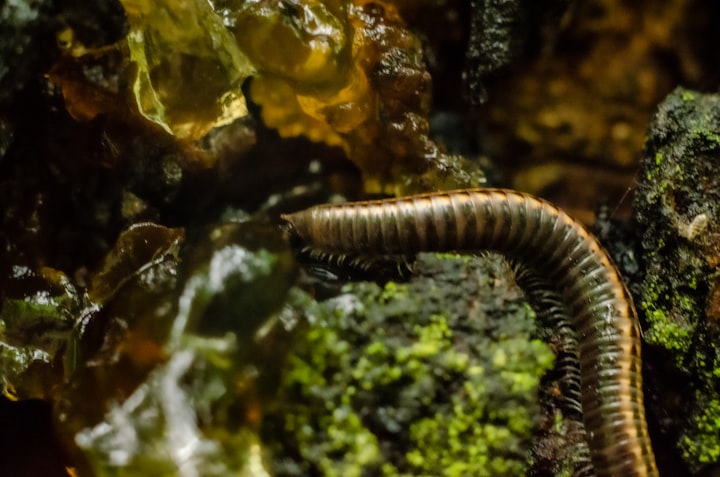
In a tropical climate, centipedes are relatively common: creepy carnivorous creatures that inject venom to kill termites, small vertebrates, flies, moths, bed bugs, spiders, and cockroaches. Prehistoric and “butt ugly,” the vile creatures haunt the night, foraging for prey. Although their bite likely won’t kill you, the pain is excruciating and guarantees a trip to the emergency room.
Description – Disgusting and Deadly
• The name centipede, which means “one hundred legs,” is somewhat misleading as centipedes have somewhere between a dozen to 177 pairs of legs. Hatching from eggs placed in moist soil, centipedes have flat, elongated, segmented bodies that contain a pair of legs per segment. As they mature, they grow more body segments with more legs.
• The Hawaiian Islands are home to three species of centipede: Lithobius sp, Mecistocephalus maxillaries, and Scolopendra subspinipes. However, S. subspinipes is the Hawaiian centipede most feared.
• The Giant Hawaiian Centipede, also known as Jungle Centipede, Malaysian Cherry Red Centipede, Orange-legged Centipede, Japanese Centipede, Chinese Red Head, Asian Forest Centipede, or Vietnamese Centipede infest not only areas of Hawaii but all the Central Pacific Islands.
• Many of the above-described sub-species of centipedes have made their way to Hawaii as “stowaways” in cargo shipments or illegally imported as pets.

• Believed to originate in Southeast Asia, giant jungle centipedes are also found in Central and South America, West Africa, and Australia.
• Campers, hikers, gardeners, and visitors and residents engaged in outdoor activities in the islands frequently encounter centipedes.
• Recipients of centipede bites are a common occurrence at urgent care clinics and emergency rooms across the State of Hawaii.
• Occurring in several different patterns and colors, centipedes live up to six years: manifesting additional legs and growing bigger the longer they live. Centipede colors range from bold orange to dark brownish-black.
• The Hawaiian Giant Centipede is most easily recognized by its bright orange legs.
• Centipedes vary in size from less than an inch long up to as big as twelve inches. Compared to centipedes that inhabit other parts of the world, the Hawaiian centipede is the “biggest and bawdiest of the bunch” – a deadly predator on the prowl. Hawaii is home to the largest and longest centipedes ever recorded: “bug killers on steroids.”
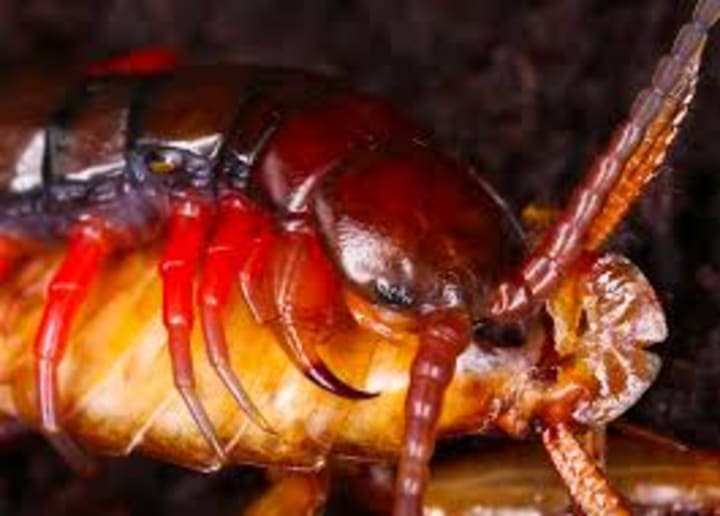
• Centipedes detect their prey utilizing two long antennae, covered with dense hairs. Heads of centipedes have tiny mouths with strong, claw-like jaws containing venom glands. Their deadly venom allows centipedes to attack prey and defend themselves from predators and other natural enemies.
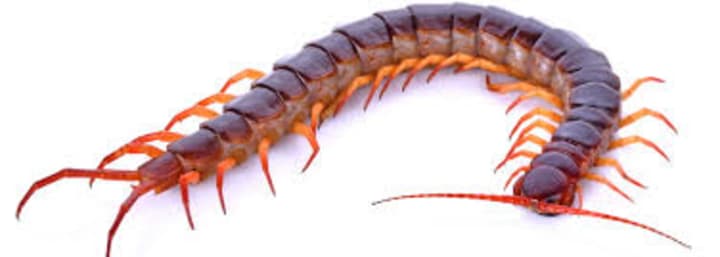
• Some species of centipede have excellent vision with eyes that contain as many as 200 optical units. Other centipede species are blind, finding their prey by a sense of smell and touch. Hawaiian Giant Jungle centipedes have excellent vision, and they attack with lightning speed.
Centipede Envenomation: Bringing the Pain to Hawai‘i and Pacific Islands
https://www.ncbi.nlm.nih.gov/pmc/articles/PMC4244901/
Nasty Habits
• Centipedes creep into homes under cover of darkness, infesting damp and dark areas around closets, basements, bathrooms, crawl spaces, and any other area frequented by other insects. As an integral part of nature’s master plan, centipedes are beneficial in their role of devouring other insect pests. You don’t want to find them in your bed, hiding in your shoes, or taking up residence in clothing items you are about to don.
• Carnivores of the night, centipedes do not roam in daylight. Undercover of darkness, they forage for food, using their poison claws (maxillipeds) to grab and paralyze their victims, such as spiders, worms, cockroaches, mice, frogs, lizards, and grubs.
• Agile, fast-moving, and nocturnal, humans rarely see centipedes: you might see a bit of movement out of your eye, but they move too fast to get a good look at them unless they are backed into a corner and then watch out!
• If you scream “ help – centipede” when you discover a crawler in your bed or scuttling up your leg, don’t expect anyone to come running to your aid. No one else wants to be bitten for his or her trouble. Hawaiian or Asian forest centipedes are nervous, fast, and aggressive.
• What gives us the “creeps” and makes the scary-looking crawling creatures, so very frightening is that they don’t cannibalize insects they encounter. They aggressively attack anything or anyone that may mean them harm: including people, pets, and other centipedes.
Vulnerable Victims
• Children, the elderly, individuals who are allergic to centipede venom, or persons with a compromised immune system are at the most significant risk for a major health problem from a centipede bite.
• When centipedes bite insect prey, their deadly venom immediately immobilizes and numbs their prey. In humans, the venomous bite, dependent on the size and species of the centipede, is a searing, burning, and stinging sensation: painful beyond description.
• Gardeners, tending their flowerbeds, or children at play in the grass are common human victims. Centipede bites cause severe pain, swelling, numbness, discoloration, edema, inflammation, tissue necrosis, and additional localized symptoms such as anxiety, fear, and panic.
• Typically, symptoms of a centipede bite also include nausea, vomiting, and stomach cramps accompanied by shortness of breath and dizziness.
• Management of a centipede bite involves wound care, pain management, and immediate treatment with topical and oral anti-inflammatory and oral antihistamine medications.
• In rare cases, anaphylaxis and death have occurred.
• Centipede venom is not usually life-threatening to humans, but the bite is one you will never forget.
• According to recent statistics provided by the Hawaii Department of Health, of the cases presenting to the emergency room due to a “natural or environmental cause,” 11 percent were from centipede bites.
How To Avoid Being Bitten
• Because much of the Hawaiian Islands are highly populated with giant centipedes, locals have developed the habit of always checking between the sheets before crawling into bed and shaking out or inspect all clothing items before wearing them: no one wants to find a centipede in their pants.
• If you see centipedes around your property, there are likely a lot more you don’t see. Call a professional exterminator: eliminate the problem.
• Homeowners are advised to reduce moisture around the exterior of the home and to seal windows, doors, and other entryways.
• It is advisable to keep garden debris, wood, compost, leaves, and other organic material away from the foundation of the home.
• Control the insects in your home. Reducing the number of spiders and other creepy crawlers that provide a food source for centipedes can substantially reduce their proliferation.
• If you find a centipede indoors, don’t try to pick it up or smash it. Remove with a vacuum cleaner.
• Reduce clutter that provides a place for centipedes to hide. Avoid storing boxes against a wall or directly on the floor. Centipedes love to hide in dark cracks and crevices.
• If you find a giant centipede in your home environment, go ahead and destroy it immediately! The Scolopendra subspinipes or Hawaiian Giant Centipede is not on the IUCN Red List of Endangered Species.
About the Creator
Marlene Affeld
“A passionate writer for more than 30 years, Marlene Affeld’s passion for the environment inspires her to write informative articles to assist others in living a green lifestyle.”
Keep reading
More stories from Marlene Affeld and writers in Wander and other communities.
Tales Of Goblins, Ghosts, Gods, And Men
Hawaiian Myths and Legends That Will Make You Want to Visit the Big Island, Hawaii Mysterious fables of forest spirits and stories of souls taken by the sea define the Big Island. Living in the shadow of the most active volcano on earth, island residents “talk story” using the tales of ghosts, goblins, gods, and men to understand the complex diversity of this “Paradise of the Pacific;” the youngest of the Hawaiian Islands.
By Marlene Affeld5 years ago in Wander
Worth the Wait: Puerto Viejo, Costa Rica
Beach bumming in a small Caribbean beach town sounded like a perfect way to end our 6-month trip through Mexico and Central America. Or so we thought. The foul, fishy stench of rotten seaweed hit our nostrils as we stepped from the cramped bus and looked out at a rather depressing, empty, and underwhelming black sand beach. It was pouring with rain, and we had to quickly fish out our ponchos. We thought, this couldn’t be it, could it?
By Sh*t Happens - Lost Girl Travel10 days ago in Wander



Comments
There are no comments for this story
Be the first to respond and start the conversation.