
Chandrayaan - 3 "A journey to the moon"
Moon mission of india
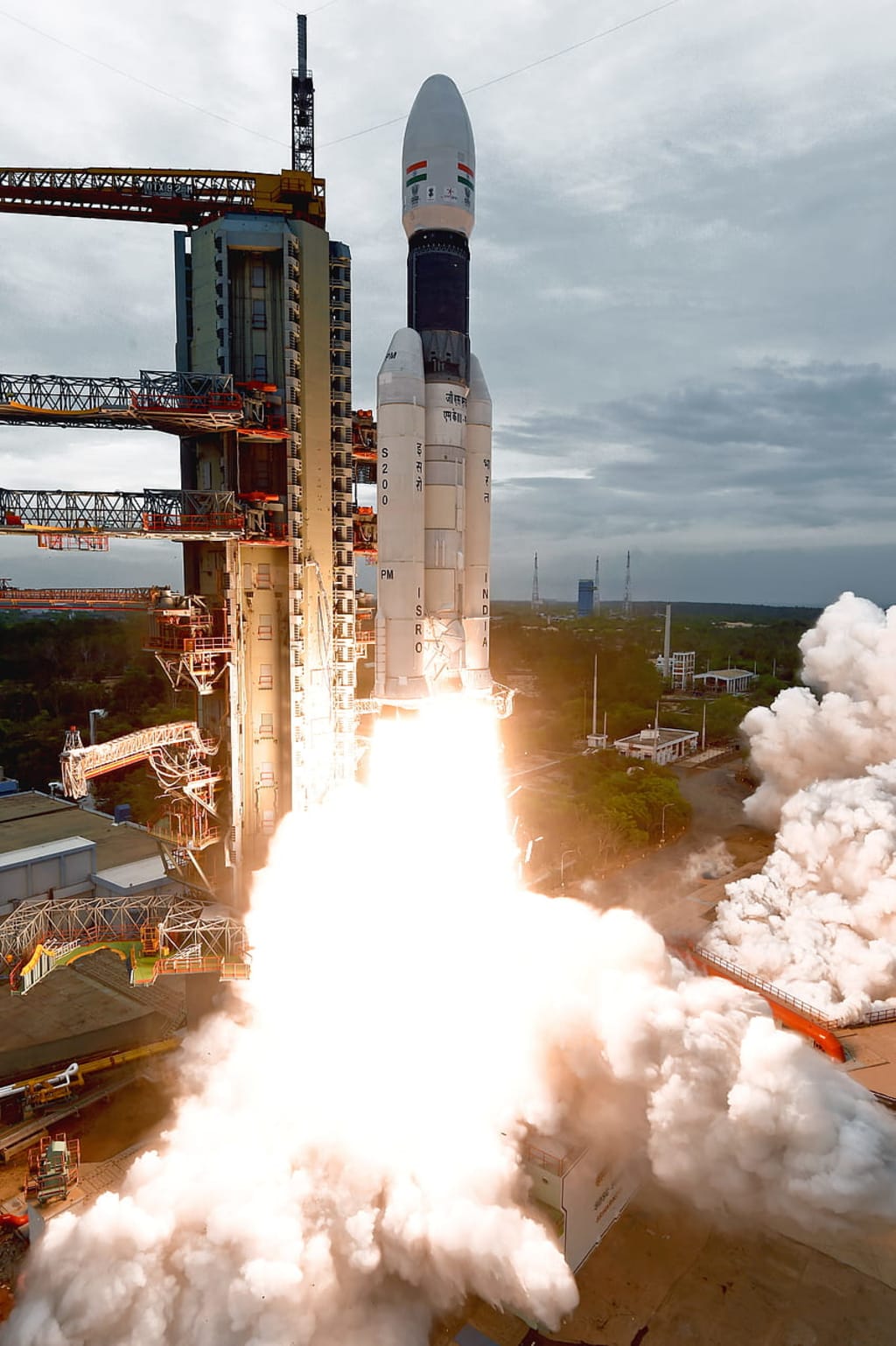
Chandrayaan-3: A Journey to the Moon
Introduction:
Chandrayaan-3 is the third mission in India's ambitious Chandrayaan program. Building upon the successes and lessons learned from the previous missions, Chandrayaan-3 aims to further explore the uncharted terrains of the Moon and expand our understanding of Earth's celestial neighbor. This article will take you on a detailed journey through the story of Chandrayaan-3, from its conception to its anticipated accomplishments.
Mission Objectives:
Chandrayaan-3 has several key objectives that drive its scientific exploration potential. Firstly, it seeks to further enhance our understanding of the Moon's geology, by conducting comprehensive mapping and analysis of its surface. The mission also aims to investigate the presence of water molecules and minerals, which could offer insights into the Moon's origins and potential for future human habitation. Additionally, Chandrayaan-3 seeks to study the lunar atmosphere and analyze the presence of volatile elements, providing valuable data for future space missions.
Mission Planning and Design:
Following the success of Chandrayaan-2, the Indian Space Research Organisation (ISRO) embarked on planning Chandrayaan-3. The mission was designed to rectify the shortcomings of its predecessor and maximize its chances of success. The spacecraft underwent significant design modifications and updates to ensure robustness and reliability during the lunar journey. The mission planning involved a meticulous examination of mission parameters, trajectory optimization, and the selection of scientific payloads to accomplish its objectives.
Launch and Lunar Journey:
Chandrayaan-3 is set to launch aboard the Geosynchronous Satellite Launch Vehicle (GSLV) Mk III, ISRO's most powerful rocket. The GSLV Mk III will propel the spacecraft into a highly elliptical Earth orbit, from where it will undertake a trans-lunar injection to escape Earth's gravity. During the lunar journey, the spacecraft will execute a series of trajectory correction maneuvers to precisely navigate towards the Moon.
Lunar Orbit Insertion and Mapping:
Upon reaching the Moon's vicinity, Chandrayaan-3 will execute a lunar orbit insertion, utilizing the spacecraft's propulsion system to maneuver into a circular orbit around the Moon. Once in the lunar orbit, the spacecraft will begin its mapping mission, capturing high-resolution images of the lunar surface using its onboard cameras. These images, along with data from other scientific instruments, will be crucial in identifying potential landing sites for future missions.
Soft Landing Module and Rover:
Chandrayaan-3 consists of a lander and a rover, similar to its predecessor. The lander, equipped with touchdown sensors and braking thrusters, ensures a soft landing on the lunar surface. The rover, designed to withstand the Moon's rugged terrain, will be deployed after a successful landing to explore the lunar surface. Equipped with scientific instruments, the rover will carry out various experiments, including sample analysis and soil composition studies, to unravel the mysteries of the Moon's geology.
Scientific Payloads:
Chandrayaan-3 carries several scientific payloads to fulfill its mission objectives. These payloads include the Terrain Mapping Camera (TMC) and the Orbiter High-Resolution Camera (OHRC), which will capture detailed lunar imagery. The Rover's instruments, such as the Alpha Particle X-ray Spectrometer (APXS) and the Laser-Induced Breakdown Spectroscope (LIBS), will analyze the composition of lunar rocks and regolith. Additionally, the mission will also deploy a Langmuir Probe to study the lunar plasma environment and a thermal probe to measure the Moon's subsurface temperature.
Conclusion:
Chandrayaan-3, India's third mission to the Moon, represents another milestone in mankind's exploration of space. With its refined design, enhanced scientific payloads, and ambitious objectives, Chandrayaan-3 aims to unlock further secrets of the Moon, expanding our knowledge of the solar system and providing valuable insights for future space missions. As the mission embarks on its journey to Earth's celestial neighbor, scientists and space enthusiasts eagerly await the discoveries it will unveil, further fueling our curiosity and expanding our understanding of the universe.
About the Creator
Keep reading
More stories from writers in Wander and other communities.
Worth the Wait: Puerto Viejo, Costa Rica
Beach bumming in a small Caribbean beach town sounded like a perfect way to end our 6-month trip through Mexico and Central America. Or so we thought. The foul, fishy stench of rotten seaweed hit our nostrils as we stepped from the cramped bus and looked out at a rather depressing, empty, and underwhelming black sand beach. It was pouring with rain, and we had to quickly fish out our ponchos. We thought, this couldn’t be it, could it?
By Sh*t Happens - Lost Girl Travel6 days ago in Wander
They Read My Future in a Coffee Cup in Istanbul
See Pictures from the trip here. That's the honest starting point. I sat down, drank the coffee - which is strong in a way that makes you question every cup you've had before it, the kind of strong you'd rather smell than commit to - flipped the cup upside down on the saucer, and waited.
By Destiny S. Harris5 days ago in Wander
Why Didn't Anyone Tell Us
Men, move along. This is not for you. This is for the women. I was forty-five when I began menopause. It is pretty young for that to be going on in a woman’s life, but I had undiagnosed PCOS, my entire life. Thank you to all the gynecologists I had seen my entire life. That in itself should encourage women to keep seeking second opinions, especially when you are not getting correct answers or any at all.
By Alexandra Granta day ago in Humans




Comments
There are no comments for this story
Be the first to respond and start the conversation.