
Bringing Back Myself
A Reflection on My Journey to Belize and the Top of Mount Xunantunich.

It was 2016. I was armed with my brand-new passport, a full bottle of SPF 50 sunscreen, and the TSA Carry-On Restrictions list. I was packing for an eight-day study abroad trip with my fellow classmates, and of course, I had left it for the absolute last minute.
Not that it would have mattered—I was so excited that even if I'd been prepacked at 7 AM the night before, I never would have fallen asleep. I'd been on trips across the States before, but it was my first time leaving the country. What would it be like to leave Texas for something more than a family visit? Would I miss my parents? It was my first voyage without them on this large of a scale. Would missing them drown out my experiences there? What if, despite all my excitement, I hated this trip?
There was so much going on in my mind that by the time I was finished with my packing, it was time to head to the airport. At four in the morning.
I hugged my mom goodbye and made my way through security to board the smallest plane I'd ever been on; the two classes coming on this trip filled nearly the entire craft with 18 students and two instructors. It was a three-hour flight, and still my sleeplessness had not hit me. I had spent some time the night before creating a perfect playlist the exact length of my flight. This was always on my “packing” list, and it was doubly important as I had forgone bringing a book to read on the plane.
Instead of taking the prime opportunity to nap, I let the music I had carefully chosen—tunes to inspire a sense of adventure but also to comfort me if I was missing home—wash over me as I mulled over the semester leading up to our takeoff. Half of the students enrolled in the literature course that would focus on Belizean culture and how it was shaped by both history and myth. The other half enrolled in a yoga class that would prepare their bodies for the several strenuous activities we would participate in. Both classes, in their own ways, encouraged the students to consider their identity in relation to their location. How did living in Texas influence us? How does living in Belize influence the people there? There would be a presentation each of us would create about a single aspect of our trip, so we were expected to cast reflection on our activities and what they would mean, often.
Part of me was unconcerned about this mindset. I was naturally a quiet and reflective person, but revealing it for a grade to a group of people, half of which I did not know, felt deeply personal and exposing. I had no idea what to expect on this trip, least of all from myself, so how could I have any idea of what to present on? Anxiety began creeping its way under my skin at the thought of the assignment, so I forced it out of my mind to tackle another day. It would be a week before I was back home; I had time.
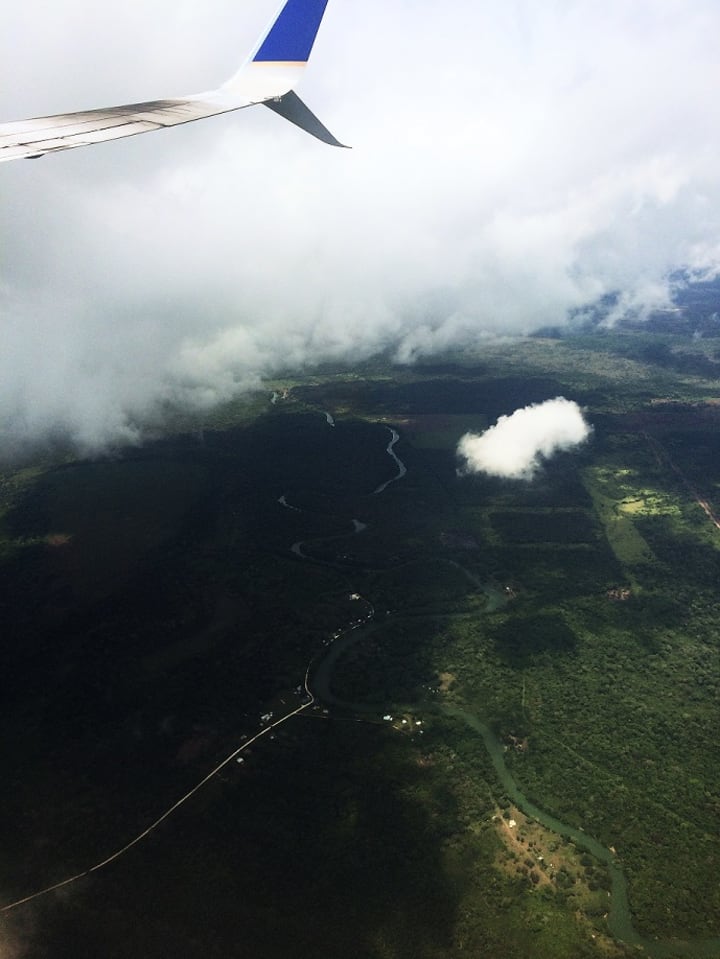
Before long, we began our descent through the sky. I buckled my seat belt and stared out the window I had been so lucky to sit beside. Takeoff and descent were often the parts of a plane ride people said they disliked the most. The jostling of the plane leaving and hitting the ground made them nervous, but it was my favorite part. It marked the leaving behind of who you were, and the arrival for who you would become, if only for that designated trip. I had my camera phone in hand, ready to document the event of my first expedition outside of the country. The clouds dispersed, parting for our plane like the curtain at a theater, and the thick, green, twisting jungle of Belize appeared below me.
Welcome
Our trip was meticulously planned. We had multiple sites to visit each day in order to fit basically the whole country in for the time we had there, so it was only logical that we began in the capital: Belize City.
The hotel we stayed at was ritzy and tourism centered. Connected was a gift shop, a hotel bar, and a homely restaurant on the water with American food that accepted American money. It was everything a foreigner could want when being welcomed into a new country. However, when we left for dinner, we left the comfort and familiarity of our own culture for something unflinchingly Belizean.
The cobblestone streets were thin and crowded, a sardine can of people and vehicles. Everything was unusually loud, too bright, too hot. The smell of sea air was sharp and inviting, and spices wafted out of open doors. I was overwhelmed not only by the sudden displacement into brightly colored rooftops and the seemingly constant friendly shouting at people from one side of the road to the other, but also by the sense of community that seeped out of the spaces between stones.
In Belize City, there was laughter, generosity, artistry and infinite invitation. There was pride in who they were and what they offered the world. Herbie, our tour guide for the trip, pointed out every other building and gave us a fact about it, how long it had been there, what its function was within their society, or what it meant to them. I expected him to be knowledgeable of the area since he lived here and this was his job, but he spoke of each place like he never tired of it. Belize was not only his home but his heart, and he was thrilled to share it with us.
Even our dinner, a humble but generous spread of black beans and rice, chicken, and spicy coleslaw, was rich with welcome and friendliness. Though my picky palette prevented me from fully enjoying the meal, I was struck by the care our cook and host had put into the dinner. Our experience with her home and business surrounded me like a cool breeze, filing down my anxious edges, loosening my fist around my fork. For the first time since landing, I felt relaxed, and suddenly, exhaustion weaved through my entire body. She put me at such ease with being in Belize that I was ready to fall asleep at her table.
Luckily, I caught a second wind on the way back to our hotel. My classmates and I stayed up another hour or so, discussing our initial impressions of Belize over a couple drinks before, one-by-one, yawning and begging off to bed.
I crawled under the covers, my roommate already asleep in the bed beside me, AC blasting as low as possible. Purposefully, I had brought a small, blank booklet with me to chronicle my experience here. Sleep yanked at my eyelids, but I forced them open long enough to write a few sentences down. I had always been aware of how much more there was to the world, I had just never been a part of it. Belize had already opened my eyes to the minutiae of my life.
“My world just got a whole lot bigger,” I wrote, before closing the book and setting it aside. I had only moments to wonder how much bigger that awareness would become, before I finally fell asleep.

A Crash Course in Culture
Our tightly packed events list led us all over the country, from ruins sites to schools and wildlife reserves, from the zoo to the white, sandy beaches of Ambergris Caye. But one thing that followed us no matter where we went, was the heat.
Before leaving the country, we were told repeatedly that the heat in Belize was dangerous. That was the word used. Our teachers always drilled into us the importance of staying hydrated and carrying at least two water bottles, even if our journey was a short one. No matter how much I heard about, and prepared for, its intensity, the heat and humidity in Belize was a shock to my system. Every time I walked outside, it was like someone had covered my face with a soaked, steaming hot cloth.
Despite the heat and my clockwork applications of sunscreen to my pale skin, I often clothed in several layers, sweating through them before an hour had passed. But it was better to be safe than sorry, so I withstood the discomfort and stuffed my fanny-pack with an extra frozen water bottle. Just in case.
We were rarely on the bus for a long time, but our driver always made sure to stop by the street vendors so we could purchase coconut water, bread rolls, plantain chips and various, sun-warmed fruits. Sweet juice dripped from our chins as we traveled to our destinations, testing our strength and endurance with multiple hikes and climbs to the remote locations we sought.
I stuck close by the side of my good friends Hunter and Mike, already big travelers and used to the strain they would be putting themselves through. I had taken much of their advice when it came to packing, but I also tended to follow their lead when it came to the solo excursions we had later in the trip. I trusted their past experiences, and the knowledge my friends gained from them, to help me on my first international journey.
Repeatedly, I was reminded of the differences between my home and Belize. Back in Texas, it was becoming clear to me that I took my state much for granted. I stayed home all the time as my hobbies and interests were largely solitary. I often bemoaned my city, its lack of greenery and destruction of blackberry bushes precious to my childhood. I wanted little to do with my home, and I was constantly looking for the fastest way out.
But in Belize, there was such a deep love and respect for their country and everything it inhabited, that it staggered me. A simple river boat ride revealed different varieties of birds, bats, flowers and vines even as we flew past them, all listed by name. There were the native Spider Monkeys and Black Howler Monkeys that groomed each other in the shade of trees. Giant yellow vines that bunched together and curled around branches were likened to snakes, as they bore a striking resemblance to enormous banana pythons. There were trees with a colossal base, hollowed out by the strangling love vines that siphoned off all nutrients from the tree until it was a twisting shell of bark.
In the ocean, each crucial part of the reef was pointed out and it's benefits to the ecosystem were detailed. Gulls were teased, nurse sharks and sting rays were tickled as we swam in the swarm. At the zoo, a handful of us were allowed to interact with Junior Buddy, the jaguar. I was among this group, and as I sat in a tiny cage that resembled chicken wire in its sturdiness, the handler had the big cat rolling and doing summersaults in the dirt for raw chicken scraps, a purr so loud I swore I felt the ground vibrate under my feet. Herbie had a story for every animal we stopped at, pride for his country and what it was teaching us dripping from every word. It was bright joy and constant adventure. Belize surprised me at every turn. There was always something to cherish and marvel over, and I felt truly put in my place.
For somewhere like Belize to survive, that love of their country had to be seamlessly turned into a tourist enterprise. I understood that our tour guides, the street vendors we bought refreshments from, the merchants selling handcrafted jewelry and art lived and breathed the beauty of their home, and turned it into a profit without losing the shine of that love. It was why I didn't mind paying fifteen dollars for a hand-carved jade jaguar the size of my middle finger. I understood that, for some, this was the only way they made their living
Quickly, I was learning that this was not a country where tourists were looked down upon, but their presence was encouraged and celebrated. Tourists and Belizeans made the economic ecosystem go ‘round. I began to wonder how I could apply their enthusiasm for their home, to me and mine.
I would often lay in bed at night, grateful for the internet access that let me message my parents and tell them the amazing things I had done, send them short videos and countless pictures of ruins sites, Junior Buddy’s massive paws above my hands, and the pictures I had taken with my friends. I missed my family, but when they asked if I was ready to come home, my answer was always “almost.” There was more that Belize could teach me than just about appreciating my surroundings. Belize also taught me so much about myself and my capabilities—something else I had often taken for granted back home.

Risk and Reward
Our first excursion was to the Lamanai Ruins, a series of five structures, each with its own name. Collectively, it meant “submerged crocodile,” a little nod to the native animals of the river that ran alongside the site. The size of the first structure, the Mask Temple, lulled me into a false sense of security that climbing these ruins wouldn’t be nearly as bad as my teachers and our tour guides warned us. The Mask Temple was nothing more than a quick scramble up the steps of the face.
And then we reached the High Temple. It stopped me in my tracks. I was expected to climb this? For the first time I thought, “this could be a problem for me.” It was at least three times the size of its sister, the Mask Temple. Again, it had steps travelling all the way to the top from the center of the structure, but it’s face was too steep for us to safely climb. A wooden staircase had been built that wrapped around the side of the Temple and led straight to the top.
I was already tired and hot from our hike and the first climb, though not exhausted yet. While the rest of my class began the trek up the wooden stairs, I stayed at the base in the shade, drinking more water and cooling off, trying to convince myself it wasn't that much taller. I could do this. Probably.
An image flitted through my head of being looked down upon for struggling to climb a staircase, and it tingled along my skin painfully enough to propel me from the bench.
Halfway up the stairs, I was realizing there were a lot more than I could have seen from the bottom. I was already gripping the wooden railing, uncaring of the splinters I could get, as I dragged myself up each step with wheezing breaths. My lungs were burning when I made it to the top, and I was grateful for the privacy being last gave me.
My classmates, however, didn't seem to notice my being out of breath, only greeted me with excitement and turned me around to view the river we had traveled upon to reach this place.
I had always been the butt of short jokes with my 5’1” frame, but being above the tops of those ridiculously tall trees was an indescribable feeling. Standing at the base, the structure had seemed intimidating, imposing, even, but this view was well worth the strain in my legs. I could see 20 miles in every direction. The horizon stretched out before me like a sweeping cinematic view. A strong breeze tugged at my braid and my hat, the first we’d had since entering the jungle, now that we were above the thick shield of the trees. I closed my eyes, exhaled, and vowed to remember the fullness that I felt, the sensation of being marked by what I saw.
When we had returned to the bus and were headed back to Belize City, our teachers asked each one of us what we had felt standing at the top of the High Temple. I pondered over my answer, wondering how to describe what I had experienced. “Awe,” I finally said when it was my turn, “of the Biblical variety.” My teachers and classmates nodded along with me with serious faces. On some level, we had all sensed a spiritual movement on top of that Temple.
This trip was doing something to me. I could feel it, but I could not name it. Part of me likened the entire trip to an evaluation test of some sort, where I would be tried and my outcome judged. Every day in Belize was one more test, the hardest of which were physical.
I had originally thought that the more active sites of the trip would be the ruins only, but even on a day where ziplining and floating on a river was planned, getting to those locations took effort.
My feet were already sore and felt bruised from the climbs at Lamanai, but in order to participate in our ziplining adventure, it required climbing a thin, steep series of staircases that wound up through the trees, or were knocked out of the side of hills that rose beside us until we got to the next wooden staircase. It looked and felt never-ending.
My fitness insecurities (and the staircases themselves) made it difficult for me to allow others to pass me by so I could bring up the rear. We were already in an established line, connected to each other by thick cords, belt to belt to belt. It was impossible for me to labor my way to the top in privacy, which made the experience all the worse. My heart pounded in my throat, my lungs burned with effort as I, literally, dragged myself up each step. I was embarrassed by the encouragement of my classmates rather than strengthened, terrified to show myself as weak or vulnerable—unable to do something as mundane as climb a staircase. For just that moment, I regretted coming to Belize. It seemed like a military bootcamp, one challenge right after the last with seemingly no end in sight. I didn’t recall signing up for this when I scrawled my signature across the waiver.
This was a test I was doomed to fail, as I had every other fitness evaluation in my life. I had never done well in gym, always had some of the slowest mile times. College was a welcome reprieve from the mandatory exercise that grade school exhibited. Physical courses were not required of me in my chosen major and I hadn’t planned on taking any.
I passed several more steps counting all the ways in which college had under-prepared me for something like this. Counting all the ways in which I was deficient.
There was a platform coming up with a water jug and thin, paper cups in a cone. My shins were burning; it was difficult to lift my legs, as if I carried weights upon my knees and no matter how loud my mind shouted at me to go faster, to keep up with the others, I had to slow down or I knew I would fall. Finally, I stepped onto the platform and immediately went to the water. I must have drunk five or six cups before my friend, Brandon, yanked the empty paper cone from my hand.
“You need to slow down,” he advised. “If you drink too much, too fast, you’ll throw up.”
I was embarrassed, but what else could I do but nod in assent? It felt like I hadn’t had a drink all day, my throat dry and parched from gasping for breath. After a moment, he nodded, satisfied with the time I had waited, filled the cup for me, and gave me a strong pat on the back. Like he would do for anyone struggling. I don’t know why I kept expecting people to look down on me because I wasn’t at their fitness level, didn’t have their strength or stamina. I don’t know why I expected it from my friends. Like this country, they kept surprising me.
No less achy, but with my breath under control again, I turned away from the water jug. There was one last short staircase, maybe seven steps, but my shins ached at the thought of lifting once more. Hunter reached for me in the line and squeezed my shoulder. “It’s just a few steps. You can do this.”
My feet fell heavy and awkward, like a toddler that was still grasping the wobbly concept of being on two legs, as I forced myself to climb. It was only a few more steps, but Hunter still waited for me at the top, reached for my hand, and helped me finish without using the railing, pulling me up beside her on the final platform.
Relief filled me like a balloon as I leaned against the railing and caught my breath once more. Funny, how fast it had left me even after so few stairs. I gazed out over the railing at the tall, thin trees well suited to the platforms necessary for ziplining. There was a creek-bed below us, shallow and clear. I imagined it was nice and cool, constantly burbling along the stones. We were so high up, higher even than the High Temple at Lamanai.
As every person in front of me took their turn, my excitement grew. Again, I had forgotten all about how hard it had been to get to this point and found myself enjoying the experience of being in the trees. Anticipation filled me as I jumped to be hooked to the cord. My harness dug into my waist; I was a little short, but our guide lifted me, asked if I was ready.
“I’m ready,” I said, grinning, and he told me to give a good kick off the platform.
There was nothing like this in the world. I had heard about ziplining from friends who had gone, but the descriptions had been cursory. “You’ll like it,” they would say. “It’s pretty fun!” They seemed inadequate compared to such a freeing sensation. Weightless. Peaceful.
When I was child, my favorite book series was called Animorphs. It featured this group of kids that were gifted the power to morph into any animal for a limit of two hours, otherwise they would be stuck and unable to return to their human form. One of these kids, my favorite character, became stuck in the morph of a red-tailed hawk. For years, I was obsessed with this animal, learning everything about them and wanting desperately to see one in real life. Any time someone asked me what my favorite animal was, there was no hesitation in my answer. There had been so many rich descriptions in the book of this character coming to terms with his new hawk identity, creating a home for himself in the forest, riding the warm thermals.
It was the last thought that intrigued me the most. The idea of being a bird haunted my thoughts every day. In my dreams I sprouted wings, long, thick, tawny feathers, but my human body was too heavy for them to support. I drew birds in the margins of my homework, researched the anatomy of feathers. But no matter how vivid my imagination was, or how powerful the passages of what being a bird was like in the books, there was no way for me to truly know.
Not until the moment I shoved off from that platform 70 feet above the forest floor and took flight. If they hadn’t told me to keep one gloved hand on the line, if they hadn’t told me to pay attention, I would have spread my arms and closed my eyes.
I knew, right then, that was as close as I would ever get to being a bird.
Delight and adrenaline filled me as, again, and again I became a bird. I watched the trees pass me by in a blur, 30 miles an hour on nothing but a single line. The air was warm and carried me easily from platform to platform. Wind caught my shirt and it billowed behind me like a tail spread out to slow my speed. It was beyond description.
Even hours later, back in our hotel after dinner, I was still at a loss for words. Ziplining had been such a giddy and rewarding experience for how hard I'd had to work to do it at all. Despite the pain in my feet, magical tingles, understanding and love for that old character and that old series, floated in my body the entire evening. When asked what I thought about the experience, all I could say was that I felt like I knew what being a bird meant, now. The answer may not have made sense to my classmates, but it held a special importance for me.
Yet, I knew there was one more Herculean feat for me to accomplish in San Ignacio, and I hoped, one more reward: We still needed to visit Mount Xunantunich.

My Own Worst Enemy
San Ignacio was a damp city, but then again, Belize was a damp country. The air and heat remained unmoving, unchanged even from our hotel at the top of a hill. At night, myself and the two other girls in my room would sleep with the window open to a view of endless treetops and stars. We slept on top of the covers, air conditioning blowing more like a fan distributing hot air than cooling us off. We were tired from endless hiking and the climbing of many, many stairs, but it was a happy kind of exhaustion. Whispers filled our room at night about what our last ruin site would offer us.
I had oiled and massaged lotion into my puffy feet the night before, but when I woke up the next morning, they were in just as much pain. I laid in bed with my feet against the wall, elevated, like my mom said would always help the swelling in them to improve. Yet, just walking to the bathroom convinced me that I would not be able to climb the structure, and I resigned myself to staying at the base of Mount Xunantunich. I’d already told my teachers about my pain, shown them my feet and how they barely fit into my athletic shoes. They had almost doubled in size, and I received pats on the back, “you poor thing”s, and a grudging okay to not climb with the rest of the students.
The animated bus ride did nothing to lift my spirits. We clambered off the bus and walked a steep incline to the base of the structure. There were other Belizeans and tourists there, but our group stayed together like a school of fish, as Herbie introduced us to another tour guide, one who specifically worked the site of Xunantunich. He spoke with heavily accented English, and his obvious excitement to share the history of this place with us made him even harder to understand. Not that I was paying attention, anyway. I was preoccupied with the sheer size of the mountain before me.
“Stone Lady,” they called her. “Maiden of the Rock.” It was a fitting name as she was both elegant and formidable. Our tour guide dated her back to 650 A.D. even though it was in the last two centuries that she had slowly been uncovered by excavators. They carefully unearthed the stairs and friezes—Mayan hieroglyphs—etched into her sides like tattoos and removed dangerous obstacles so that people could experience her for themselves. She was a lasting piece of history that, as I later learned, was created by hand. Or by the gods, if you believed Mayan myths. I couldn’t take my eyes off her.
It was afternoon, so the sun was at its zenith, yet the structure was so tall that if I stood in the right spot, it blocked the sun, leaving Xunantunich incredibly backlit like something out of a dramatic tapestry. I wanted to step forward, lay hands on her and see if I could feel the history, but with that intention came another spear of pain through my feet.
The other students began filing behind the guide who would lead them to the top. Some of them asked me why I wasn’t going, and I reiterated the story of my feet, shortening it with every inquiry. There were more sympathetic nods and waves goodbye as I watched them turn away from me.
Then, my friend Hunter approached. She had seen how much I had struggled on this trip already, seen my swollen feet, heard my embarrassing wheezing. She had pulled me up the lasts few steps for ziplining. Now, she put her hand on my shoulder.
“If you don’t do this, you will regret it.”
I bristled a bit, thinking I had already done so much. You climb one ruin you’ve climbed them all, right? I smiled at her but brushed aside her words, thinking it really wasn’t that big of a deal to miss out on this. Lamanai had been cool, and being that tall was fun, but I wasn’t worried about doing it again. It was almost as if I had forgotten the way I described Lamanai’s influence to my classmates: Awe of the biblical variety. It was almost as if I had forgotten my longing to be a part of Xunantunich only moments ago. Hunter frowned at me but left me at the base while my classmates began the climb.
I stood before a stone stairway, alone and frustrated at myself for not being strong enough to scale a mountain like this for the third time inside a week. I was well equipped to discuss myths and cultural significance in relation to this country. I could talk someone’s ear off about the importance of preserving its’ ancient sites. Literature was what I was good at; it was why I had chosen the literary class to take. I felt qualified for everything expected of me on this journey except for this.
Somewhere inside my heart, I felt cheated. Why should I be the only one so obviously struggling? I shifted my weight, trying to see if there was any relief at all. There wasn’t. It was as if my feet had been cut and I was standing on sharp rocks without the protection of shoes. Nothing about my situation told me I could climb this mountain, and I blinked back tears that told me I was a failure.
When I was younger, I would often hear my mother say “the enemy” was holding her back, as if she were fighting against an invisible force that kept her from reaching her goals, regardless of what they were. “The enemy” was everywhere and in everything. It kept her in bed all day, it made her sick, it made her late to everything, and she cast it out in her prayers nightly until her goal was accomplished. Until she was up. Until she was well. Until she was on time. It was something I had rolled my eyes at, as I so often did with her prayers and her religion even when, after years, I saw results.
I didn’t always think it was because the enemy was gone, I just thought it was because she had made the decision to change for the betterment of herself. That wasn’t something that had to be prayed about, it just had to be done, like taking medicine, like setting a bone, like apologizing.
Like climbing a mountain.
I startled at the words that I had very, very clearly heard even though I was standing alone. All at once it struck me that the enemy was not always an outside force that acted upon my mother. Often, the enemy was herself. That day, at the base of Mount Xunantunich, I realized the enemy was finally upon me. My words came crashing back into my skull.
You’re not strong enough. You can’t do it. You’re in too much pain. It’s just like any other mountain, what’s the point? You’re a failure.
I hated that voice. It offended me, because I knew it wasn’t true. Other phrases from earlier bombarded me in a different light. I knew I was capable, and I could work through the pain, because I had already done it three times before. I knew this wasn’t just any other mountain, because standing at the base had already been an experience unlike anything else. And I knew that, despite my aching feet and the fact that I was so far behind my classmates, I needed to climb this mountain.
I winced with every step, but I kept taking them. I used my hands to pull me up whether by rope railing, or by rocking outcropping. The trail my classmates took to the top was easily recognizable and I followed their progress, crawling up the steep stone stairs when standing was too difficult. When I didn’t think I could breathe anymore, or make it any farther, I kept going. I pushed myself harder than I ever had before, the burning in my lungs echoing the burning in my heart to make it to the top. It was harder than Lamanai, harder than the stairs for ziplining. My entire body was in pain now, not just my feet.
El Castillo was the tallest structure of Mount Xunantunich, 130 feet tall on its own. When I dragged myself up the final step, one of my teachers grabbed my arm and leaned me up against a boulder that sat at the top. She pushed water into my hand, encouraged taking small sips so I wouldn’t choke, and instructed me to breathe slowly. After a moment, I felt able to stand, and pushed myself to my feet with palms that were scraped raw with the climb.
“Good job,” she said, and I grinned wearily at her.
Using my hand to steady myself, I circled the boulder I had sat against to finally see what I had fought so hard for. My breath that was coming so rough from the journey up was stolen away. I had dragged myself up a structure not made for an easy trek, my sweat salting the stone beneath me. Here, at the top of Mount Xunantunich with the ground 12 stories below me, there was silence. There was reverence. Again, tears sprang to my eyes as I looked around, and this time it was not because my feet were stinging and aching. I sat on the edge and dangled the sore appendages over the side, let the warm air play with the hair on the nape of my neck, curled with sweat.
I had grown up in a church environment, thanks to my parents. I knew what worship sounded like; I had witnessed the movement of Christ in a building even if I hadn’t felt it for myself. It was a sensation I didn’t know if I would ever feel, but I could recognize it moving around me. There was nothing that made me believe others were experiencing what I was, but until that moment, I had never known what holiness felt like.
After climbing several ruins sites and finally being taller than I’d ever been, you’d think I’d have gotten used to the stretched-out horizon. I could see the borders of Guatemala and Mexico, the land spread out before me in a sea of green and brown and gold. The people still milling about at the base of the mountain were like tiny ants and the sun covered everything. I wondered how people who came to this place ever left. I didn’t think I would ever have been able to get used to it.
I found peace and wonder at the top of El Castillo. Something inside me shifted and made room for the realization that I wasn’t just here to see ruins or experience a culture different than my own. The majesty spread out before me was teaching me a new lesson; that these structures were built by hand though I had no idea how. That there was devotion in this country—a kind of devotion I knew little about. The kind of genuine adoration that had a hand in creating and preserving these structures, these experiences. The mountain spoke to me that day, saying even though I was so small, tiny as the ant-people below me, I could one day accomplish something like this. If someone, centuries before me, was strong enough to build this place, then I was strong enough to climb it. One day, I would build something for myself and find a purpose through that devotion.
For the few minutes I sat upon that structure, I felt like I was living up to what my mom had told me throughout my life: That I was meant for something greater. Xunantunich made me so small, but also made me realize that by even going on this trip, by opening myself up to these new experiences and forcing myself through discomfort, I was doing something bigger with my life… Something important.
We made our way carefully down the way we had come, maintaining the quiet respect felt at the top of the mountain. I found Hunter at the base and smiled at her, authentically this time.
“You were right,” I said. “I would have regretted not going.” She didn’t have to respond, she simply took my hand and squeezed it before walking away.
We boarded the bus after sincere thanks to our tour guide for the day, and Herbie didn’t regale us with new colloquialisms to quiz us on. He left us in our state of reflection while we rode to our next location. I felt disconnected on the bus, like my spirit was still anchored to the ruins. Awestruck and distracted by the occurrence, I thought that if Xunantunich had been the only item on our itinerary for this trip, it still would have been worth it to go. I knew I had been changed by the mountain, as if my identity had shifted with its new realizations and new capabilities. A weakness, an enemy had been left behind at the base, and a new strength found at the top of the mountain.
I folded my sore feet under me as we bumped along the road. The pain held a new significance for me. It was as if part of me had been chiseled out like the ancient friezes, sharing with the world the makeup of myself, and it didn’t include embarrassment at my poor physical fitness, but a perseverance and ability to work through the pain. A trait, I told myself, that made me like the mountain: A “Stone Lady,” a “Maiden of the Rock.”

Returning Home, Changed
Belize was stimulating. Food I struggled to eat, drinking more water in a week than I’d probably had all year, and more exercise than I knew I’d get was broken up by intellectual conversations of culture, new experiences, debates centered around literature, story-telling, and philosophy. Everything we discussed on bus rides, during dinner, or late at night in our hotel rooms was punctuated by a driving force of understanding. We wanted to learn the colloquialisms of our tour guide. We wanted to see the machinations of education in Belize. We wanted to stand upon the ruins that we learned about in class, breathing in a new culture and a new appreciation for life.
I often remember my time in Belize as one of the hardest and most rewarding things I’ve ever done. On the day we left and said goodbye to the tour guide we had made our friend, we turned our thoughts inward, asking ourselves those questions our teachers wanted us to reflect on. Who were we before we left on our trip? Were we the same person returning home? What experiences influenced us? These answers would play a part in our final presentation two weeks away but were not a necessary factor. For me, they were the entirety of the trip, the reason I had come, and part of the reason why I was reluctant to leave Belize.
Just before we landed back in America, the flight attendants handed out a customs pamphlet requesting we list everything we were taking home from Belize. I checked boxes for little gifts I had bought for friends, the tiny, jade jaguar, a necklace that had my birth month written in Mayan. I read over the list several times and mentally unpacked to make sure I was filling it out properly, but there was no box that suggested the something new that I brought to my home country would be myself. Where was the box asking what pieces of myself I left behind? Where was the box I could check that brought perseverance and strength home with me?
In my heart, I had always known I was a world-traveler, even if my only traveling had happened between the covers of a book so far. I knew my time would come. Belize was the first step. This country initiated me into a craving for experience and understanding, for the desire to see myself shaped and influenced by my surroundings in more than just where I was raised or where I went to school.
The hardest parts of my trip, physically, had instantly been followed by the most rewarding. I wondered what my life would be like if I had not gone on this trip, if I had stayed home and waited to hear about it from the friends that went without me.
I realized I would have been missing a part of myself that I now considered extremely important. I carried an empathy with me, a new respect for my surroundings, an awareness of my connection with my past and with my location. Belize was an irreplaceable experience that taught me as much about myself as it taught me about the country: A country that loved tourism for what it contributed to their society, a country that considered everyone family, a country that encouraged pushing limits, conquering fears, displacing doubts. It was a journey that changed me—a journey that rebuilt me, and when I brought back myself, I was stronger than I was before.
About the Creator
M.G. Sprinkle
Aspiring author, killer of houseplants.
Keep reading
More stories from M.G. Sprinkle and writers in Wander and other communities.
The Weight of Grief
“An oxygen mask will automatically appear in front of you. Place the mask firmly over your nose and mouth…” I had one headphone in, my face turned to look out the window while the flight attendant continued, “…secure the elastic band behind your head…” and breathe normally, I thought along with her. “If you are traveling with a child or someone who requires assistance, secure your mask on first, and then assist the other person.”
By M.G. Sprinkle7 years ago in Families


Comments
There are no comments for this story
Be the first to respond and start the conversation.