
Bhutan is Not My Hometown
How Garry Davis inspired me to expand my horizons and be a liberal.
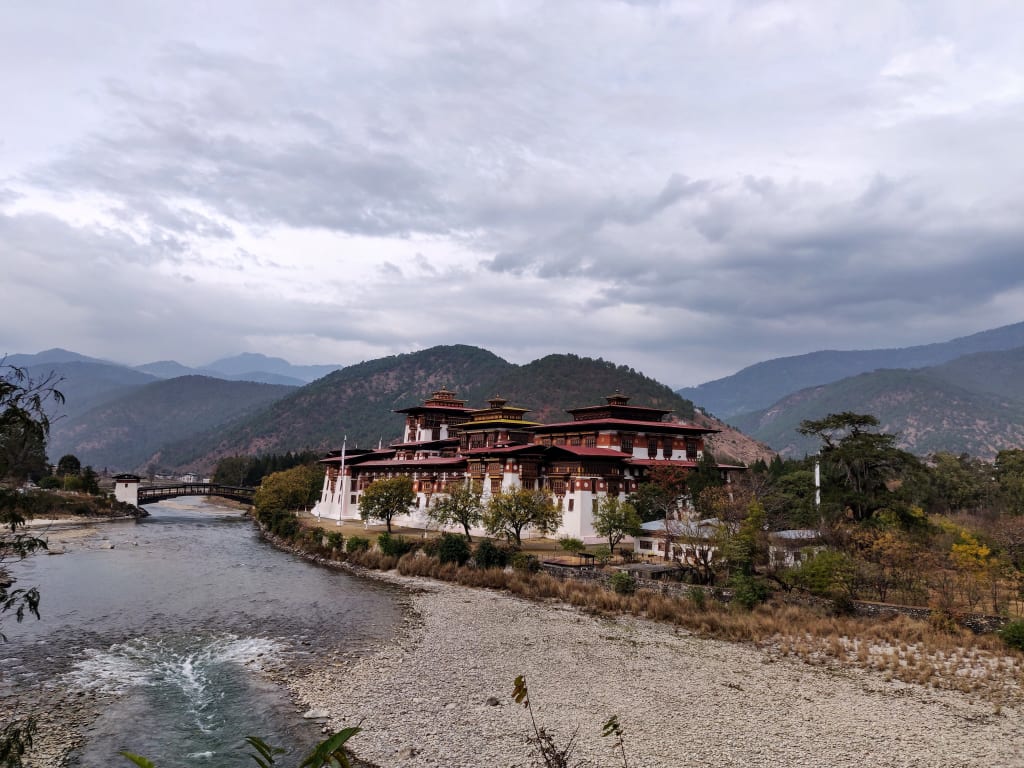
First, let me put it out front that I'm not from Bhutan. I'm from India. Though I love my country very much, I had a strong urge to document my experiences with Bhutan for the hometown feature. But Bhutan is not my hometown. You can seldom call a country you visited for ten days a hometown. But I can, and I will. Garry Davis paved the way for that. Let me explain.
Who is Garry Davis?
Garry Davis was a rare kind of person who dreamt of one world, one country. Have you heard of world citizenship? It means that you don't belong to one country but the world. You no longer hold a passport for a single nation but the world, and you can freely visit more than 180 countries. I first heard of him in one of my favorite books, Aram. There was a separate chapter dedicated to his struggles of making his fantasy a reality. The idea was so fresh that only a dreamer could conceive it. Garry Davis was a dreamer, and he made me not constrain myself with borders across landscapes. His vision inspired me to think of the world as my hometown.
The World is My Oyster:
Garry Davis is only a modern daydreamer who brought the time-old idea to reality. The proposal of 'one world' dates back to the period of Rigveda(1700-1000 BCE). Vasudhaiva Kutumbakam is a Sanskrit phrase found in Rigveda which means 'The world is one family'; A similar notion also appears in the Tamil text Purananuru written by the famous Tamil poet Kaniyan Pungundranar. He wrote the famous quote 'Yaadhum Oore Yaavarum Kelir' meaning, 'All towns are our own; Everyone is our kin'. It is my personal favorite since my childhood because, every time I'm bound with the idea of my people and my culture, I remind myself that 'Yaadhum Oore Yavarum Kelir'. It breaks the shackles in my mind and allows me to have a broad-minded perspective. The world will see fewer wars if we all consider the world as one country and the people as our kin.
With Garry Davis, Rigveda, and Kaniyan Pungundranar as my inspirations, I now present to you one of the Himalayan countries - Bhutan.
Why Bhutan?
- It is called the happiest place on Earth. They measure their economy through GNH(Gross National Happiness) instead of GDP(Gross Domestic Product), unlike many other countries. GNH takes into account protecting the environment and measuring the well-being of people.
- It is the only carbon-negative country in the world. 72% of the land area is covered in forest, and there is a connectivity of forests across the country.
- Their King - Bhutan's king is one of the humblest royals in the world. He is a champion of environmental preservation and the well-being of the country's people. Though he is a king, he is one of the noblest and most modest humans one can encounter. His love for nature is visible from the policies he brings to fruition. Here's a picture of the King chopping onions for a community school in Bhutan. While most of such photos we see on the Internet are for publicity, this one is not. Of all the royals in the world, he earns my utmost respect.
- Finally, since it is under-represented here (The total population is only ~763,000), I want the readers to get a taste of Bhutan before planning to visit there.
It has been my lifelong desire to travel to Bhutan at least once, which is why I chose it as my travel destination for my 1st wedding anniversary. I wanted to experience a country that is not in a race with the other countries in terms of economy and growth but defines its success in its terms through environmental preservation. We can all learn a few lessons from this small Himalayan country and implement the necessary measures in our countries.
So, fasten your seat belts, come travel with me as I take you through the picturesque landscapes of Bhutan.
The Tour:
Phuentsholing - The Indo-Bhutan Gate
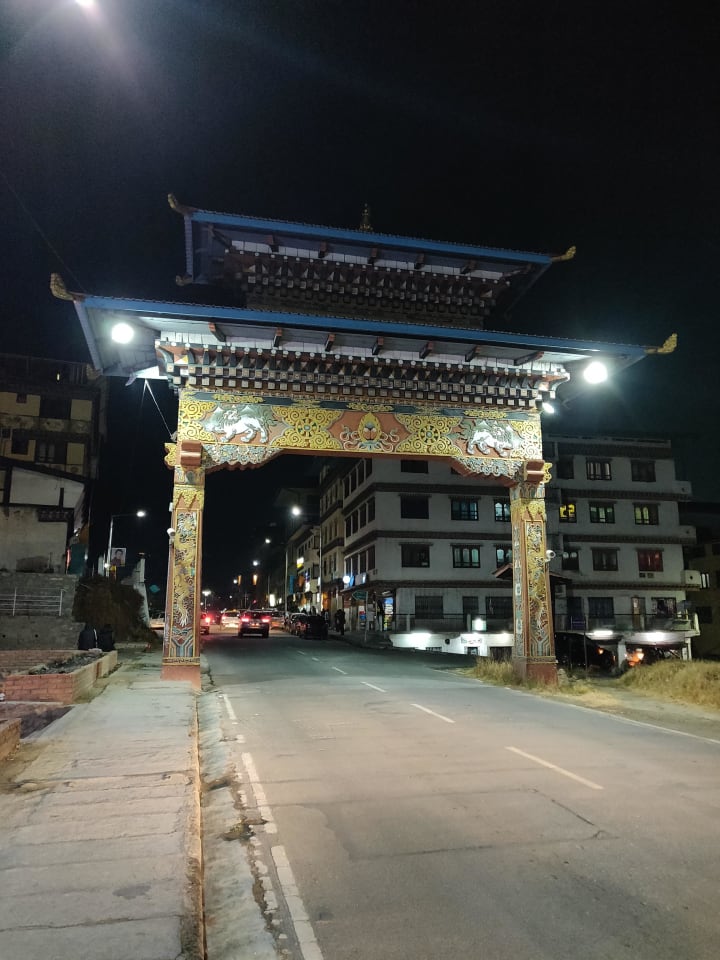
Do you see the gate that is different from the others? The one with beautiful wood painting and Bhutanese-style architecture? Yes. We've reached the entry point to Bhutan. We're now in Phuentsholing. Take your passport. We're going to make a small stop at the immigration office before proceeding into Bhutan. It will not take much time.

The immigration process was quick. Now, proceeding onwards with the journey. We're on the way to Thimphu, the capital of Bhutan. But before that, since you haven't had anything to eat, let me take you to a nice hotel, and you can try the Thukpa. Put on thermal wear and sweater. The weather is cold here compared to Phuentsholing as we are going up the altitude. A piping hot tea along with the Thukpa will do you good.

Thukpa tasted more like ramen, isn't it? I thought you would say that. Since it is chilly outside, Thukpa tastes more divine than usual. It brings back the much-needed warmth. On the way to Thimphu, you can see that we're going higher up the altitude following the hairpin bends. We pass the seven stupas and several waterfall streams on the way. There is also the Wangchu river running below. Don't lean from the window if you're afraid of heights. You might get dizzy. We've almost reached Thimphu. In front of us, you can see the crossroads. The one straight ahead leads us to Thimphu, and the one on the left takes us to Paro, which is home to the famous Tiger's Nest. We will go there shortly. Now we enter Thimphu, the capital city of Bhutan.
Thimphu - The Capital City of Bhutan
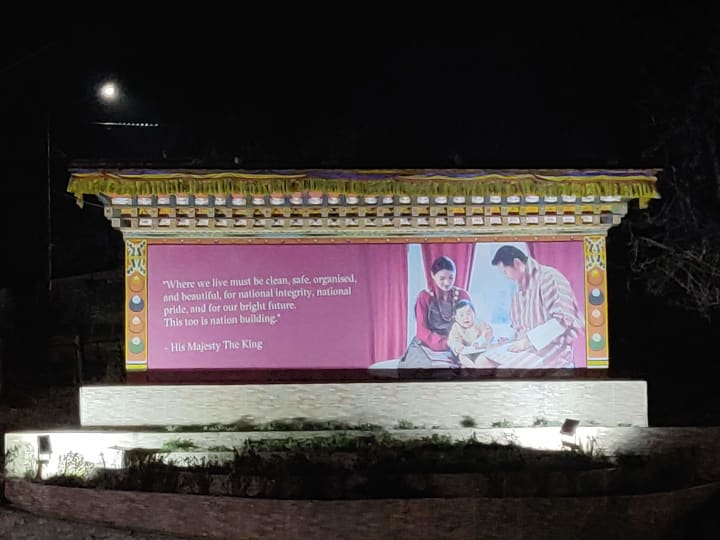
You might have noticed the below image in many places. It is an old folktale of Bhutan and is called Thuenpa Puen Zhi or 'The Four Harmonious Friends'; It represents co-operation and co-dependence among the four animals that live together. You can see this statue after entering Thimphu, along with a message from His Majesty.

Oh, yes. You are right. All the buildings look alike with intricate paintings and exquisite craftsmanship. All the constructions are planned in the same Bhutanese-style by the government to preserve and enrich the Bhutanese architecture.

We now enter the Norzin Lam, the most famous and busiest street in Bhutan. You will see all the cultural events happening near the clocktower. Since it is the month of February, and the King's birthday is around the corner, we can see a live musical show celebrating His Highness's birthday. It's been some time since we ate anything, so let's have Suja. Suja is a type of tea made with butter, milk, and salt. Have a sip of it. Yes, it tastes like milk soup. You can never get enough tea here as you need to bring back the warmth often.

Let's do some sightseeing in Thimphu now? While we're in the car, I'll put on some Bhutanese music to get a feel for it. (Unfortunately these songs are not available on Spotify, so I've included my Youtube playlist)
There, on our right, is the Memorial Chorten. It is a stupa constructed in memory of the third king.

You asked about the massive Buddha that we saw on entering Thimphu. We're en-route there. It is one of the mightiest Buddha statues in the world. Let's get down from the car and offer our prayers. Shall we? How peaceful the Buddha looks as He watches over Thimphu. It is an awe-inspiring sight. We have arrived at the right time as they are offering prayers inside the temple. Let's too take a moment and pray in silence.

Do you want a holistic Bhutan experience? Here is the place to be. You have reached the Simply Bhutan museum. Oh. They are offering their local wine, Ara. Hmm. It is sour, as intended. In fact, the sourer it is, the better. Take a look around, and you will see that it depicts Bhutan from the past. There is a model ancient house built with mud to withstand earthquakes. You know, farmers sang while they worked on the fields. The two lovely ladies in front of us depict that. The song has a nice ring to it. We also have a celebrity artist here. Meet Pema Tshering, the inspirational cerebral palsy foot artist. His artworks are a result of sheer hard work. Hey. I'm going to buy 'The Four Harmonious Friends' art as a souvenir. Are you? While you're buying, let me reserve a place for us for our traditional Bhutan meal. It has spinach soup, broccoli, boiled vegetables, rice, ema datchi, chili cheese, and noodles. And here is the live dance from the talented Bhutanese dancers. It is a feast for both eyes and mouth. Let me tell you. My belly is full of food as well as my soul is enriched with Bhutan culture.

Our next stop is Motithang Takin Preserve. Takin is the national animal of Bhutan. The general belief is that a Buddhist monk called 'The Divine Madman' created the takin. You will hear all about him when we go to Punakha. Oh. There's a takin running towards us. Hi, cutie-pie.

Finally, we reach the most awaited place to visit in Thimphu, The King's Residence. Don't expect to see an actual palace. Being the simple man he is, the current king lives in a small residence while the previous kings lived in a palace. There. Can you see it? No? Let me take a picture and show you, then you can see it for yourself. Yes. It is a modest residence. I thought you would say that. There is a reason why Bhutan's king is one of the most loved royals in the world.

Let's head back to Norzin Lam and buy some souvenirs from the handicrafts store. How about this cute little Buddha?

Are you enjoying the journey so far? Take some rest as we have to climb the Tiger's Nest in a little while. Don't worry about the climb, I can take you up in a jiffy. Hang on. We're now en-route to Paro to visit the Tiger's Nest.
Paro - The Tiger's Nest
You are now in the city of Paro. The river we just crossed is the Paro chhu. Chhu means river in Bhutanese. Let's park our car here and take the climb. Tiger's Nest is a Buddhist monastery dedicated to Guru Padmasambhava, who introduced Vajrayana Buddhism in Bhutan. The trek is easier at first and gets steeper as you climb. Huff and puff and take a deep breath. Look at the nature around us. Oh. Those small things? Those are stupas. You can also see the stacked stones everywhere. It is a religious practice followed by Buddhists. The stupas are a means of offering prayers, and stacked stones are a gesture of wishing for the well-being of the family. Let us also try to stack some stones and pray to Buddha while we're resting?

Ah! Those stacked stones we've made are balancing well. We can now see the temple from here. The view is breathtaking. It makes one wonder about the hurdles the builders went through to construct this architectural marvel. We will take a pause here to appreciate its beauty.


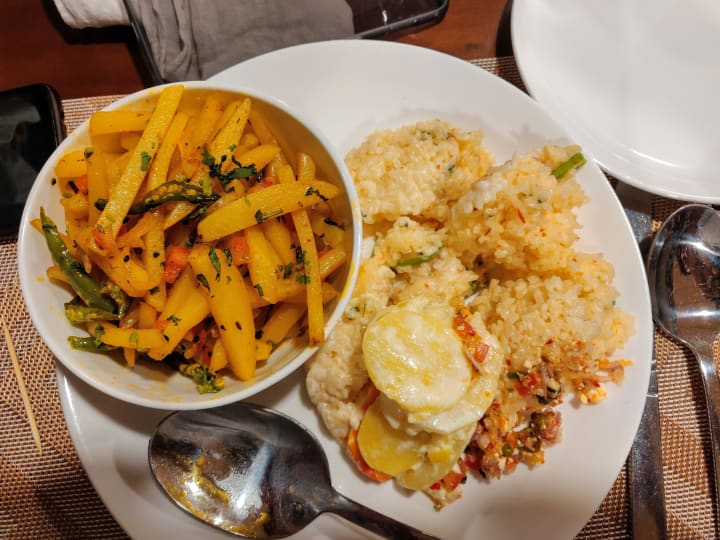
We're inside the shrine, and we can see the main deity Guru Padmasambhava. We'll pray in silence for a few moments and start the climb down. Hey. You are getting down at a much quicker pace than me. Wait for me, will you? Ah. We're at the ground level, finally. Are you hungry? Because I'm a little. Let us try a new Bhutanese meal. Shall we? I present to you, 'Ema Datsi Totse with Kewa Datsi and Ezay'; It is a combination of chili cheese, potato cheese, and rice. It is a bit spicy than I like but different. I guess I like it after the strenuous climb. Let us get on with our journey. Shall we?
You can see the Paro airport to your right. We will get down here and enjoy the scenic view. We're at a higher altitude, and you can see all of Paro from here. It is windy, so hold your cap. Oh. There's a flight taking off. Did you know that Paro airport is one of the top 10 dangerous airports in the world? You have to be a specially trained pilot to take off and land here. Whenever a VIP arrives by plane, the pilot does the test run to ensure that the landing and take-off are smooth. Phew! Glad we didn't come through a flight. Oh, who's this nibbling at our shoes?


Let's take a little walk here since the view is captivating. There. Look straight ahead, and you can see some locals playing Khuru. It is a long-distance dart game and is Bhutan's traditional sport.
There's one more town to cover on our tour before we conclude our trip. It is a town dedicated to phallus. Yes, you heard me right the first time. They even have a temple dedicated to it. You would see phallus everywhere from the moment you enter the town. Don't believe me? Get in the car and sit tight. We're now heading to Punakha.
Punakha - The town dedicated to Phallus
To reach Punakha, we've to go via the Dochula Pass. It seems like snowfall is coming. Yippee. I love snow. Are we in the winter wonderland? I kind of feel like we're in Narnia. Oops, the car is skidding as the roads are slippery. The cars ahead of ours are stopping. I guess, we have to stop for a while too. Do you want to get down? Me too. We are both in luck today because it is not every day you see the Dochula Pass covered in snow. It is a sight to behold, isn't it? I have some butter cookies with me. Do you want some?
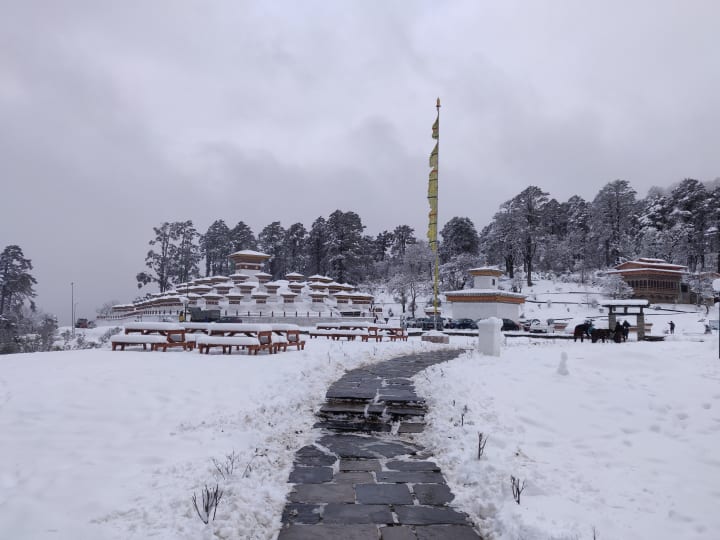
Ah. It feels cozy to be inside. You shouldn't have hit me with the snowball like that. I hope the Divine Madman punishes you. Who is he? That's what we're going to find out. All the phallus images in the town of Punakha are a symbol of his "Thundering Bolt of Wisdom"; Haha, don't hang your mouth open like that.
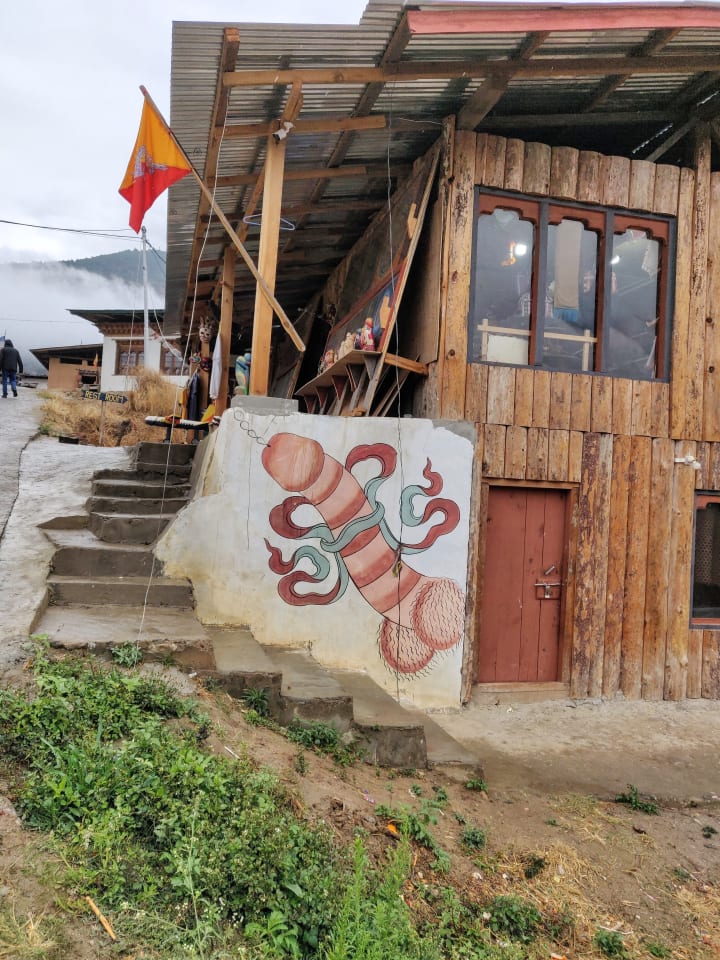
You told me I exaggerated when I said you would see phalluses everywhere. Now that you're seeing with your own eyes, what do you say? Yes. They've gotten very creative with the phallus-themed paintings on the walls. Look there. A violin-playing phallus. And another one playing tennis. Like I told you, it is dedicated to a Buddhist monk from the 16th century AD named Drukpa Kunley, who also goes by the name of 'The Divine Madman'; He famously provided the path to enlightenment through sexual intercourse with many women. He also established the Chimi Lhakhang, a temple in Punakha. There are many folk stories about his teaching methods and enlightenment path. Do give them a read when you can. And, if you're interested, you can buy a phallus as a souvenir. There's a sentence I never thought I would say.
We're concluding our virtual tour here. This is my first time as a tour guide. How did I do? I had a lot of fun talking to you and taking you through the experiences I had. If you get a chance to visit Bhutan, never miss it. The virtual tour might be all we can do at this time, but it doesn't even come close to the real deal. Bhutan is a rare country and a must-visit if you want to see for yourself that humans can co-exist with Nature and accept her for who she is. It reminds me of a quote I once read,
"Time spent in nature is time spent realizing that you don't know it all and that you never will".
If you liked the tour experience, give me your heart. It's free of cost.
About the Creator
vaisrinivasan
Writer of musings. Occasional traveller.
https://ko-fi.com/vaishnavi_scribbles
Keep reading
More stories from vaisrinivasan and writers in Wander and other communities.
How Bitcoin Saved and Ruined My Life
It is polite to introduce oneself before starting the conversation. But I'm afraid I will give out more information than intended. If I have to tell my name, it would have to be a fake one. But I don't want to keep adding to the lies. Not again. The information given here is accurate to the best of my knowledge without affecting Ollie or I. Ollie. My saviour and my guardian angel. Ollie is the reason I'm alive today. There are some times I wish I had not met him. But I'm digressing. This is the story of how Ollie and Bitcoin saved me only to tear my heart to pieces.
By vaisrinivasan5 years ago in The Chain
10 Reasons to Choose a Beach Villa with Private Pool
A beach holiday is about more than warm sand and gentle surf. When you choose a beach villa with a private pool, you unlock a level of comfort, privacy, and personalised experience that simply cannot be matched by standard hotel rooms. But what makes a private-pool villa genuinely worth it — beyond the glossy photos?
By Island Life Maldives6 days ago in Wander
Review of 'Man on the Run'
My wife and I saw Man on the Run, a nearly 2-hour documentary on Amazon Prime, about Wings, Paul McCartney's group that flew around the world from shortly after The Beatles broke up in early 1970 to shortly after John Lennon was murdered at the end of 1980, making a Beatles reunion forever impossible.
By Paul Levinson5 days ago in Beat



Comments
There are no comments for this story
Be the first to respond and start the conversation.