
Arvalem Caves and Waterfall: The Pandava Caves In Goa
Goa is known to be the housing relics of almost 300-year-old Portuguese architecture.
Goa is something more than that which is unknown to many people out there. This mesmerizing state is located on the Western Coast of India and is a damn perfect holiday destination. On the other side, Goa is known to be the housing relics of almost 300-year-old Portuguese architecture. The state is wholly filled with restaurants and mouth watering sea-foods.
It is a hundred per cent dream destination for nature lovers, history enthusiasts, adventure seekers and food lovers. But have you explored Arvalem Caves and Waterfalls in Goa? If not, then don’t worry, explore it with us.
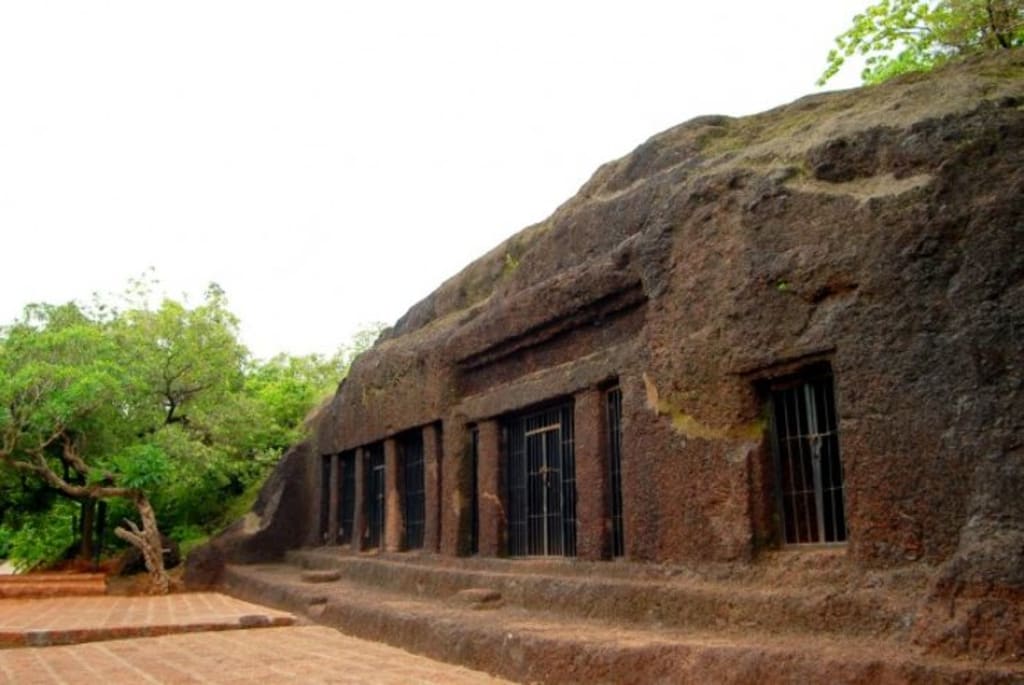
Arvalem caves have found its permanent place in the Sanquelim village in North Goa which is about 31 km from Panaji. The caves are dated back to the 6th century and are excavated from red laterite hills.
Do you know that it is also called Pandava Caves? If not, here is the reason why it is called so. It is believed that the Pandava brothers – Yudhisthira, Bhima, Arjuna, Nakula and Sahadeva from the epic of Mahabharata lived here during their exile period of 12 years. And the caves have five separate compartments which are why the story is firmly held to it. Among these five compartments, 3 of them have a shrine with the middle one incorporated with the main shrine of a Shivalinga, which confirms that the caves have a Hindu origin.
The unknown Arvalem Waterfalls are one of the greatest gifts of Goa. The Mystical Arvalem waterfalls are located just about 1.5 km from the caves, and its gushing sound will make you lose in the beautiful rhythm of the water. It gushes from a height of 70 ft and forms a pool or a lake, which is the particular spot for the swimmers to soak themselves in it. You can visit the waterfalls at any time of the year because the climate is blissful throughout the year. After all, monsoon is the perfect time to visit the waterfalls. Meanwhile, the cave is open to the public visit from 9 am to 5 pm, which has an hour break between 1 pm to 2 pm.
Golconda, situated in Hyderabad and is surviving for about 500 years, has terrific architectural style. The place discloses an enigmatic small kingdom more than a fort, and the defence has confronted multiple battles and plunders. Mystery and history flash almost every part of the defence.
The fort has witnessed several dynasties of ancient Kakatiyas, Bahmanis, Qutub Shahis to Mughals, which means the fort has umpteen tales to manifest.
At first, the fort was built with mud on a granite hill, which is why the fort could not hold on to the annexation.
Later, it continues to see the changing rulers, and at last, it falls in the hands of Mughals.
Due to its popularity in mining, it showers affluence to Hyderabad, Nizams, and Qutb Shahis’s rulers.
It was during the Kakatiya dynasty, Golconda turned out to be a pivot for diamond cutters. It thus transformed to be the place where precious stones and gems were sold in the market palaces and witnessed bright profitability.
Golconda was known for its famous Kohinoor, Daria-i-Noor and Hope Diamond which were exhumed from this historical place. Eventually, the fort handed over to one of the most strapping Muslim Sultanates and the fort turned out to be the ruler’s home as well as the hub of the prospering diamond trade.
Golconda inhabits secret passages and water systems, where the route links to the durbar halls located at the top and to one of the palaces situated at the bottom of the hill. The exciting part is that the route was considered an escape route for the royals, but it was never found. Another remarkable fact is that you would explore the wonder of audile in this great fort. If one tried clapping inside the lofty portico under the dome, you would be amazed to hear the clap’s sound in Bala Hisar pavilion which is situated 1 km away. And the reason behind this is the majestically erected arches within the walls of the fort.
Golconda has been fascinating in the visitors’ eyes and welcomes several travellers to explore its history and myth.
Ladakh is one mysterious place where every one of us would like to visit at least once in a lifetime. The bike riders often choose this place to enjoy the ecstasy ride here in Ladakh.
Meanwhile, Ladakh flashes in our mind as one of India’s mysterious lands, and local people themselves accept it. This is nothing but a small stretch of road located about 30 kilometers from Leh towards Kargil and is known as Magnetic Hill of Ladakh.
–The enigmatic phenomenon is a magnetic force so strong that it can pull cars uphill. The airplanes which fly over this particular part of the region will automatically increase their altitude to avoid magnetic interference.
–Another concept is that optical illusion in neuroscience is where you see something that is not even there, or you might see things differently from how they physically are. As so many optical illusions recorded, there is this one known as Gravity Hill, which is the very slight downhill slope that appears to be an uphill slope. This is because our eyes and minds are used to using the horizon as a reliable reference.
–While there are so many scientific experiments to be done, here comes the myth for this particular part of the place. Local people believe differently, and as per their tale, there lied a pathway that led straight away to heaven. People who deserve heaven would be pulled up immediately, whereas those underserved could never make the path.
About the Creator
Keep reading
More stories from aman mehta and writers in Wander and other communities.
Amritsar and the Golden Temple: The Complete Guide
History Guru Ram Das, the fourth guru of Sikhs, founded Amritsar after being appointed in 1574. It's thought that the land was donated by Emperor Akbar. In order to establish his new base, the guru invited merchants and artisans from nearby areas to settle with him there. In 1977, Guru Ram Das inaugurated the excavation of the holy tank, which became the center point of the city. His youngest son and successor, Guru Arjan Dev, later designed and built the temple complex. Its foundations were laid in 1588 by popular Muslim Sufi saint Miyan Mir (in keeping with the notion that people of all faiths are welcome) and construction was completed in 1604.
By aman mehta 4 years ago in Wander
What I Learned Is Considered Disrespectful in Morocco by Morocco Family Vacation
Before visiting Morocco with my family, I read countless articles about customs, etiquette, and cultural differences. Still, I worried I’d make a mistake especially traveling as a mom with children who ask questions loudly, touch everything, and don’t always understand unspoken rules.
By Ariel Cohenabout 22 hours ago in Wander
What a Truly Comfortable Travel Experience Feels Like — Beyond Hotels and Flights
When people talk about comfortable travel, the conversation usually revolves around hotels, flight classes, or airport lounges. While these details matter, comfort in travel often comes from something less visible: how smoothly everything fits together.
By Jeffrey Mathew5 days ago in Wander
The Devil's Cut
“Comrade, finally you’re awake.” The voice was smooth, sensual. A flickering incandescent bar was all that lit the white, sterile room. All Vladimir remembered was everything going black. He tried to move his arms and found them strapped to the gurney.
By Matthew J. Fromm5 days ago in Fiction


Comments
There are no comments for this story
Be the first to respond and start the conversation.