
Across Temples and Tuk-Tuks
A Southeast Asia Travelogue

Once-In-a-Lifetime, Again
I’ve always had a thing for off-the-beaten-path travel — not in the Instagram-influencer sense, but in the real, footsore, soul-thirsty kind of way. The kind where you sweat through your clothes by noon, get lost in markets that smell like lemongrass and diesel, and come home with stories that don’t require filters.
Cambodia and Laos had been tugging at my sleeve for nearly two decades. I’d been to Vietnam a few years back, and loved it — but this time, I was after something different. Something older, deeper. More tangled in jungle vines and centuries of spiritual memory. So I carved out one precious week — an ambitious itinerary stitched together with tuk-tuks, temple tours, and tiny planes — and set off.
It took nearly 24 hours of travel to get from Dulles to Siem Reap. There were layovers in Abu Dhabi and Bangkok, a fast-track concierge with the energy of a hummingbird on Red Bull, and an airport shuffle that felt like an international obstacle course. By the time I stepped out into the Cambodian heat, it hit me like a wall — and a whisper. I was here. Finally here.

SIEM REAP: Stone Faces, Sacred Silence, and Smoothie Betrayal
My tuk-tuk from the airport never showed. Apparently, it broke down en route. A car was sent in its place, and honestly, after the flights, I didn’t care if a donkey showed up as long as it had a seat and got me to a shower. I checked into Sakaban Suite on Sok San around 4:30 p.m., peeled off my travel shell, and took what I’m pretty sure was the best shower of my life. (Though in fairness, better ones would follow.) That first night was low-key. I wandered the neighborhood a little, wide-eyed and jetlagged, then circled back for some lok lak at the hotel restaurant — tender beef, a fried egg, and a punchy pepper and lime dipping sauce, and the perfect gateway drug into Cambodian cuisine.
Sunrise Over Stone
The next morning began at 3:45 a.m. — because when you’re in Siem Reap, you rise with the sun to greet the temples. I met up with my tour group, a patchwork of travelers from Norway, Dubai, India, Ireland, Japan. We were all half-asleep and quietly reverent as we waited by the reflecting pool. The sun didn’t give us drama — no epic silhouette shot — but instead offered a soft, almost sacred light. A slow reveal.

Walking the Angkor complex was like paging through a forgotten chapter of humanity. Built in the early 12th century during the reign of King Suryavarman II, Angkor Wat is the largest religious monument in the world — and it feels like it. But it’s not just the scale that moves you. It’s the stories told in stone. The intricate bas-reliefs along the inner galleries are vast, narrative tapestries of Hindu epics — the Churning of the Ocean of Milk, the Battle of Kurukshetra — each carved with painstaking devotion. These were more than decoration; they were scripture in sandstone. As we moved through the complex, the line between spiritual past and present blurred.

Steep staircases led us to active shrines, where incense curled around worn stone. The architecture told stories of shifting faiths — Hindu motifs interlaced with Buddhist serenity — etched into sandstone by hands long gone.

Tomb Raider Roots and Bayon Smiles
Ta Prohm, the so-called “Tomb Raider Temple,” was like Angkor’s wild, overgrown sibling. Tree roots poured over towers as if the earth itself had decided to pull the temple back underground . There was even an echo chamber that responded only to the sound of a chest-thump — anything else was swallowed in silence. It felt… ancient, yes, but weirdly alive.


By the time we hit Bayon, the heat had ramped up to “grill-your-soul” levels, but I still remember the strange calm of those stone-carved faces. Dozens of them, serene and enigmatic, staring down from the towers like celestial sentinels. They’ve watched empires rise and fall, and still they smile.
Into the Jungle
Day three took me farther afield: to Beng Melea and Koh Ker. Our group was small. Conversation was sparse. But in the hush, the jungle spoke. Beng Melea felt like myth made real. Beng Melea was like Ta Prohm turned up to eleven — raw, crumbling, haunting, gorgeous. Nature was winning here.

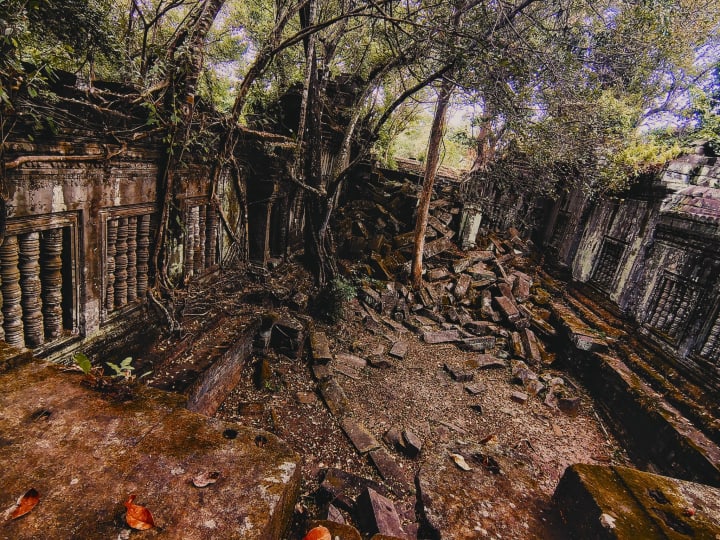
At Prasat Pram, two of the towers were so entangled in roots they could’ve been a set from a Guillermo del Toro movie. It was haunting and beautiful and absolutely surreal.

Lunch was bitter melon and egg, which my mouth liked more than my stomach. That became evident as I climbed the steep staircase of Koh Ker, a 36-meter pyramid built by King Jayavarman IV in the 10th century. My lungs filed a formal complaint. But the view from the top? Jungle stretching into forever. No crowds. No hum of modernity. An ocean of green, trapped in time. That night, a smoothie. Another lok lak. A sleep like stone.

Stillness and a Blessing
The next morning brought a quieter, more personal excursion — a solo tuk-tuk tour to three Buddhist temples around Siem Reap. The ride itself felt like a gift; for the first time on this trip, I wasn’t sharing space with strangers or racing a schedule. Just me, the city streets, and the steady hum of the motor.

The temples were tranquil, removed from the buzz of the more famous sites. Monks moved slowly through courtyards, saffron robes catching the light. My guide was patient, insightful, and let the spaces speak for themselves. After the second temple, we took a detour through a local market — not one of the polished, tourist-facing ones, but a real, fragrant, chaotic sprawl of fish, fruit, textiles, incense, and motor oil. It was vibrant, pungent, and unforgettable.
At the third temple, I received a traditional Cambodian water blessing. I sat beside my guide as the monk tied a saffron string around my wrist, murmuring prayers. Then, with a rhythm both soothing and ceremonial, he poured ladles of water over my head, continuing to chant. I’m not Buddhist, but in that moment, beneath the ancient roof of a temple tucked into the edges of town, I felt still. Grateful. Reverent. A change of clothes, a moment of reflection — and I was back on the road, headed north.

LUANG PRABANG: Forgotten Wallets, Found Temples, and the Sound of Water

Leaving Cambodia felt like walking out of a dream I wasn’t finished having. But Laos waited, and my flight north to Luang Prabang turned out to be one of the most beautiful landings I’ve ever experienced. As the plane dipped toward the tarmac, mist curled over emerald mountains and the Nam Khan River wound through the hills like a silk ribbon tossed by a careless god. Like drifting into Shangri-La
The airport was refreshingly tiny — like, “did I time travel to 1987?” tiny. Almost everything was closed, save for a few currency exchange booths that felt like lemonade stands. I changed my cash, found the taxi queue, and soon enough was in a shared van with a few strangers, rumbling down quiet roads as twilight settled over the city.
And then, in classic Southeast Asia fashion, my hotel appeared to be located… in the middle of a night market.
The driver pulled over, looked at me, and asked if I had Google Maps. I looked down at my suitcase, looked up at the sea of stalls, lanterns, and bodies, and laughed. Of course.
So I forged ahead on foot, dragging my suitcase through the crowd like a lost extra from The Amazing Race. And somewhere between the silk scarves and sizzling skewers, I ran into two familiar faces — the sisters from Dubai, from my Angkor Wat tour. A brief reunion, just long enough to smile and say how crazy it was to see each other again. Then, on I went, eventually finding my lodging: Queen’s House. Soft bed, cold shower, and a room full of charm — and mosquitoes. But honestly? Beautiful.
I passed out.
Waterfalls, Zip Lines, and the Great Smoothie Betrayal (Part II)

My original plan was to take a riverboat down to Kuang Si Falls that morning. But the organizer evaporated, so I rerouted. I strolled through the morning market — watching locals haggle over fruit, spices, and what I think might have been buffalo snouts — then swung by Saffron Café for some much-needed coffee. Eventually, I arranged a trip to the falls with a tuktuk driver.
But — curse or blessing — I have some kind of tuk-tuk hex. My solo ride turned into a 15-passenger van. And that 15- passenger van somehow acquired 17 passengers. But what a drive. Rolling hills, roadside villages, stilt houses with tin roofs. There’s a rawness to the Laotian countryside — poverty that’s visible, yes, but met with smiles and warmth and a sense of pride that no economic metric can measure.

When we arrived, we were told we had two and a half hours to explore. My heart sank. I had come to zipline over those falls, and I wasn’t about to miss it. So I bolted down the walking trails, past the bear sanctuary (yep — sun bears, adorable and sleepy), and met my arch nemesis: a 542-step staircase going all the way to the top.
In 98° heat with 70% humidity and a backpack. Grueling. But I made it. The view was glorious. And the zipline? Worth every lactic acid-soaked step.
Zipping over those turquoise pools, high above limestone terraces and through the jungle canopy — it wasn’t just exhilarating. It was cinematic. A heart-in-your-throat, air-on-yourskin kind of thrill that feels like you’re rewriting gravity, if only for a second. Each station offered a fresh gasp, a new angle on paradise. It was five scenes of euphoria, strung together by cable and courage.
But then… reality. I got back 30 minutes late. My ride? Gone. My wallet? Still in my hotel. My cash? Nearly gone.
Cue Google Translate, downloaded Lao dictionary, and a small miracle named compassionate staff member. She helped me find a tuk-tuk driver willing to take me back to town on the promise that I wouldn’t vanish when it was time to pay. (He believed me. I don’t know if I would’ve.)
Back at the hotel, cash delivered, soul intact. That night I treated myself to dinner at Tamarind — a restaurant that elevates Laotian cuisine to art. I ordered the stuffed lemongrass, and I’m not exaggerating when I say it was one of the most beautiful dishes I’ve ever eaten. Crisp, fragrant, layered in flavor and color. If Southeast Asia had a culinary cathedral, that lemongrass dish was one of its stained glass windows.
A Quieter Day, a Warmer Goodbye
In my infinite wisdom, I had also ordered a smoothie at Tamarind. My stomach, still recovering from its last fruity betrayal, objected. Loudly.
So I took it easy the next morning. A slow stroll through the streets, some final souvenirs, and then it was time to pack for Bangkok. This time, my hotel actually did send a tuk-tuk. I know, shocking. Except — it was actually a very nice car. At this point I stopped asking questions and just enjoyed the ride.
Luang Prabang’s airport, felt like a relic from another era. No bustle. No chaos. Just the slow shuffle of time. My flight back to Bangkok was short, scenic, and bittersweet.
BANGKOK (BARELY): Tom Kha Kai and Temple Light
By the time I reached my hotel in Bangkok — Two Three a Homely Hotel, a small and quiet spot tucked in the labyrinthine streets of Sukhumvit — I was feeling… off. My plans to explore the chaos and nightlife of Bangkok evaporated in favor of hot soup and air conditioning. I ordered Tom Kha Kai via Grab. It arrived warm, fragrant, and perfectly soothing.

The next morning, I felt human again. With my last full day in Asia, I navigated the metro and made my way to the old city. I wandered the temple complex, shooting photographs of Wat Arun’s delicate porcelain surfaces and Wat Pho’s golden reclining Buddha. The heat was oppressive, the sky washed in white light, but I was back in wonder mode again.

That afternoon I cooled off in the hotel pool, repacked my gear, and caught a few hours of sleep before my 3:00 a.m. flight out. By 11:00 p.m., I was in a taxi to the airport — one last ride through Bangkok’s neon streets.
Departure Lounge Reflections
And here I sit, an hour from boarding, body aching in the best kind of way. I’m not sure if I ever fully stopped moving. There was more I wanted to see — more waterfalls, more temples, more time to sit still and let it all soak in. But that’s how you know a trip was good, right? You leave full — but never finished.
About the Creator
Keep reading
More stories from writers in Wander and other communities.
Tea for one in Brighton: Afternoon Tea at the historic Old Ship Hotel
There is still something quietly radical about a woman choosing to travel alone, one who enjoys life’s small pleasures entirely on her own terms. As spring approaches and travellers begin to plan their escapes, Brighton feels like the perfect place to practise that freedom. Whilst Afternoon Tea is a year-round ritual, there is something especially enchanting about enjoying it in this seaside town in the south of England as winter loosens its grip.
By Susan Fourtané about 9 hours ago in Wander
Why Hanifaru Bay is a Dream Destination for Marine Life Enthusiasts
Hanifaru Bay, situated in the Baa Atoll in the Maldives, is one of the earth's most bizarre protected marine areas. This protected zone has a special reputation for the annual visitation of mantas and whale sharks and provides a chance for a nature enthusiast to explore the wonders of the ocean.
By ameliarosanna5 days ago in Wander
📢 Raise Your Voice Thread: 01/22/2026
Our “Raise Your Voice Threads” are hosted most alternating Thursdays at 12PM ET to offer creators more avenues to uncover exceptional stories on Vocal. As we are continuously searching for fresh creators and inspiring stories, this thread provides an opportunity to exchange and discuss the stories that have moved and motivated us on Vocal.
By Raise Your Voice by Vocalabout 12 hours ago in Resources




Comments
There are no comments for this story
Be the first to respond and start the conversation.