
A Mountain Overture Beneath the Alps
I met this mountain feast at dawn, the moment I pushed open the window.
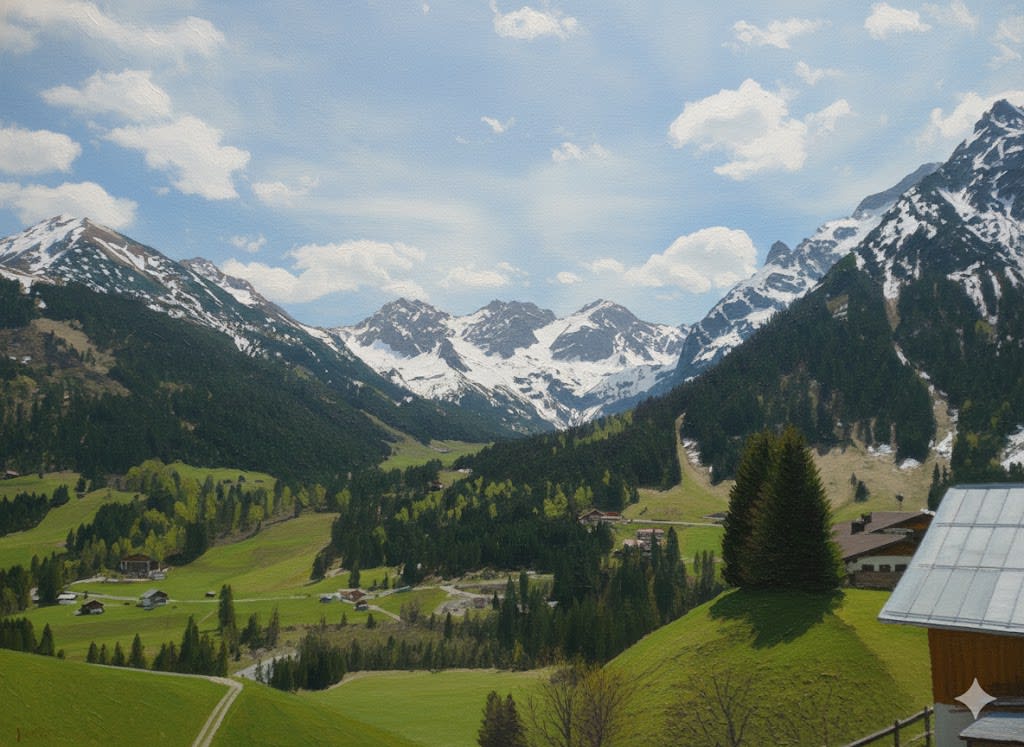
I met this mountain feast at dawn, the moment I pushed open the window.
The wind rushed in, carrying the damp scent of pine needles and fresh grass. Lifting my eyes, I saw the Alps stretching their boundless arms in the morning light. The distant peaks wore crowns of silver, their snow gleaming with a sacred glow beneath the rising sun. Dark gray mountain faces, like ancient books worn smooth by time, stood in silent devotion, bearing this purity upon their backs.
Midway up the slopes, forests wove themselves into layered carpets of green—from deep emerald to pale jade—stacked gently upon one another. Occasionally, sturdy branches jutted outward, like the arms of an old man reaching to gather the distant mountains into an embrace.
My gaze drifted downward along the terrain. Meadows unfurled like vast green velvet, stretching toward the horizon. Wooden houses lay scattered across them: some in weathered brown, their solar panels glinting softly like silver threads, as though tradition had donned a modern cloak; others small and red-roofed, with wisps of smoke curling faintly from their chimneys, harmonizing with birdsong from the woods. Yellow flowers dotted the grass like fragments of sunlight. When the wind passed, they swayed gently, whispering, *“Come and see—this is the heartbeat of spring.”*
I followed a winding path deeper into the valley. Dew disturbed by my steps slipped from blades of grass, shattering into tiny sparks of light. That shimmer mirrored my first impression of the yellow fields ahead: like a spring letter laid open by the earth itself, each dandelion dipped in sunlight to write its message. Up close, the field revealed more than gold—some flowers still faced the sky in full bloom, while others had already turned to soft spheres of seeds. When the wind brushed past, a few tiny parachutes lifted into the air, tangling with the green beneath. Along the ridge, a reddish-brown wooden fence half hid among the blossoms, framing the scene with rustic restraint.
At the field’s end, a village of white walls and red roofs appeared quietly. The houses lay scattered like toy blocks across the green slopes. No smoke rose from the chimneys; instead, vines crept over the walls, unfurling tender leaves that waved in the breeze. At the village entrance, an elderly man was trimming roses. When he noticed me, he smiled and greeted me in halting English: “Willkommen.” In the corner of his garden, tulips bloomed—echoing the yellow fields beyond. It struck me then: spring’s romance is a duet between village and wilderness.
Climbing higher, the air grew colder, and green slowly surrendered to white. Suddenly, a sharp-peaked snow mountain broke into view—like a silver sword thrust into the dark green forest. Its summit blazed so brightly under the sun that it stung the eyes. Halfway up, snow-covered ridges revealed dark veins of exposed rock—the bones of the earth—creating a striking contrast with the softness of snow. In the foreground, conifer forests remained dense and tall. Snow crystals clung to the needles, and when sunlight struck them, they glittered like scattered diamonds. I caught a falling flake in my palm; the chill spread gently through my skin. Then came a crisp *crack* from the woods—the sound of an icicle breaking, clear as winter’s final sigh.
No matter the season, the sky was always the true protagonist. A sapphire blue dome held drifting white clouds. Snowy peaks brightened and dimmed beneath their shadows, like intentional blank space in an ink painting. Clouds unraveled like cotton, layering sky, grassland, forest, and snow into a four-part harmony so vivid it invited touch. Most unforgettable was a thin airplane contrail slashing diagonally across the blue—a modern line of poetry added to nature’s canvas. Here, silence and movement coexisted in perfect accord.
Descending from the snowline back toward the valley, another expression of the countryside unfolded. In the pasture, brown-and-white horses stood upon lush grass. Their pale-gold manes curved smoothly in the wind, blue reins tied neatly around their necks. Their eyes were gentle, like meltwater from snow. One did not shy away, only tilted its head and brushed my hand with warm breath, cool and grassy in scent. In the distance, another horse grazed, its tail flicking up small bursts of green. Nearby, two light-brown cows stood with their backs turned—one nudging the other lazily, philosopher-like in its calm. The horse gazed far away, reins and mane composing quiet verses in the breeze.
At the edge of the pasture, flowering trees leapt suddenly into view. Deep pink and white blossoms intertwined like dancers in formal gowns, spinning before a wooden house topped with red tiles. A few white petals had fallen onto the stone steps; pink branches leaned over the garden wall, reaching toward the distant chimney. Up close, the pink flowers dusted my fingertips with fine pollen and a faint sweetness. The white petals were thinner, almost translucent—sunlight revealed veins filled with spring. The house walls bore the soft wear of age, their woodgrain etched with time, while the red tiles gleamed new. Old and new played together, tradition and modernity in quiet harmony.
On a stone bench outside the house, an elderly man in a straw hat brought freshly baked rye bread. Its warmth mingled with the scent of pine.
“Willkommen,” he said with a smile. “It tastes better with the mountains.”
I sat there, watching slopes where conifers and broadleaf trees merged into mist. Snow peaks glowed cold beneath the sun, standing in vivid contrast to the house’s warm red roof. A white building peeked from the grassy hillside, guarded by trees like sentinels. Together—the house, the flowers, the animals, the distant mountains—they wove a tapestry of rural life. The wind descended from the snow peaks, carrying fragments of yellow fields. And suddenly I understood: the beauty of the countryside lies not in landmarks, but in these unmarked moments—the bread, the smoke, the fallen petals, the steady gaze of a horse. They are love letters written by life itself.
At dusk, holding the bread, I stood before the house and looked back. Behind me were the pasture, the animals, the flowers, the chimney smoke; before me, mountains dissolving into cloud, snowlit peaks, and a sky fading through gradients of light. The wind carried pine and blossom alike. I closed my eyes and heard the Alps whisper, *“This is all that I am.”*
I realized then that the meaning of walking mountains lies not in arrival, but in passage. Like reading a poem in chapters—spring its light-hearted prelude, winter its solemn epilogue—while fields, villages, forests, snowlines, pastures, and gardens form the living lines in between. “Home” need not be a fixed place; it is the moment when heart and earth breathe together. The cow does not hurry. The horse does not race. Flowers bloom as they will; smoke rises as it must. I need only sit, take a bite of bread, glance toward the mountains, and understand what it means to feel at peace.
Every moment in these mountains speaks softly: travel is merely borrowing a landscape to rediscover one’s gentle resonance with the world. And beneath the Alps, that resonance has already been written—into an eternal poem.
About the Creator
Keep reading
More stories from writers in Wander and other communities.
Worth the Wait: Puerto Viejo, Costa Rica
Beach bumming in a small Caribbean beach town sounded like a perfect way to end our 6-month trip through Mexico and Central America. Or so we thought. The foul, fishy stench of rotten seaweed hit our nostrils as we stepped from the cramped bus and looked out at a rather depressing, empty, and underwhelming black sand beach. It was pouring with rain, and we had to quickly fish out our ponchos. We thought, this couldn’t be it, could it?
By Sh*t Happens - Lost Girl Travel3 days ago in Wander
They Read My Future in a Coffee Cup in Istanbul
See Pictures from the trip here. That's the honest starting point. I sat down, drank the coffee - which is strong in a way that makes you question every cup you've had before it, the kind of strong you'd rather smell than commit to - flipped the cup upside down on the saucer, and waited.
By Destiny S. Harris2 days ago in Wander



Comments
There are no comments for this story
Be the first to respond and start the conversation.