
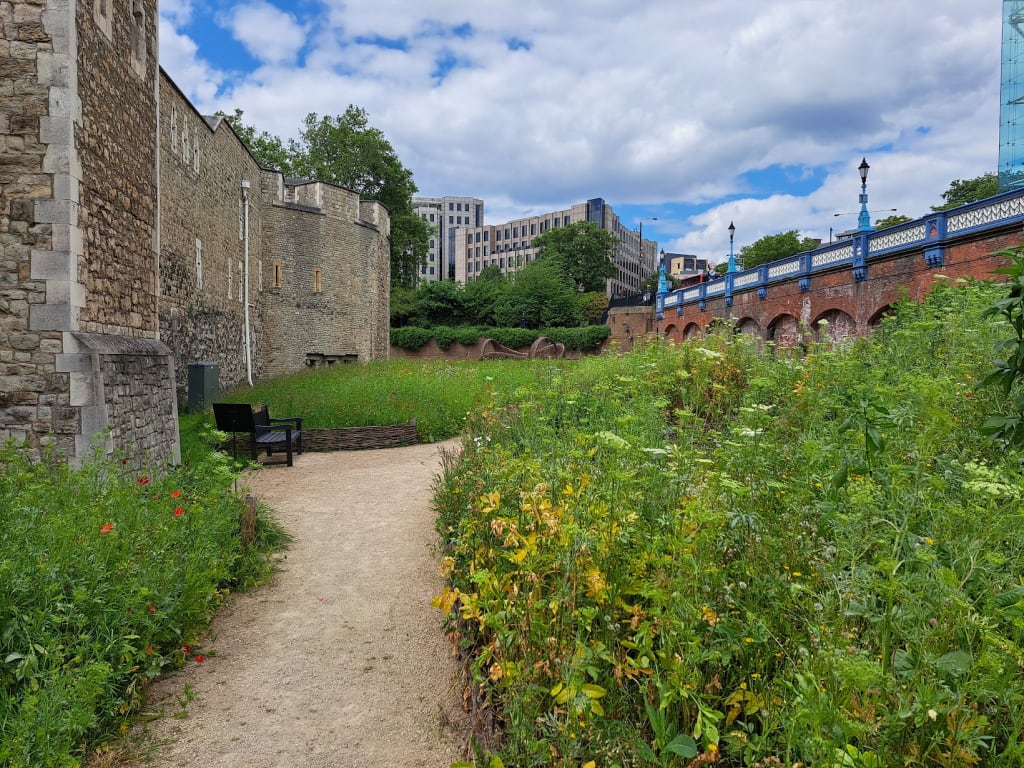
The Moat is a wonderful surviving example of defence in London. Prior to it being opened to the public, I always felt a bit envious when I saw residents walking along it. Little did I know back then that, fast-forward a few years, I would walk along the Moat, too.

Since then, I’ve been to the Tower of London a number of times, and on my last trip, I walked along The Moat practically by myself. There were only a handful of people, albeit dispersed along the path. For a few precious moments, it felt as if my dream had come true.
Here are 10 Facts about The Moat

* A Historical Defence. The moat at the Tower of London was originally constructed in the 13th century during the reign of Henry III and expanded by Edward I to enhance the fortress's defenses, making it difficult for attackers to reach the castle walls. It was filled with water from the River Thames to act as a formidable barrier.
* It’s been dry Since the 19th Century. The moat was drained in 1843 due to health concerns, as it had become a stagnant, unsanitary sewer causing disease among the garrison. It has remained dry ever since and is now a grassy area used for various events and activities.
* Archaeological Discoveries. Excavations in the moat have uncovered significant artifacts, including Roman and medieval structures, such as a Roman riverside wall and a 13th-century sluice gate, revealing the Tower’s long history and its connection to London’s development.
* Variable Width and Depth. The moat at the Tower of London was designed with varying dimensions, reaching up to 160 feet wide in some areas and about 30 feet deep, creating a significant obstacle for potential invaders and reflecting medieval engineering prowess.
* Sluice Gate System. The moat was managed by an intricate system of sluice gates, built around 1280 during Edward I’s reign, which controlled water flow from the Thames. These gates allowed the moat to be flushed and maintained, though blockages often caused stagnation.
* Defensive Drawbridges. Access across the moat was limited to drawbridges, such as those at the Middle Tower and Byward Tower, which could be raised to prevent entry, enhancing the Tower’s security during times of conflict.
* Ecological Role in the Past: When filled, the moat supported a small ecosystem, including fish and waterfowl, which provided a supplementary food source for the Tower’s inhabitants during sieges or times of scarcity.
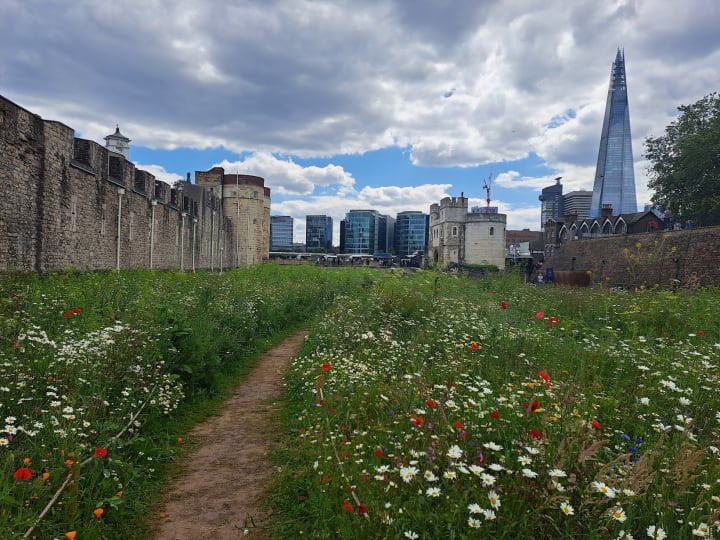
* Modern Uses: Since being drained, the moat has served various purposes, including as a venue for events like the “Superbloom” in 2022, where it was filled with wildflowers to celebrate Queen Elizabeth II’s Platinum Jubilee, attracting thousands of visitors.
* World War II Damage. During the Blitz in World War II, the moat was damaged by bombings, with craters formed in its base. It was later used as an allotment for growing vegetables to support the war effort, reflecting its adaptability.
* Archaeological Protection. The moat is a scheduled monument, legally protected due to its historical significance. Recent archaeological work, such as surveys in 2022, continues to uncover details about its construction and the Tower’s medieval defenses.

Parting Comments
I've grown up with the Tower of London in the background, and it's always a pleasure to pop down when I get the chance. I felt as if I got two for the price of one on this visit
An entertaining Yeoman Warder's Tour and a solo walk around The Moat.
It's mind-blowing to think that the Moat at the Tower of London is more than just a defensive feature; it is a living piece of history that has evolved, adapted and transformed through the centuries. It reflects the changes in military technology, public health practices, and urban development.
I'd recommend The Tower of London, especially the Yeoman Warder Tours if you're in London.
If you enjoyed reading this article and want to support my work, you can now buy me a coffee ☕️.
https://www.buymeacoffee.com/TabbyLondon
Thank you for your attention.
Best wishes
Tabby
About the Creator
Tabby London
The London I've been discovering is usually off the well-beaten track.I love the nooks and crannies and walking along the streets steeped in centuries worth of history. I'm fond of Zone 1 because that's where it all began centuries ago.
Keep reading
More stories from Tabby London and writers in Wander and other communities.
How Did Pelicans End Up in St James’s Park?
Did you know there are Pelicans in St James's Park? How did they even get there? St James's Park got its pelicans through a diplomatic gift from Russia in 1664. The Russian ambassador presented them to King Charles II in 1664, making the park home to pelicans for over 350 years.
By Tabby London8 months ago in Wander
Signs That You Grew Up in Texas
Greetings, Vocal creators! We're going to talk about arguably the best state in this country. I'm talking about Texas and it's also my home state, in case you didn't know. Nicknamed The Lone Star State, it has over 31 million people as of 2024 and is the second largest in the country. Last year, I wrote a story about the things that I loved about Arlington, which is where I'm originally from and where I grew up. Some notable people from the 28th state include Matthew McConaughey, Nolan Ryan, Matthew Stafford, and Willie Nelson. You can read the full story by clicking the link down below. The following entries are not in any particular order.
By Mark Wesley Pritchard 6 days ago in Wander


Comments (2)
The Tower of London's moat has a fascinating history. Love learning about its past and present uses.
Always great when you can read up on history facts I plan on going to London this may be in my list