
Prosecutors Demand Death Sentence for Ex–South Korean President Yoon Over Martial Law Crisis
The unprecedented request highlights the gravity of charges that Yoon Suk Yeol led an insurrection by deploying the military against democratic institutions.

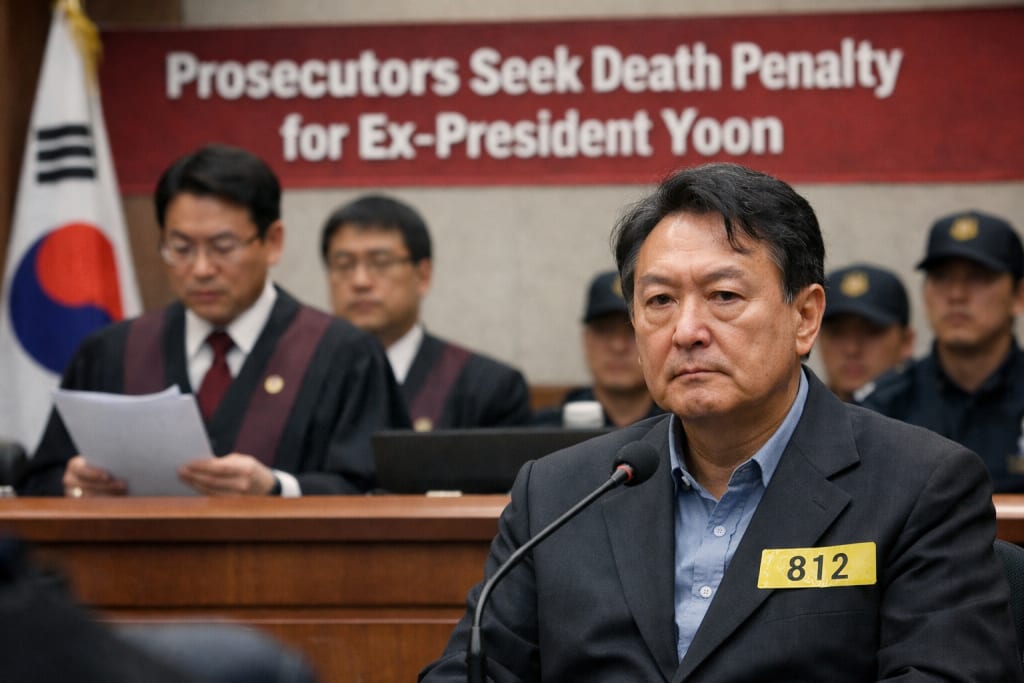
In a case that has sent shockwaves through South Korea and drawn international attention, independent prosecutors have formally demanded the death penalty for former president Yoon Suk Yeol, accusing him of leading an insurrection through his short-lived but explosive declaration of martial law in late 2024. The move marks one of the most dramatic moments in South Korea’s modern democratic history and underscores how seriously authorities view the former leader’s actions.
The demand was made during closing arguments at the Seoul Central District Court, where Yoon is currently on trial for rebellion. Prosecutors argued that his decision to impose martial law, deploy military forces, and attempt to restrict the authority of the National Assembly constituted a direct and calculated assault on the constitutional order. According to the prosecution, the former president abused his powers in a way that fundamentally threatened democratic governance.
The Martial Law That Sparked a National Crisis
The case centers on events that unfolded on December 3, 2024, when President Yoon abruptly announced the imposition of martial law amid mounting political tension. His conservative administration had been locked in an increasingly bitter standoff with an opposition-controlled National Assembly, which he accused of paralyzing governance and undermining national stability.
Invoking emergency powers, Yoon authorized extraordinary measures that included the involvement of military forces in maintaining order. Troops were deployed near key government sites, and restrictions were placed on political activities. The announcement immediately triggered widespread alarm, with critics warning that the country was witnessing a dangerous return to authoritarian tactics once used during South Korea’s era of military rule.
The response was swift. Lawmakers rushed to the National Assembly, defying military blockades, and convened an emergency session. Within hours, they voted to nullify the martial law decree. Large-scale protests erupted across the nation, with citizens demanding Yoon’s resignation and chanting slogans in defense of democracy.
Although the martial law order lasted only a few hours, its consequences proved long-lasting. The incident plunged the country into political turmoil and set in motion the legal reckoning now confronting the former president.
From Impeachment to Criminal Trial
In the months following the martial law episode, Yoon faced mounting pressure from both the public and political establishment. The National Assembly voted to impeach him, and in April 2025, South Korea’s Constitutional Court unanimously upheld the impeachment, removing him from office.
The court ruled that Yoon had violated the constitution by attempting to use military power to interfere with the legislative branch. While impeachment stripped him of the presidency, it did not shield him from criminal liability. Prosecutors soon launched a separate investigation, culminating in formal charges of rebellion.
Yoon was later arrested and detained as the case moved toward trial, marking the first time in South Korean history that a former president faced such severe criminal charges linked to actions taken while in office.
Prosecutors Push for the Harshest Punishment
During closing arguments, independent counsel prosecutors made clear that they consider Yoon’s actions among the gravest crimes possible under South Korean law. Rebellion, they argued, is not simply a political misstep or misuse of authority but an act that endangers the state itself.
“The defendant mobilized armed forces to obstruct the functioning of the National Assembly and undermine the constitutional system,” prosecutors stated. “Such conduct strikes at the heart of democracy and demands the strictest accountability.”
Under South Korean law, a conviction for leading an insurrection carries only three possible sentences: death, life imprisonment with labor, or life imprisonment without labor. Prosecutors emphasized that no fixed-term prison sentence is legally permitted for such an offense, reinforcing the gravity of the charge.
Death Penalty in a De Facto Abolitionist State
While the request for a death sentence has drawn global attention, South Korea has not carried out an execution since 1997. As a result, the country is widely regarded as a de facto abolitionist state, even though capital punishment remains on the books.
Legal experts note that prosecutors seeking the death penalty does not necessarily mean Yoon would be executed. If convicted and sentenced to death, he would still have access to multiple layers of appeal, a process that could take years. Moreover, any execution would require political approval, which successive governments have declined to grant for decades.
Many analysts believe a life sentence is a more likely outcome if Yoon is found guilty. Still, the symbolic significance of seeking the death penalty against a former head of state cannot be overstated.
Defense Arguments and Deepening Divisions
Yoon has consistently denied that his actions constituted rebellion. His defense team argues that the martial law declaration fell within presidential emergency powers and was intended to safeguard national stability during a political crisis. They also stress that the order was rescinded quickly and did not result in widespread bloodshed.
Supporters of Yoon have echoed these claims, warning that the prosecution risks criminalizing political decisions and deepening partisan divisions. Critics counter that the rule of law demands accountability, especially when democratic institutions are placed at risk.
A Defining Moment for South Korean Democracy
The court is expected to deliver its verdict in early 2026. Whatever the outcome, the case is already being viewed as a watershed moment for South Korean democracy. It sends a powerful message that even the highest office in the land does not place a leader above the law.
As the nation watches the trial’s final chapter unfold, the question remains not only how Yoon Suk Yeol will be judged, but how South Korea will define the limits of power, accountability, and democracy in the years to come.
About the Creator
sehzeen fatima
Sehzeeen Fatima is a writer with a Master’s in Science who shares inspiring stories about sports, life, and people. She writes in simple, clear language to connect with readers and spark meaningful thought.
Keep reading
More stories from sehzeen fatima and writers in Viva and other communities.
Germany Downplays US Threat to Greenland
Introduction Recent comments about the United States and Greenland have drawn international attention, especially in Europe. Reports suggesting that the US could threaten or pressure Greenland have raised concerns among NATO allies and Arctic nations. In response, Germany’s Foreign Minister Johann Wadephul has moved to calm the situation. He has clearly stated that Germany does not see a serious or immediate threat from the United States toward Greenland and has urged allies to focus on cooperation rather than speculation.
By sehzeen fatima6 days ago in Viva
Recapping an Amazing Night for the Knockouts on Impact's AMC Premiere
The broadcast history of Total Nonstop Action Wrestling has always been quite interesting. TNA started in 2002, but it wasn't until 2004 that they had an actual TV deal. I remember their days on Fox Sports Net, but it was in the fall of 2005 that TNA moved to what was then known as Spike TV, moving there just days after the network aired WWE's Raw program for the final time. It was around that time that I started watching TNA, and they were on Spike for nine years. After that, it was years of being on a lot of different channels. Destination America and Pop, two channels that no one would know without TNA. It's similar to how TruTV airs the earliest March Madness games. I still remember the brief time when they were on Twitch in 2019, but that ended that fall when they moved to AXS TV.
By Clyde E. Dawkins3 days ago in Viva
What is Slow Travel by Yacht and Why It's the Most Enriching Way to Discover Indonesia's Hidden Islands
Slow travel by yacht is not simply a holiday style — it is a mindset. At its heart, slow travel means absorbing a destination intimately rather than racing through highlights. In Indonesia, a country of more than seventeen thousand islands, this philosophy becomes even more powerful. A yacht allows travellers to drift through remote archipelagos at a thoughtful pace, with the freedom to linger where beauty is deepest and connection feels effortless. The experience shifts travel from a checklist to a rich, unfolding narrative shaped by water, solitude, and untouched landscapes.
By ameliarosannaa day ago in Viva


Comments
There are no comments for this story
Be the first to respond and start the conversation.