
Female Rites
If you like coming of age stories, check out these female - fronted gems.

If you’re a fan of the coming of age or rite of passage film you’re in good company. Who can’t identify with the traditional ‘passage’ from adolescence to adulthood? From the iconic 80s Stephen King adaptation Stand by Me, to Jeff Nichols’ recent Mark Twain-like caper Mud, Richard Linklater’s three- hour epic Boyhood to Shane Meadows’ gritty Brit flick This is England, these brilliant movies often have enduring appeal because their themes and journeys are easily identifiable for all members of the audience.
While other ‘rites of passage’ may include death, separation, mid-life or addiction; personal growth and change are key to all these types of stories, which focus on the psychological and moral transition of their protagonists, from one stage of life to another.
And while these transitional journeys may be negotiated successfully in real life, in film stories they are not. This is because film stories deal with conflict. In these stories, the biggest villain is the perhaps most probable of all: change. And it is only via working through the painful struggle of acceptance with change that allows the protagonist closure of life’s challenges.
Yet, until the last decade or so, you’d be hard pressed to find any epic female coming of age stories. Where is our Catcher in the Rye? The majority of classics in this genre seem have focussed solely on the journeys of boys and young men.
Luckily, the past few years have seen a significant effort to prioritise more films that are helmed by women which also focus on the journeys of young women. Recent efforts in the genre have produced high profile award - winning stories such as Lady Bird, American Honey and Booksmart.
But you can also flash back to the naughts (almost two decades ago) to discover some classic hidden gems which are some of my favourite stories in the genre. I would love to recommend Morvern Callar (2002) Juno (2007) and Fish Tank (2009).
While Fish Tank and Morvern Callar both come from the British school of social realism in contrast to US indie comedy Juno, which is tonally very different, all these stories deal with equally challenging female life lessons and growing pains.
Fish Tank
British writer-director Andrea Arnold is one of the masters of the female rite of passage, coming from the school of British social realism that documents working class life (See anything by Ken Loach, Lynne Ramsay’s Morvern Callar (below) or This is England by Shane Meadows).
I’ve already mentioned her recent epic American Honey, which you must check out in this genre if you haven’t already, starring Sasha Lane and Shia LaBeouf. But it is Arnold’s 2009 film Fish Tank about a socially isolated 15 year -old and her relationship with her mother’s new boyfriend, which is one of the greatest films in the genre. Despite its prizes and plaudits, I’m always surprised by how few people say they have seen it when asked.
Like American Honey, where Arnold selected talented non - professional Sasha Lane to play the main character; Fish Tank also features newcomer Kate Jarvis as Mia, who Arnold first spotted at a train station having a shouting match with her boyfriend then cast her in the film. It is a mesmerising performance by Jarvis and also Michael Fassbender, who plays her mother’s boyfriend Conor.
Mia lives on an Essex council estate, with her gregarious yet foul -mouthed little sister Tyler, a friendly dog and her mother Joanne (Kierston Wareing); a 32-year -old immature party girl who is occasionally violent and seems to have forgotten that she is no longer a teenager herself. A sign on her mother’s bedroom door reads ‘Parental Advisory-Keep Out’ and at one point she charmingly confesses that she was thinking of having Mia aborted. In another scene when Joanne asks Mia the parental cliché ‘What’s wrong with you?’, Mia responds with what is now obvious to the audience: ‘You’re what’s wrong with me!’
In this sexual awakening story, Mia must learn the difference between abuse and love. A big clue to the required transition or area of growth in this film, is in the title: like the proverbial goldfish will Mia repeat her mother’s mistake of mistaking sex for love and so enter a cycle of neglect and abuse, or will she escape it? Fish Tank also nods to a realm where the larger creatures can’t help but devour the smaller ones.
Mia is indeed headed for a lifetime of misery – she has been thrown out of school, has no job, does not seem to have many friends and often retreats to an empty room to play her music and dance alone. She has never really been shown any love. Because of this she does not know how to manage it or express it. There is a big father sized hole in Mia’s life and no-one to offer her a safety net or comfort for her bleak existence.
The status quo is upset on the arrival of Conor her mother’s new boyfriend. Different from the others he is kind, fun and generous and supports the one passion that Mia has which is urban dance. He is also the first person to talk to her as if she were an adult. Mia is thrilled when he takes the family out for a day in the countryside and catches a fish with his bare hands.
Mia hopes Conor could be a father- figure, but she also has a crush on him. At 15, she is confused about love and hormones are raging. In the name of spoilers, it’s probably best not say too much about what unfolds. A low point comes when Mia breaks into Conor’s home and realises he is already a both lover and a father to another family. She may have subconsciously ignored the red flags and this final realisation hits her hard. We see her feelings escalate from adoration to rage.
The cinematography is really notable in this film with the story unfolding in warm, glowing, soft summer colours. Music is also often playing, particularly connected with Mia’s dancing and the soundtrack is defined by great soul, rap and RNB artists including Bobby Womack, Nas, Jah Rule & Ashanti, Wiley, Gregory Isaacs, Robin S and James Brown.
By the end of the film, we see Mia escape her surroundings for a new life with a boy her own age. Clearly a huge life lesson has been learnt which is that Mia can now see the difference between abuse and love and she hopefully will no longer confuse these two things, which is a huge growth.
Morvern Callar
Lynne Ramsay’s Morvern Callar (2002) is an adaptation of Alan Warner’s 1995 novel of the same name, which featured in the Directors Fortnight of the Cannes Film Festival that year and was also nominated for seven British Independent Film Awards.
An overlooked gem of a rites of passage movie, it is often quoted as Ramsay’s ‘one that got away’, a masterpiece that somehow didn’t get the recognition it deserved, compared to the director’s coming of age debut Ratcatcher or her more recent noirs, We Need to Talk About Kevin and You Were Never Really Here.
While Ramsay and Arnold may come from the same school of social realism, I see their filmmaking as fairly distinct, with Arnold’s canon focusing predominantly on hopeful and transformational female led stories about working class women. Ramsay, particularly more recently has focussed on her own interpretations of book adaptations with dark subject matter. Although in this case you could say Morvern Callar fits the former bill.
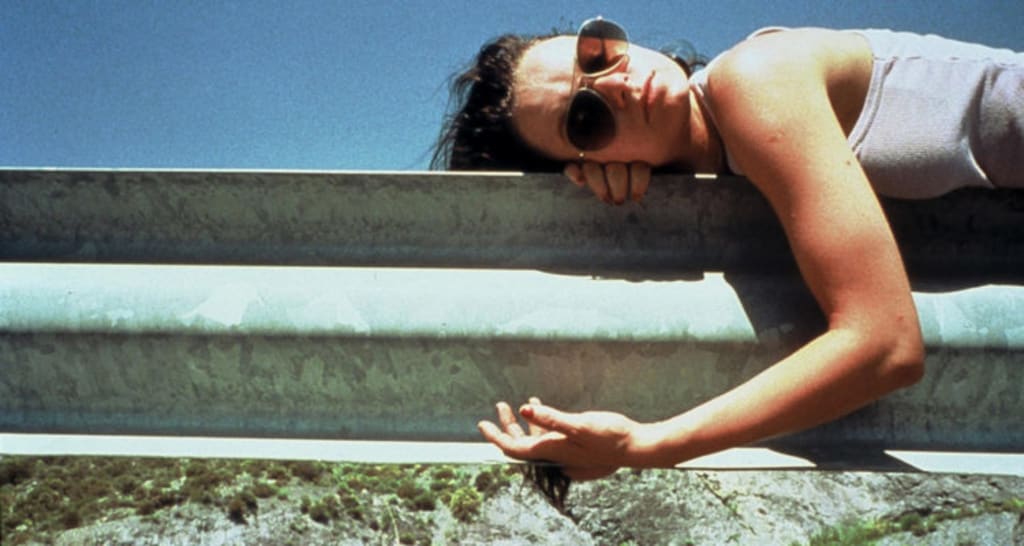
In Morvern Callar, the titular character, played by an electrifying Samantha Morton (Minority Report, Sweet & Lowdown) is about to embark on a passage that is about more than adolescence to adulthood, as she also has to come to terms with the death of a loved one.
Movern is a supermarket employee living in Glasgow, Scotland, who seems to have little prospects. She comes home one evening to find her husband’s dead body, a suicide note, a mix tape ‘Music For You” and a completed novel on his computer.
She subsequently seems to go into shock, telling no-one about his death. She disposes of his body, sends the novel to a publisher under her own name and takes her best friend off on holiday for good times in Spain. The film is a great shocking depiction of how grief can blindside a person and make them do irrational things. It is only through eventually coming to terms with this literal death, that Morvern actually discovers who she really is as a woman and starts to make her own way in the world.
The soundtrack, inspired by the husband's mixtape, features some classic ambient and left-field sounds from the time, often accompanying visceral dream like sequences. Artists include Stereolab, Aphex Twin, Broadcast, Velvet Underground and Nancy Sinatra.
When in Spain, Morvern and her friend, have several adventures, they party, they fight, Morvern meets a man in a hotel whose mother has recently died and has sex with him. But it is also in Spain that Morvern discovers her true independence.
When she returns, Morvern asks her friend to leave Scotland with her but her friend declines. The last scenes see Morvern collect her suitcase and go to a railway station. She is also seen in a nightclub listening to the mixtape her boyfriend bought her.
In the film we see Morvern transition from a stagnant life with little opportunity to discovering who she really is. Someone who is an independent and impulsive person that seeks joy and beauty and is capable of living a rich and wonderful life as the next person. It is really a story about discovering who you really are and making your way in the world.
Juno
Juno was the first script from writer Diablo Cody (Tully) and second film from its director Jason Reitman (Thankyou For Smoking). It became one of the defining indie films of the decade that really launched the career of actor Elliot Page as hyper- articulate 16- year old Juno MacGuff, a pregnant teen with a hamburger phone and great taste in punk music (The Stooges).
The era-defining lo-fi indie soundtrack features The Mouldy Peaches, Sonic Youth, The Kinks, Belle & Sebastian and Cat Power, with the film also really putting on the map the careers of Michael Cera (Superbad), Jason Bateman (Ozark, Arrested Development).
In the film, our too cool for school heroine uses witty sarcasm to insulate herself from the awkwardness of being a teenager. Her acid sharp tongue and humour sometimes make her appear mature beyond her years, yet Juno’s immaturity lies in thinking that she understands the world better than her elders do.
We find out early that Juno loves her boyfriend Paulie (Cera) but is afraid to admit that she has feelings for anyone because she believes that relationships never work out (her mother ran out on her when she was younger). At the beginning of the story, we find out that Juno is confronting an unplanned pregnancy after the first time she has had sex with Paulie. When Juno tells Paulie that she is pregnant, he is confused and hurt and abdicates all decision-making to her.
On realising that she cannot go through with an abortion, Juno believes she must find the ‘perfect’ couple to abort the baby. It sets her off on a more grown - up journey where she faces the pressures of adult life on her own, only eventually to realise that true love isn’t and needn’t be perfect.
By the end of the film she has learned her own lesson by dabbling in friendship with a potential adoptive father of her baby, Mark (Jason Bateman). But sometimes signifiers of cool aren’t enough to put two people on the same page. Juno also discovers that ‘mature for your age’ doesn’t mean grown up.
Juno goes from being a frightened loner to finding true love with Paulie and realises that while everything may not be perfect it will be okay, and she gives the baby to Vanessa, the potential adoptive mother, to solely adopt.
Ironically in this rite of passage story, Juno goes back to being a teenager rather than moving on to the next stage of life. However, she has made some very grown- up decisions to get there.
About the Creator
Jules
London-based writer, journalist & producer.
The Soul of the Stone: Why I’m Betting on Oval Diamonds This Valentine’s Day
Valentine’s Day has a funny way of making us overthink everything. We obsess over the reservation, the flowers, and—most nerve-wracking of all—the ring. For years, I’ve watched friends and colleagues agonize over finding a diamond that isn't just a status symbol, but a reflection of their partner's personality. In my time exploring the nuances of jewelry and the emotions behind proposals, I’ve realized that we often overlook the most important factor: the "vibe" of the stone itself.
By Mohd Kaish4 days ago in Viva
Inspirational Stories of Women Leading Change Today
In an era marked by rapid change, complex global challenges, and evolving social norms, women everywhere are rising to lead, innovate, and inspire. From teenagers creating solutions for their communities to seasoned leaders breaking barriers in science, sustainability, and social advocacy, the stories of women today reveal resilience, courage, and transformational impact. These narratives not only celebrate individual success — they help reshape what is possible for future generations.
By Stories Today4 days ago in Viva



Comments
There are no comments for this story
Be the first to respond and start the conversation.