

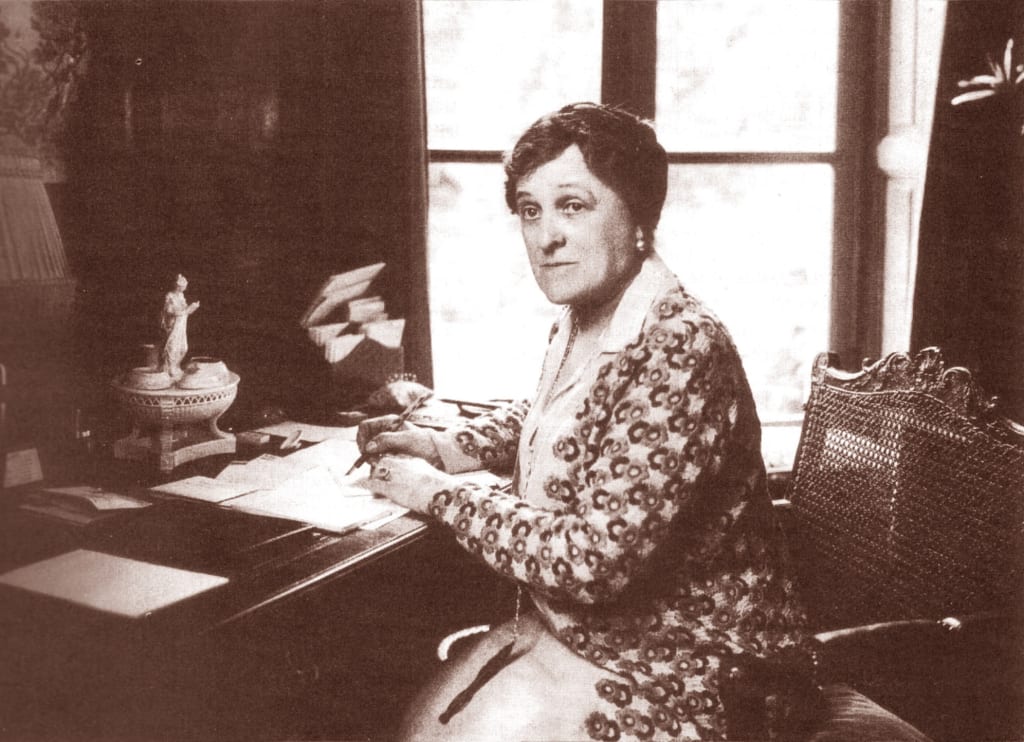
A name that resonates with beauty, elegance and literary excellence, she became a novelist, designer and avid traveler. This lady triumphed over many struggles and achieved remarkable success against all odds. She became a ‘voice’ for women’s rights in the early 20th Century.
She was Edith Wharton.
Edith was born on 24th January, 1862, in New York City to a privileged life. Her father was George Frederic Jones and her mother was Lucretia Stevens Rhinelander, and the family lived at their brownstone at 14, West Twenty-third Street. Her nickname within the family and friends was “Pussy Jones”. Edith had two older brothers, Frederic and Henry.
The family was a very wealthy one, having made their money in real estate. The old saying: “Keeping up with the Joneses” is said to have referred to her father.
As a young child, the family traveled, visiting France, Italy, Germany and Spain. As a result, Edith (or “Pussy”) became fluent in French, German and Italian. When she was nine years old, Pussy suffered from typhoid fever which nearly killed her, but thankfully she recovered. Whilst traveling Europe, Pussy had several governesses and tutors, but she rejected the ‘standards’ of fashion and etiquette that was expected of rich young ladies of the time. It was ‘expected’ that Pussy be put on display at balls and parties so that she would marry well. However, she was more interested in education and learning, and read books from her father’s library, but her mother forbade her only daughter to read novels, ‘until she was married’, which Pussy actually obeyed.
Edith (or Pussy) started writing from an early age. Whilst traveling Europe, Edith was about five or six years old, and from this early age, she started ‘making up’, inventing stories and walking about with an open book, turning the pages as if she was reading the book, even at such a young age. She started to write poetry and fiction, and ‘attempted’ to write her first novel when Edith was eleven years old. Her mother ‘squashed’ Edith’s confidence though so she gave up the novel, and instead turned to poetry.
At fifteen, Edith published her first work, which was a translation of a German poem “Was die Steine Erzählen”, (“What the Stones Tell”), by Heinrich Karl Brugsch. Edith was paid $50 for this which must have seemed an amazing amount, even for a young girl from a wealthy background. Writing was not considered a ‘proper’ occupation for a young lady so her name did not appear in this first work of hers.
Despite other successes at writing poetry and publishing it, even under a pseudonym name, Edith’s family still did not approve or encourage her to write. Even those in her ‘social circle’ did not ‘entertain’ Edith’s poetry.
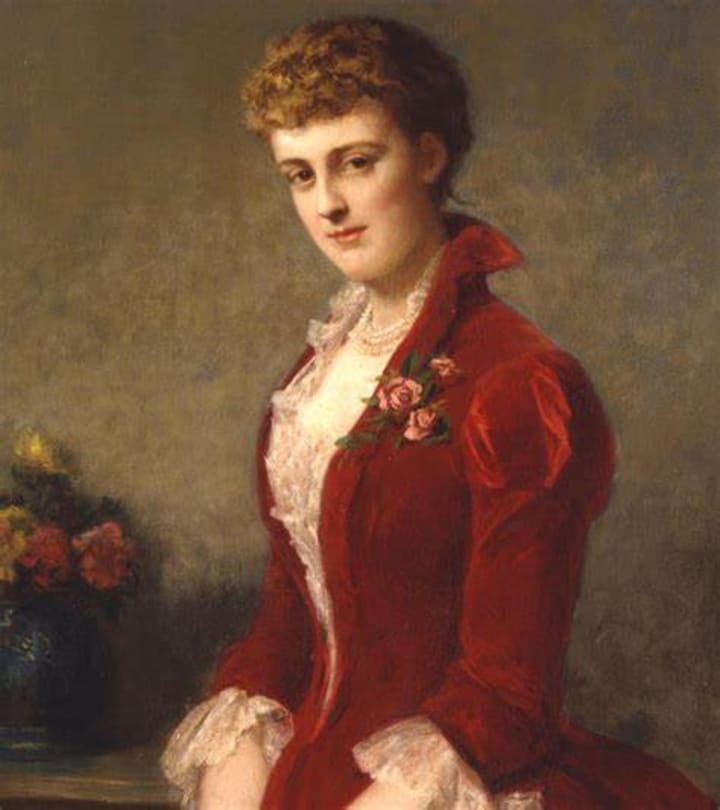
Between 1860 and 1890, Edith participated in the social seasons of New York’s upper classes, putting her writing to one side. She keenly observed the social changes which were happening at the time, much of which Edith used in her later writing. Edith officially came out as a ‘debutante’ in 1879, when she was allowed to bare her shoulders and wear her hair up. Edith started courting Henry Leyden Stevens, the son of a wealthy hotelier and real estate investor, but, again, her family did not approve of Edith’s choice of partner.
Her father died of a stroke in 1882. The same year, Edith became engaged to Henry but in the same month they should have married, the engagement ended. Lucretia (Edith’s mother) moved back to Paris in 1883, where she died in 1901.
29th April, 1885, Edith finally married Edward Robbins (Teddy) Wharton. She was 23 years old, he was 12 years her senior. Edward was a sportsman and a gentleman, and from the same social class as Edith. The couple set up home at Pencraig Cottage in Newport. They both loved to travel, and in 1893, they bought a house for $80,000 in Newport, called ‘Land’s End’. Moving into it, Edith decorated the new house with the help of designer Ogden Codman. In 1897, the couple purchased their New York home, 884 Park Avenue and between 1886 and 1897, they traveled, visiting Italy, Paris and England.
From this time on, three interests dominated Edith’s Life, American houses, writing and Italy.
Teddy started to suffer from chronic depression between the years of 1880s and 1901, so the couple stopped traveling. The depression became debilitating for Teddy so the couple lived almost exclusively at their estate, The Mount, in Lenox, Massachusetts. During this time, it seemed that Edith ‘caught’ the same type of depression but also suffered from asthma. Unfortunately, Teddy’s condition was determined to be incurable in 1908. In that same year, Edith began an affair with Morton Fullerton, who was an author himself, and in whom she found an intellectual partner. The couple divorce in 1913, after 28 years of marriage.
Edith wrote novels, at least 85 short stories, and she became a garden designer and interior designer, writing several books on design. Her first major work published was “The Decoration of Houses” in 1897, co-authored by Ogden Codman, who decorated the house in Newport.
“The Valley of Decision” was her first novel, published in 1902, and the first of her short stories, “The Greater Inclination” was published in 1899.
“The House of Mirth” was published in 1905 and it became a bestseller. Writing about what she knew, the novel was about the lives and struggles of New York’s high society, and it also was a running commentary on the ‘restrictions’ that were placed on women in that high social class. The book was highly praised because of its accurate portrayal of society and its complex female characters.
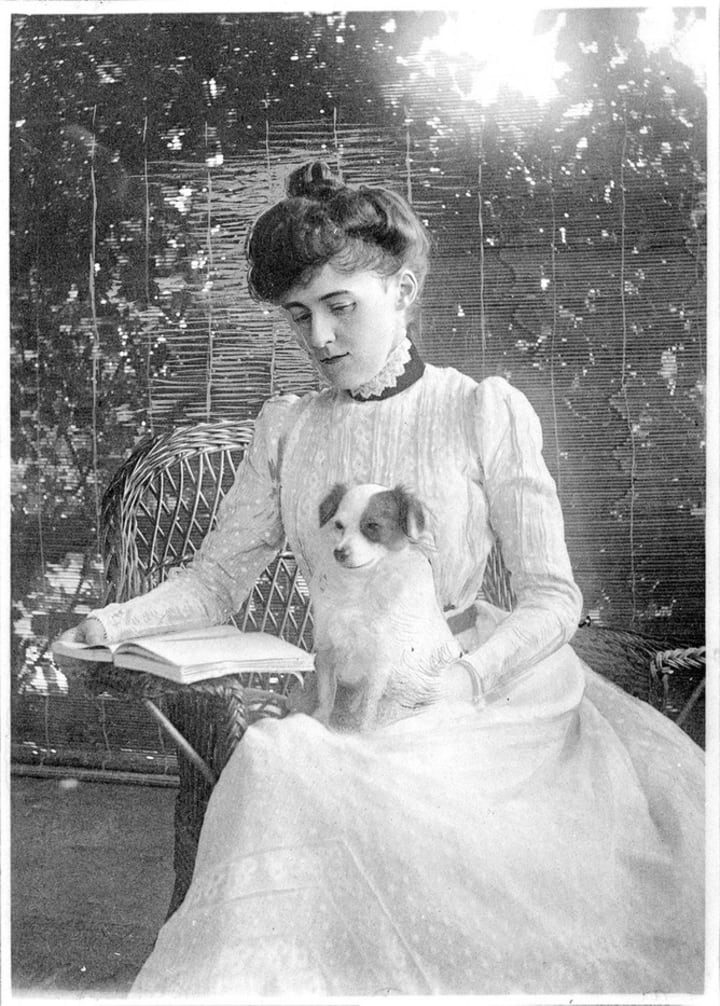
Edith’s most famous work was the “Age of Innocence”, which was published in 1920. No doubt many of us have heard of this book, if not read it. For this novel, Edith won the Pulitzer Prize for fiction, the first woman to receive this honour. Even today, it is considered one of the greatest pieces of American literature and has been adapted into several films and plays.
Edith Wharton wrote over 40 books during her life. These include novels, short stories, poetry and non-fiction. ‘Her writing style was characterised by her keen observation of human behaviour’, her attention to detail and she had the ability to ‘capture’ the distinction of the social class she was born into.
It is interesting that Edith was an advocate for women’s rights and a supporter of women’s suffrage, speaking out many times on the struggles of women in that high class society. She believed in education for girls and supported many charities. Edith helped the refugees during World War One, doing her bit for the war effort.
All through her life, Edith suffered with bouts of depression and other health issues. After her divorce in 1913, Edith never remarried, and she died on 11th August, 1937 at 75 years old.
Her impact on society is still felt today, even though we live in quite a different world to hers, and her books are still studied today. Her many books have been translated into numerous languages and Edith was awarded the French Legion of Honor for her contribution to Literature. Edith also became the first woman to receive an honorary doctorate from Yale University.
Edith Wharton was way ahead of her time, and continued determined to pursue her passion for writing at a time when women were ‘expected’ to conform to the society rules. She was a strong and resilient woman, and continues to be a good example for girls and women to read about today.
About the Creator
Ruth Elizabeth Stiff
History and knowledge, especially about the Earth, are my passions. I enjoy putting my thoughts to paper and I always try to encourage self-motivation and love for life. LIVE AND LOVE LIFE!
Keep reading
More stories from Ruth Elizabeth Stiff and writers in Viva and other communities.
How Class Shapes Access to Elite Sports
Elite sports are often portrayed as meritocratic arenas where talent, discipline, and hard work determine success. The dominant narrative suggests that anyone with sufficient dedication can rise to the highest levels of competition. In reality, however, access to elite sports is strongly influenced by socioeconomic class. Financial resources, social networks, institutional access, and geographic location all shape who is able to train, compete, and remain in high-performance pathways. Talent is necessary, but opportunity is unevenly distributed. As a result, class functions as a structural filter that determines which athletes can realistically pursue elite competition.
By Gus Woltmannabout 5 hours ago in Viva
Why Every Woman Should Buy Her Own Diamond: The New Era of Independent Sparkle
For a long time, the narrative surrounding diamond rings for women was strictly linear. It began with a romantic proposal, followed by a wedding, and perhaps an anniversary a few years down the line. The diamond was always a gift—a token of someone else’s affection, a symbol of a promise made by another. But as we navigate 2026, that old-fashioned script is being rewritten.
By Mohd Kaishabout 5 hours ago in Viva
Review of 'Man on the Run'
My wife and I saw Man on the Run, a nearly 2-hour documentary on Amazon Prime, about Wings, Paul McCartney's group that flew around the world from shortly after The Beatles broke up in early 1970 to shortly after John Lennon was murdered at the end of 1980, making a Beatles reunion forever impossible.
By Paul Levinson7 days ago in Beat


Comments
There are no comments for this story
Be the first to respond and start the conversation.