
Why Brady Manek's possible concussion is troubling for the NCAA
In the aftermath of the men’s college basketball championship, the conversation lacks discussion of concussion protocols designed for safety.


On Monday, April 4, the 83rd annual edition of the men’s NCAA Division I basketball tournament came to a rip-roaring end. The overall #1 seed Kansas Jayhawks battled back from a 15-point halftime deficit to edge an ascendent University of North Carolina (UNC) squad that played several levels better than its #8 seed suggested.
From the first games in their respective sections of the bracket to the final, both teams played with poise, intensity, and brilliance to go the distance. In the hours and days after the final, the conversation has centered itself on the superb play, competitiveness, and surprises of the tournament.
But a single storyline from the UNC-Kansas final has undermined what should be a straightforward celebration of another fantastic competition.
Early in the first half of the final, UNC forward Brady Manek took a hard elbow to the forehead from Kansas center David McCormack. Replays showed Manek reel instantly and collapse to the floor, where he stayed for more than 15 seconds clutching his head.
Although the elbow from McCormack was unintentional, it struck Manek with the kind of force only a 6’10, 250-pound center can generate during a shot attempt. Manek eventually got to his feet with the help of his teammates and tottered back to the UNC bench.
Manek, a player whose flowing hair, red beard, and outstanding talent have made him a college basketball icon, often patrols the court with his mouth ajar. The look lends him a bemused or even puzzled countenance, though it’s just his way of focusing on the game.
Following the elbow, Manek’s expression seemed to take on an extra degree of bewilderment. He sat down on the UNC bench to gather his bearings while the officials viewed slow-motion replays of the incident. Their priority was to determine if McCormack’s errant elbow warranted a flagrant foul, not to address Manek’s health at that moment.
Two minutes passed until players returned to the court. No foul - just a basketball play (see: accidental contact).
Since collisions of this nature don’t happen in every basketball game, the hard impact between McCormack and Manek prompted a lot of chatter. In the immediate aftermath of the event, others were left wondering about Manek’s fitness.
TBS’s game coverage didn’t appear to show any trainers or medical staff assessing Manek’s condition. Manek continued to play after the game resumed, his movement and reaction time perhaps somewhat diminished until getting substituted a few minutes later. Not long after that, he entered play once more.
The commentators on TBS made remarks about “being dazed” and “wondering how he feels.” Absent from their commentary was a discussion about proper check-ups or an apparent flouting of NCAA protocols.
Zac Al-Khateeb, a content producer and writer, addressed the issue in an article for The Sporting News. He wrote how the lack of examination sparked concern about Manek’s well-being and failed to follow the NCAA’s basic concussion procedure.
Mr. Al-Khateeb included a section from the procedural document in his article:
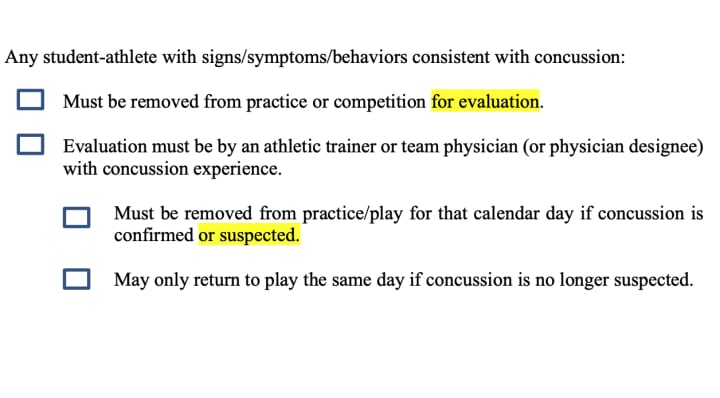
Not long after re-entering the game as a substitute, Manek took another incidental swipe to the face -- this one less severe -- during a rebound attempt. Again, Manek stayed in the game.
While UNC stuck to their key player, numerous people took to Twitter to voice their concern at what they saw as a clear lack of response.
The obvious question now is why the Tar Heels medical staff failed to intervene and assess Manek’s condition. Yes, this was the pinnacle of college basketball - a final against a formidable, higher-ranked opponent. Yes, Manek played a crucial role in this Tar Heels team. Yes, this was his last game before (presumably) going pro.
Perhaps the UNC staff did give him a brief check-over and he got the thumbs up to play, unbeknownst to TV audiences.
But without an official explanation from either UNC or the NCAA, observers are left fumbling in the dark, struggling to understand why a mandated procedure never materialized. It’s an issue that speaks to how a flawed mechanism (the NCAA’s concussion protocol) failed to protect a student-athlete. Furthermore, it’s a communication issue.
On its website, the NCAA has a page titled Health and Safety that claims to “[work] hard to protect [athletes] physically and mentally, on the field and off. Through its Sport Science Institute, the NCAA is working to ensure college athletes are getting the best care possible.”
At the time of this article’s publishing, clicking the ‘Learn More’ button generated a blank white screen with no additional information. The NCAA’s website lacks a clear description of expectations, steps, and measures to safeguard health and safety.
The NCAA is a 116-year-old organization that oversees dozens of sports and tens of thousands of student-athletes across three different divisions. Some of these sports attract billions of dollars of investment and generate tens of millions in revenue for the organization.
In recent years, the NCAA has come under fire for its handling of myriad issues, including the uneven treatment of men's and women's sports; a lack of competitiveness in flagship sports such as football; even its long-held, stubborn insistence on the student-athlete model. In just the past year or so, rule changes have allowed players to earn money on endorsements and product lines.
In short, the NCAA doesn’t wish for another PR gaffe to muddle its marketing-friendly approach to health and safety.
Other sporting entities have been slow to address the concern around head injuries. The NFL has its own history of failing to address possible concussions on the field. In addition, it has resisted investigations into the long-term brain damage and premature death of former players. An ongoing lawsuit describes racial discrimination in settled payments for plaintiffs.

Expanding the scope beyond American borders, the global soccer organization FIFA has sought to rectify high-profile blunders with head injuries on the soccer field. Play now stops automatically after a collision or incident involving head or facial contact, allowing medical teams to determine the possibility of an injury. Other initiatives have been implemented as well to screen for trauma and reduce the chances of a player suffering further harm during a match.
In the week following the Division I men’s basketball final, communication from UNC and the NCAA has not been forthcoming. Look up “Brady Manek concussion” on any search engine or webpage related to the institutions above and you will find little beyond Twitter and a handful of short articles.
Health specialists and researchers have known about the effects of traumatic brain injuries for decades. In 2022, it’s unacceptable to look past an incident that sets off alarm bells for the sake of a game. Too much is at stake in the way of health and safety.
While it’s unfair to ask ordinary people to hold accountable institutions that fail to follow through with the guidance they set forth, we can speak up and demand better outcomes. The NCAA must do better.
Let’s hope that the McCormack-Manek incident sparks an urgent reckoning inside the NCAA, and other sports organizations, for more robust and universal protocols. Otherwise, the next errant elbow could lead to a far more serious injury.
And the NCAA would hate the bad press.
~
Header image credit: http://imagn.com/setImages/424337/preview/18021594
About the Creator
Hans Pohai Müller
I believe we’re only as old as we feel, and that each person has a story to tell
Northern Michigan // pohaimuller.com
Keep reading
More stories from Hans Pohai Müller and writers in Unbalanced and other communities.
Super Bowl LX Recap: A Team Called Hawks
Sixty. The Super Bowl turned 60! Still amazes me that this was the sixtieth Super Bowl played in NFL history. It seems like yesterday that I watched Super Bowl XXVII, the first SB I ever watched. The QB who won Super Bowl XXVII has since called a few SBs, and will call next year's game, but that's another story. Super Bowl LX took place at Levi's Stadium in Santa Clara, California, the home stadium of the San Francisco 49ers. However, it was one of their division foes who represented the NFC, as the Seattle Seahawks faced off against the New England Patriots.
By Clyde E. Dawkins26 days ago in Unbalanced
A Cacophony of Shenanigans
The Colorado Avalanche's resumption began with a 4-2 victory over the Utah Mammoth, win #38 of the season. We were back to work on the following night, this time at home, but still facing a division foe. In this case, it's our oldest division rival: the Minnesota Wild. Our third meeting of the season against Minnesota, but it's the first time that the Avs hosted the Wild, as the previous two meetings were in Minnesota. It is also the second time that the NHL's top two defensemen, Cale Makar and Quinn Hughes, battled each other this season (the third if you count the Gold Medal Game this year).
By Clyde E. Dawkins7 days ago in Unbalanced
Review of 'Man on the Run'
My wife and I saw Man on the Run, a nearly 2-hour documentary on Amazon Prime, about Wings, Paul McCartney's group that flew around the world from shortly after The Beatles broke up in early 1970 to shortly after John Lennon was murdered at the end of 1980, making a Beatles reunion forever impossible.
By Paul Levinson6 days ago in Beat



Comments
There are no comments for this story
Be the first to respond and start the conversation.