
What the F***?
The Psychology and Culture of Swearing

### What the F***? The Psychology and Culture of Swearing
Swearing, often considered taboo, has a complex role in human communication and society. The phrase "What the f***?" exemplifies how profanity can convey a wide range of emotions—from shock and disbelief to frustration and anger. But why do we swear, and what does it say about us?
#### The Nature of Swearing
Swearing is a linguistic phenomenon that involves the use of words or phrases deemed offensive or socially unacceptable. While many associate swearing with negative emotions, it serves various purposes beyond mere expression of anger. Linguists categorize swearing into several types:
1. **Emphatic Swearing**: Enhancing the intensity of a statement. For example, "That was f***ing amazing!" emphasizes enthusiasm.
2. **Expressive Swearing**: A natural response to pain or frustration. A stubbed toe might elicit an instinctive “f***!” as a way to release tension.
3. **Social Swearing**: Used in group settings to foster camaraderie or convey a sense of belonging. Shared profanity can create bonds among peers.
4. **Humorous Swearing**: Employed for comedic effect. Comedians often use swearing to elicit laughter or surprise.
#### The Psychological Impact of Swearing
Research indicates that swearing can have therapeutic benefits. A study published in the journal *NeuroReport* found that swearing can increase pain tolerance. Participants who uttered swear words while immersing their hands in ice-cold water reported less pain than those who used neutral words. This suggests that swearing may tap into primal emotional responses, allowing individuals to cope with stress or discomfort.
Moreover, swearing can serve as a form of emotional release. In moments of intense emotion, whether it’s frustration, joy, or surprise, the act of swearing can provide a necessary outlet. It allows individuals to articulate feelings that might otherwise be difficult to express.
#### Cultural Contexts and Attitudes
Attitudes toward swearing vary widely across cultures. In some societies, profanity is deeply stigmatized, while in others, it is woven into everyday language. For instance, in many Western cultures, swearing is often viewed as a mark of lower social status or lack of education. Conversely, in some communities, swearing can signify authenticity or a genuine expression of emotion.
The context in which swearing occurs also matters. Using profanity in casual settings among friends may be perfectly acceptable, while the same words could be deemed offensive in a formal or professional environment. This fluidity reflects broader cultural norms and values.
#### The Evolution of Language
Swearing also highlights the evolving nature of language. Words that were once considered vulgar can shift in acceptability over time. For example, the word “damn” was once viewed as highly offensive but has become relatively mainstream. This evolution raises questions about what constitutes profanity and how societal norms shape our language.
The internet has further influenced the landscape of swearing. Online communication often lacks the immediate feedback of face-to-face interactions, leading to new forms of expression. Memes and social media platforms have popularized phrases like “What the f***?” as a shorthand for expressing disbelief or exasperation. This digital age has democratized swearing, making it accessible to wider audiences and contexts.
#### Swearing and Identity
For many, swearing is intertwined with personal and social identity. Certain groups embrace swearing as a part of their cultural or regional identity, using it to assert belonging and authenticity. For instance, some subcultures may view profanity as a badge of honor, signifying rebellion against societal norms.
Additionally, swearing can be a tool for empowerment. Marginalized communities may reclaim derogatory terms as a means of self-affirmation. This reclamation highlights the fluidity of language and the power dynamics that underpin it.
#### Conclusion
The phrase "What the f***?" encapsulates much of what swearing represents: a raw, unfiltered expression of emotion that transcends linguistic boundaries. Far from being merely vulgar, swearing is a rich and multifaceted aspect of human communication, reflecting psychological, cultural, and social dimensions.
As we navigate our increasingly complex world, the role of swearing in our lives will continue to evolve. Whether as a form of emotional release, a social bonding tool, or a reflection of cultural identity, swearing remains a powerful element of language that reveals our shared humanity in all its messy glory. So the next time you find yourself exclaiming, “What the f***?” remember that you’re tapping into a long-standing tradition of expressive language that connects us all.
About the Creator
Keep reading
More stories from Someone and writers in Unbalanced and other communities.
The I in the Internet
# The I in the Internet: Exploring Identity in the Digital Age In a world increasingly defined by connectivity and digital interaction, the concept of identity has undergone a profound transformation. The phrase "The I in the Internet" invites us to examine how individuals express, shape, and experience their identities online. This exploration delves into the multifaceted nature of digital identity, the interplay between online personas and real-life selves, and the implications for personal and societal dynamics.
By Someoneabout a year ago in Unbalanced
Super Bowl LX Recap: A Team Called Hawks
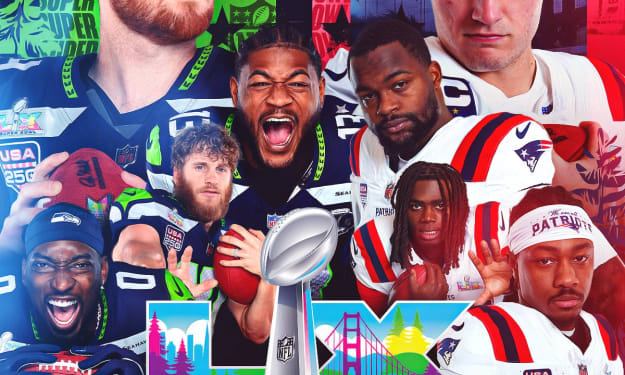
Sixty. The Super Bowl turned 60! Still amazes me that this was the sixtieth Super Bowl played in NFL history. It seems like yesterday that I watched Super Bowl XXVII, the first SB I ever watched. The QB who won Super Bowl XXVII has since called a few SBs, and will call next year's game, but that's another story. Super Bowl LX took place at Levi's Stadium in Santa Clara, California, the home stadium of the San Francisco 49ers. However, it was one of their division foes who represented the NFC, as the Seattle Seahawks faced off against the New England Patriots.
By Clyde E. Dawkins23 days ago in Unbalanced
Ready for the Stretch
It was a very interesting and fruitful Saturday for this hockey and wrestling fan. On that day, Chicago's United Center hosted the annual Elimination Chamber event, which serves as the final PPV (or PLE) stop before WrestleMania. While that was going on, the Colorado Avalanche hosted the Chicago Blackhawks, with the Avs donning the division rivalry alternates for the second straight game. The Avs were coming off a terrible loss to the Minnesota Wild, so we were looking to take that out on somebody.
By Clyde E. Dawkins3 days ago in Unbalanced
I wanted to title this something different, but worried that my chosen title might cause problems entering the United States in the future so this is the new title. It's the greatest title. No one has ever written a title better than this. (All titles unrelated to content).
Let me be honest. I am finding this difficult. Now, I like a challenge, a stretch, a bit of an obstacle course. “Write about the decline of the British Empire in the form of a narrative poem in which your protagonist is an artichoke” I read, and flex my fingers. “Write a haiku to evoke the sensation of sibilance using only the first half of the alphabet.” “Well”, I think to myself, “this should be fun.” But “write about a system that isn’t working”? A system that isn’t working? Now? In 2026? ONE system? My favourite system that isn’t working? The sexiest system that isn’t working? The one giving me the most angst day to day? The one giving me the most existential dread? I am, as I say, finding this difficult. I will own that I have contemplated writing a thousand words on why the steady “all on” setting on my fairy lights is the EIGHTH of seven options which must be sequentially activated to get there, because that is a system that some fool came up with and it definitely doesn’t work, and now who is paying the price, eh? But how can I write about my fairy lights when…. When…. When….
By Hannah Moore6 days ago in Humans



Comments
There are no comments for this story
Be the first to respond and start the conversation.