
The Night Basketball Felt Like Home
How a Winter Game in a Packed Arena Taught Me That Belonging Has Nothing to Do with the Score


I didn’t go for the basketball. I went because my son asked me to.
He’s eleven, wears his hair in messy curls, and talks about the game like it’s poetry written in motion. “You have to see how they move together, Dad,” he’d said, eyes wide. “It’s like they’re speaking a language only they understand.”
So I went—even though I hadn’t been to a live game since I was his age, sitting next to my father in a chilly arena, sharing a bag of peanuts and a silence that felt like love.
That night, the arena buzzed with something I hadn’t felt in years: wonder. Not the kind you get from highlights or stats, but the quiet awe of watching strangers move as one body—passing, cutting, trusting without words.
And then I saw them: two young players, barely older than college kids, dancing across the court. One with lightning in his feet, the other with calm in his eyes. They weren’t just teammates. They were in conversation—a glance, a spin, a no-look pass that landed like a promise kept.
My son leaned over. “See that? That’s trust.”
In that moment, I understood: this wasn’t about winning. It was about connection.
I thought of my father, who never talked much but always showed up—on weekends, at games, in hospital rooms. He didn’t need to say “I love you.” He said it by being there.
That’s what this game felt like: love in motion.
Later, a play broke down. The ball bounced loose near our section. One player dove, slid across the floor, and saved it out of bounds—right at my son’s feet. He caught it, stunned, and the player looked up, smiled, and tapped his own chest like, “You got this.”
My son held that ball like it was holy.
On the drive home, he didn’t talk about the score. He talked about the dive. “He didn’t have to do that,” he said. “But he did. For the team.”
And I knew: he wasn’t just learning basketball. He was learning how to show up for people.
I’ve spent most of my adult life chasing success—promotions, paychecks, the illusion of control. But in that arena, none of it mattered. What mattered was the man beside me sharing his popcorn with a stranger. The woman leading a chant for a player no one knew. The way 20,000 people rose as one when the underdog made a free throw.
This wasn’t entertainment. It was ritual.
In a world of digital isolation, where connection is reduced to likes and follows, a live game is one of the last places where presence still matters. Where showing up—cold, tired, hopeful—is its own kind of love.
My son fell asleep in the car, jersey wrinkled, sneakers scuffed, one hand still clutching the ticket stub like a relic. And I thought: This is why we still watch.
Not for the highlights. Not for the stats.
But for the moments that remind us: you don’t have to be perfect to belong. You just have to show up—and play like you mean it.
And sometimes, that’s enough to carry you through the winter.
Since then, I’ve thought about that night often—especially when life gets heavy. I don’t need to know the standings or the stats. I just need to remember: there are places in this world where you don’t have to be perfect to belong. You just have to be there.
That’s the real magic of basketball.
Not the dunks or the blocks.
But the hand on a teammate’s back after a mistake.
The shared breath before the final play.
The quiet understanding that we’re all just trying to stay in the game.
And as I looked at my son’s peaceful face in the streetlight, I knew: the game wasn’t over.
It was just beginning—for him.
#Basketball #FatherAndSon #HumanConnection #Belonging #HopeFor2026 #RealMoments #Presence #Teamwork #Legacy #SharedHumanity
Disclaimer
Written by Kamran Ahmad from personal reflection and lived experience.
About the Creator
KAMRAN AHMAD
Creative digital designer, lifelong learning & storyteller. Sharing inspiring stories on mindset, business, & personal growth. Let's build a future that matters_ one idea at a time.
Keep reading
More stories from KAMRAN AHMAD and writers in Unbalanced and other communities.
The Night the World Held Its Breath
I don’t remember most New Year’s Eves. But I remember the one in 2020. The world was silent. Streets were empty. And yet, at 11:59 p.m., I sat alone on my couch, eyes fixed on a glowing sphere in a city I’d never visited, tears streaming as strangers on screen counted down to a year none of us were sure we’d survive.
By KAMRAN AHMAD2 months ago in Unbalanced
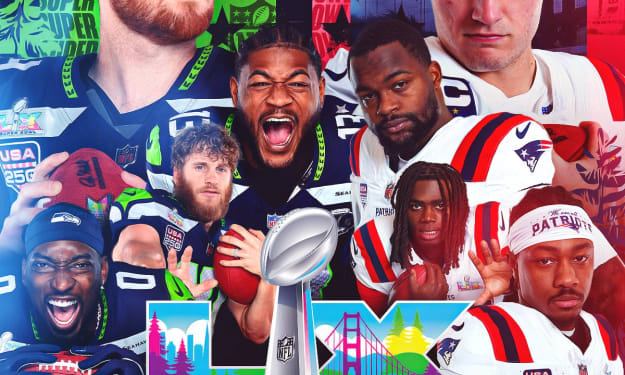
Super Bowl LX Recap: A Team Called Hawks
Sixty. The Super Bowl turned 60! Still amazes me that this was the sixtieth Super Bowl played in NFL history. It seems like yesterday that I watched Super Bowl XXVII, the first SB I ever watched. The QB who won Super Bowl XXVII has since called a few SBs, and will call next year's game, but that's another story. Super Bowl LX took place at Levi's Stadium in Santa Clara, California, the home stadium of the San Francisco 49ers. However, it was one of their division foes who represented the NFC, as the Seattle Seahawks faced off against the New England Patriots.
By Clyde E. Dawkins19 days ago in Unbalanced
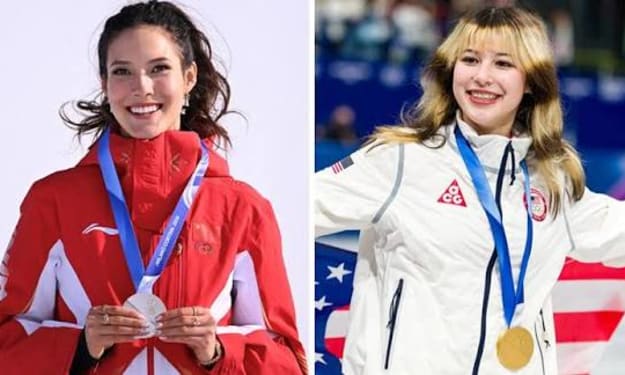
Alysa Liu vs Eileen Gu — How Two Chinese American Stars Wound Up on Opposite Sides of an Olympic Proxy War
The rivalry between Alysa Liu and Eileen Gu has come to symbolize more than athletic competition. As both athletes rise to global prominence at the Winter Olympics, their contrasting national affiliations have turned them into unlikely figures in a broader geopolitical struggle between the United States and China. Though they share Chinese heritage and were both raised in the United States, Liu and Gu have made different choices about which flag to represent. Those decisions have placed them at the center of heated debate over identity, loyalty, and the politicization of sport. Two Paths from Similar Beginnings Alysa Liu grew up in California and became one of America’s most promising figure skaters at a young age, winning national titles and emerging as a symbol of the U.S. skating future. She competes under the American flag and has consistently emphasized her identity as an American athlete shaped by the U.S. training system. Eileen Gu, by contrast, made headlines when she chose to compete for China despite being born and raised in San Francisco. Her decision transformed her into a national celebrity in China and a marketing icon with sponsorship deals and widespread media coverage. Both athletes have said their choices were personal and rooted in family ties and opportunity rather than politics. Yet their visibility has ensured that their decisions are interpreted politically whether they intend it or not. Media and Public Reaction In the United States, Gu’s decision sparked controversy and accusations of divided loyalty, while others defended her right to define her own identity. In China, she was celebrated as a homegrown champion returning to her cultural roots. Liu, meanwhile, has been portrayed by American media as a symbol of domestic talent and perseverance, with her Olympic performances framed as part of the U.S. sporting narrative. Chinese social media users have sometimes contrasted her path with Gu’s, turning two athletes into symbols of competing national pride. “Neither athlete asked to become a political statement,” said one sports sociologist. “But in today’s climate, elite athletes with dual cultural identities are inevitably drawn into geopolitical narratives.” Sport as a Proxy Battleground The rivalry reflects how the Olympics increasingly function as a stage for soft power competition. Medal counts and star athletes are viewed as reflections of national systems and global influence. Gu’s success for China has been presented domestically as proof that China can attract global talent and compete with Western sports powers. Liu’s performances for the United States reinforce the American emphasis on individual achievement and freedom of choice. This dynamic has fueled what some commentators call an “Olympic proxy war,” where athletic outcomes become symbolic victories in a wider ideological contest. Personal Cost Both athletes have faced intense scrutiny online. Gu has been targeted by critics in the U.S. accusing her of exploiting opportunities in both countries. Liu has endured pressure to perform not only as an athlete but as a representative of American values. Friends and coaches say the athletes have tried to shield themselves from political commentary and remain focused on training. Yet the weight of expectations is difficult to escape. “These are young women who want to skate and ski,” said a former Olympic coach. “Instead, they’re being treated like diplomats.” What It Says About Identity The Liu-Gu divide highlights a deeper tension faced by many Chinese Americans navigating multiple cultural identities in a polarized world. Their stories show how personal heritage can be reframed as political allegiance under international spotlight. Rather than a simple rivalry, their parallel careers illustrate two valid expressions of identity: one rooted in birthplace and opportunity, the other in heritage and cultural connection. Looking Ahead As future Olympic Games approach, both athletes are expected to remain central figures in their respective national teams. Whether their rivalry continues to be framed politically may depend less on them and more on the evolving relationship between Washington and Beijing. For now, Alysa Liu and Eileen Gu remain linked in public imagination — not because they compete directly, but because their choices represent opposite sides of a cultural and political fault line that extends far beyond sport. Their journeys remind the world that in the modern Olympics, medals are no longer just about athletic excellence. They are also about identity, narrative, and the power of symbols in an age of global rivalry.
By Fiaz Ahmed 7 days ago in Unbalanced


Comments
There are no comments for this story
Be the first to respond and start the conversation.