
The Legend of Mikheil Khergiani
A remarkable life cut short too early
He was buried in a closed casket.
When I asked his cousin's son, who was giving me a tour of Mikheil's house in Mestia, Svaneti, how the Italians had managed to retrieve his body, my guide replied honestly, "I don't know. I was five when he died. I don't think anyone knows, and I don't want to think about how badly his body was damaged. He plummeted from 600 meters of Mount Su-Alto in the Italian Alps. I do know it took days for his body to be retrieved. His funeral was almost three weeks after he died, hence the closed casket."
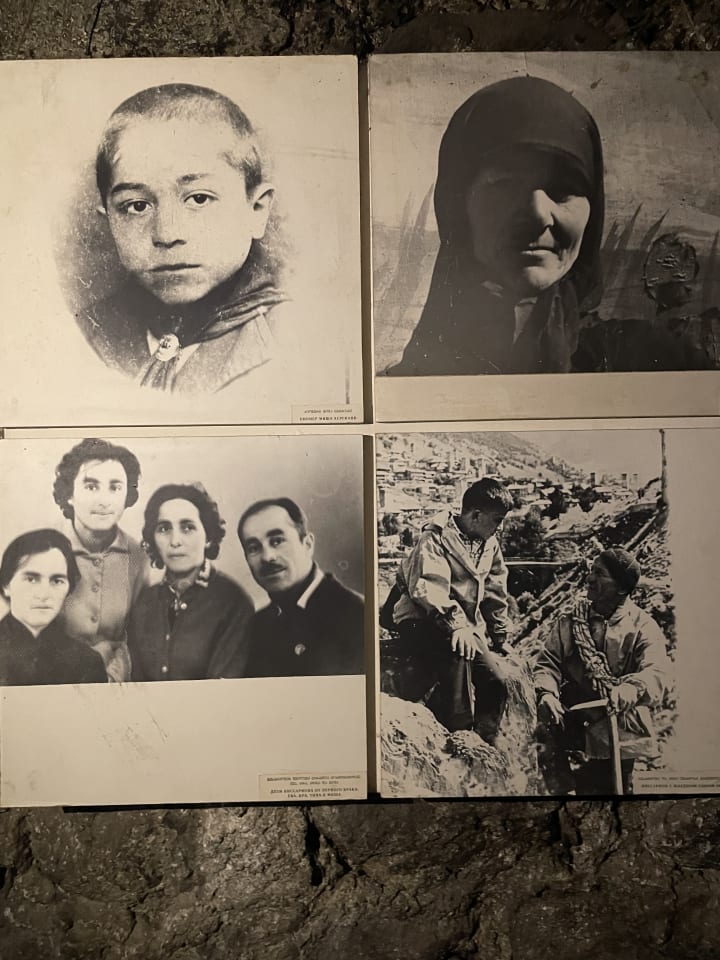
At this point, we were standing near the pictures of the funeral in Khergiani's house. The entire town of Mestia, and a lot of Georgian dignitaries and prominent mountaineers came to pay their respect. What I am struck by in the photo are the images of Mikheil's mother and young wife, clad in black, and stricken with unimaginable grief.
Even though I was born a year after he died, I knew of Khergiani. When I was climbing mountains in my youth, he was always used as an example of endurance and uncanny ability to climb rock sheets. For any mountaineer, it was an honor to be compared to the "Tiger of the Rocks," as Khergiani was nicknamed by Baron John Hunt, the leader of the 1953 British Mount Everest expedition.
He was a true legend among mountain climbers. In the USSR, the term for mountain climbers was "alpinist" and I am going to use it here a lot because that's what Mikheil really was - a climber of snow-covered (Alpine) mountains, mountaineer.
Even though in the Soviet Union no one would call him a "professional" climber because all sport in the USSR was officially considered amateur, non-commercial, climbing was all he knew and loved.
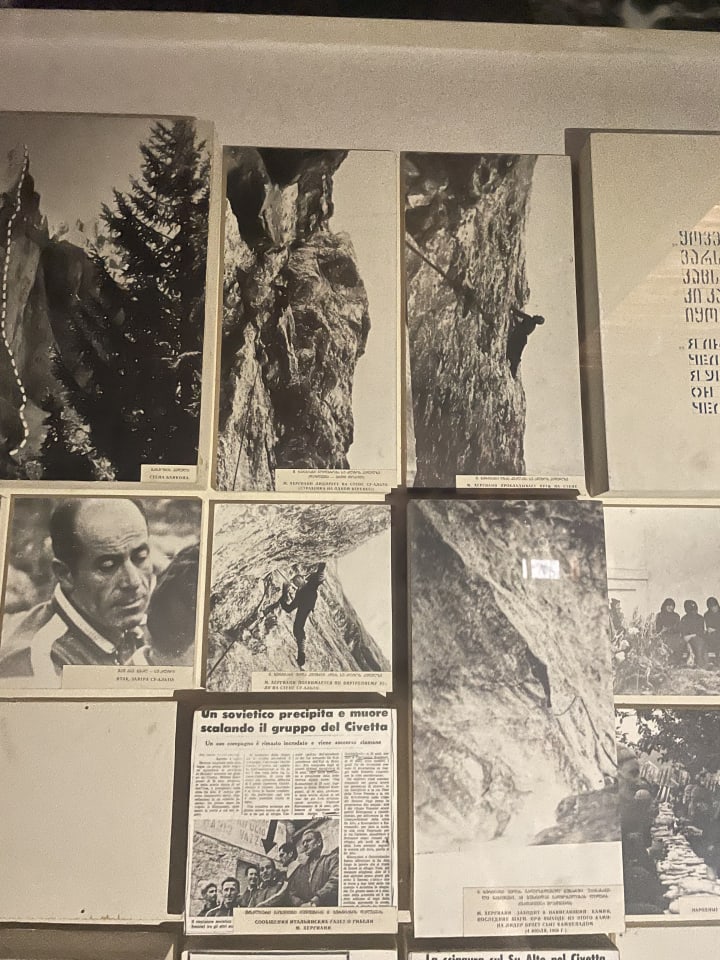
Born in 1932, Mikheil was only five when his father, Vissarion Khergiani, one of the first well-known Svan climbers, scaled the difficult two-peaked Georgian mountain Ushba in 1937. In 1964, Mikheil ascended Ushba's mirror in an almost perfect vertical line - a fit no one was able to do before his group. He dedicated the ascend to his father.

From early childhood, Mikheil was exposed to his father's stories about mountain climbing, roamed the surrounding mountains, climbed rocks, and practiced alpine skiing and traditional Svan wrestling.
When he finished secondary school, Mikheil enrolled in All-Union Central Council of Trade Unions' (AUCCTU) mountain climbing instructor courses in 1951. Upon completion, he worked first as an instructor in a mountain climbing camp (1952-56) and later, until his death in 1969, headed the rock-climbing rescue team at the Spartak Alpinist Camp at Mt. Shkhelda.
Khergiani was the most decorated alpinist of his time, not only in terms of his personal achievements but also for saving lives of other climbers stranded in the Great Caucasus Mountains. Here's an incomplete list of his most significant achievements:
1946 — Awarded the “Mountaineer of the USSR” badge.
1952 — Fulfilled the standards for Class II in mountaineering and became AUCCTU champion in rock climbing.
1956 — Awarded the title Master of Sports of the USSR. Champion of the USSR for the first ascent of the north face of Tyutyubashi (together with Yu. Murzaev, L. Zanilov, and A. Sinkovsky).
1957 — Third place at the USSR Championship for the first ascent of the northwest face of Donguz-Orun, climbing as a rope team with Iosif Kakhiani.
1963 — Awarded the title Honored Master of Sports of the USSR.
1964 — USSR Champion, Ushba via the “Mirrors” route (as part of a group including: Misha Khergiani (his cousin), Shaliko Margiani, Jumber Kakhiani, Givi Tserediani, and Jokia Gugava).
1966 — Awarded the Order of the Badge of Honor for outstanding athletic achievements.
In total, Khergiani became USSR Champion in rock climbing seven times. Imagine all of that in the 1950-60s, when there was nothing like the modern equipment and gear available for mountaineers nowadays. These pictures of Khergiani's equipment will humble any climber today.


Khergiani was also a very humble man, as the following quote from the display of his badges, medals, and orders at his house museum shows:
My biggest achievement is not my medals. My biggest achievement as a climber is that I have saved many lives. My heart fills with joy and happiness when I save lives of people.

He was one of the few Soviet alpinists who were so good they were allowed to travel outside the USSR to train and compete internationally. The fateful July 1969 trip was his second to the Italian Alps, where a group of Soviet mountaineers intended to complete a series of striking climbs. For that reason, it was a well-documented trip, with pictures taken at different points. They planned to finish their journey with an ascent of Mount Su-Alto from the town of Alleghe.
For this final climb, Khergiani was joined with a Moscow climber, Vyacheslav Onishchenko. Leading the ascent, Khergiani was suddenly struck by a rockfall and thrown from the mountain wall. Onishchenko, who was positioned around a bend and could not see what happened, heard the roar of falling stone and a cry, and instinctively braced himself for a strong pull of the rope as Khergiani did not have a safety rope. The pull came, but only for a moment. Almost immediately, the rope fell slack: it had been cut by rocks from the same collapse.
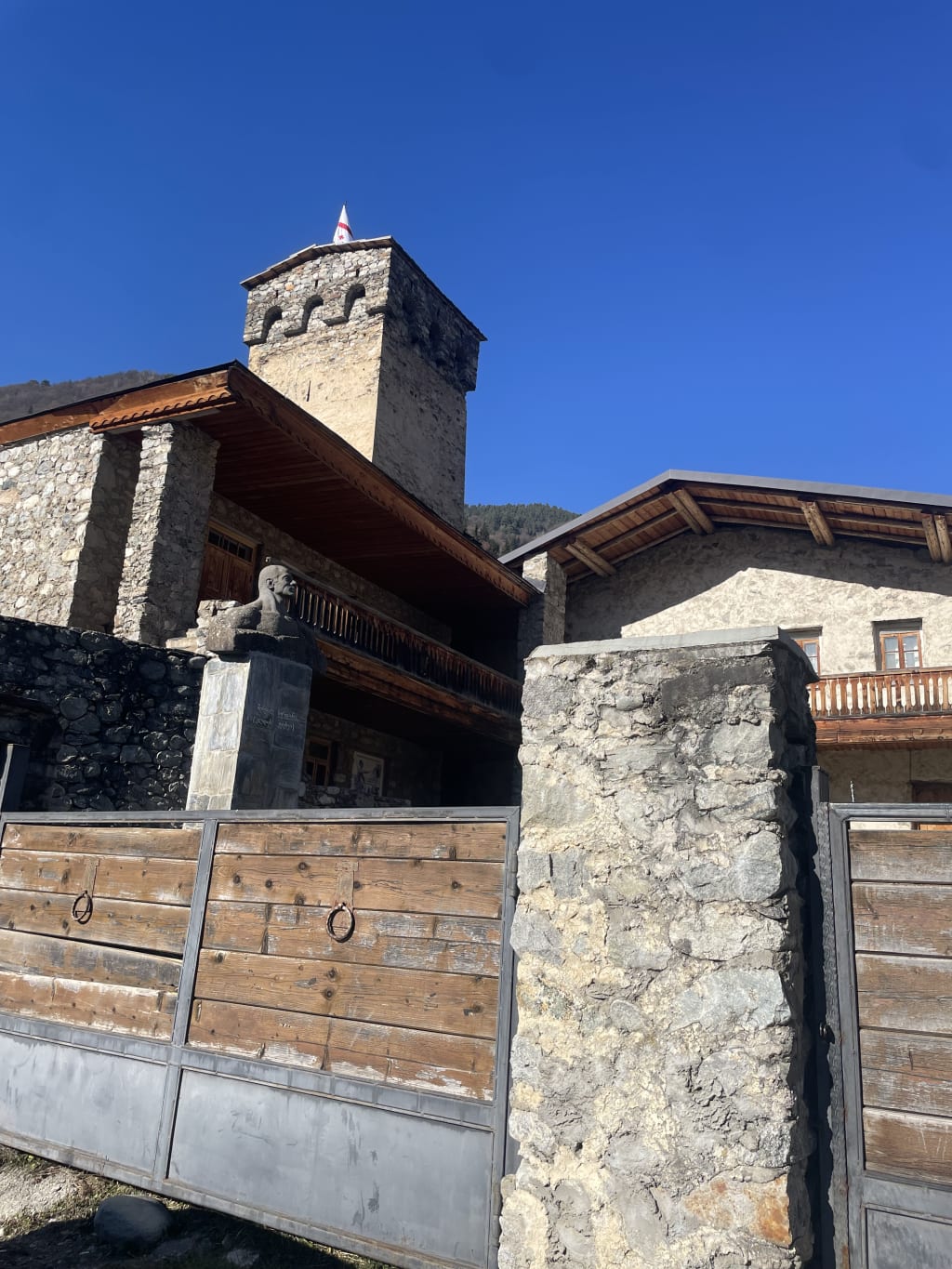
In 1985, Khergiani's relatives (he'd married only a couple of years before his death and had no children) established a museum in the family house he was born in and lived all his life in Mestia, Svaneti region of Georgia.

It houses a lot of artifacts from his life, as well as things that commemorate his achievements and legacy, including books and songs about him as well as paintings of him.

It is one of the most interesting, welcoming and warm museums in the country. If you are ever in Mestia, you absolutely need to visit it.
About the Creator
Lana V Lynx
Avid reader and occasional writer of satire and short fiction. For my own sanity and security, I write under a pen name. My books: Moscow Calling - 2017 and President & Psychiatrist
@lanalynx.bsky.social
Keep reading
More stories from Lana V Lynx and writers in Unbalanced and other communities.
Sweden’s Lindström to Remain Hospitalized After Big Crash at Milan Cortina Paralympics
CORTINA D’AMPEZZO, Italy — A major crash during a competitive event at the 2026 Winter Paralympics has left Swedish para‑alpine skier Aaron Lindström hospitalized and under close medical observation, officials confirmed Tuesday. The 25‑year‑old, one of Sweden’s top medal hopes, will remain in hospital for at least two days after suffering a severe concussion and a minor collapsed lung following his fall in the standing Super‑G race. The incident occurred on Monday during the Super‑G event, a high‑speed alpine skiing discipline that challenges athletes to navigate a course with fewer, more widely spaced gates than in giant slalom, demanding precision and courage at breakneck speeds. Lindström, who had shown promising form at the Games, was pushing for a top finish when disaster struck. Television replays and eyewitness accounts describe how Lindström lost control after a jump on the course. He became unbalanced in the air and landed heavily, tumbling before coming to a stop. The impact was strong enough that he lay on the slope for several minutes as medical personnel rushed to attend to him. The organizers temporarily halted the race while Lindström was treated on the scene. After initial on‑course care, he was transported down the mountain on a stretcher and taken directly to a hospital in Cortina d’Ampezzo. Swedish Paralympic officials later posted an image on social media showing Lindström in his hospital bed, smiling alongside his parents, suggesting his spirits remained resilient despite his injuries. According to the Swedish Paralympic Committee and team medical staff, Lindström’s primary injuries include a significant concussion — typically caused by a violent blow to the head — and evidence of a minor collapsed lung, a condition that can accompany chest trauma and warrants careful observation. Doctors have decided to keep him in hospital for at least 48 hours to monitor both conditions and ensure no further complications arise. Lindström’s crash shocked spectators and competitors alike, as he had been coming off a strong performance earlier in the Games. Just days before the Super‑G, he placed fourth in the downhill standing event — narrowly missing a medal and demonstrating competitive form among the world’s best para‑alpine skiers. Para‑alpine skiing is known for its speed and intensity, making it one of the most dramatic and risk‑laden sports at the Winter Paralympics. Athletes race down steep, icy slopes at high velocities, using adapted equipment based on their classification. Standing skiers like Lindström rely on balance and precision — a slight misstep can lead to serious consequences. Coach Joel Åkerström described the moment of the crash as frightening. According to Swedish media reports, Lindström initially appeared disoriented immediately after hitting the slope, a common sign of concussion. Yet despite the severity of the tumble, the young athlete was able to lift himself and wave to the crowd before being removed from the course. “This was a very tough moment for us all,” Åkerström said. “He was so close to a medal here, and to see him go down like that was distressing. But Aaron is a fighter, and his positive attitude is clear.” He emphasized that the priority now is Lindström’s recovery and long‑term health. The interruption of the race attributed to Lindström’s accident also reflected the high‑stakes nature of Paralympic competition. Super‑G events draw a deep field of talented athletes from multiple nations, and a crash at such speeds can quickly become a focal point for safety discussions and strategy adjustments for teams competing later in the Games. Despite this setback, Sweden’s Paralympic team remains active in competition. Team members and officials have reiterated their support for Lindström and their commitment to the rest of the Nordic squad’s performance goals at the 2026 Games. The Paralympics, which bring together athletes from around the world with varying physical challenges, emphasize resilience and the spirit of competition — qualities Lindström has already exemplified in his career. Aaron Lindström’s journey to elite para‑alpine skiing began early in life. Born in Sweden with an upper‑limb difference, he embraced skiing as a child and steadily progressed through international competition ranks. He has represented his nation in multiple events, including the 2018 and 2022 Winter Paralympics, showcasing both skill and tenacity. As the Winter Paralympics continue, medical updates on Lindström’s condition are expected from team officials. While the road to recovery can vary for concussions and lung injuries, the extended hospitalization suggests caution and thorough care by the medical staff — both crucial for an athlete whose future competitions hinge on full physical recuperation. Spectators and fellow competitors alike are wishing Lindström well as the Games progress, hoping that this terrifying moment can become a chapter in a comeback story rather than a career‑ending incident. For now, attention remains on his recovery and on the thrilling yet unpredictable drama of Paralympic competition.
By Fiaz Ahmed 2 days ago in Unbalanced
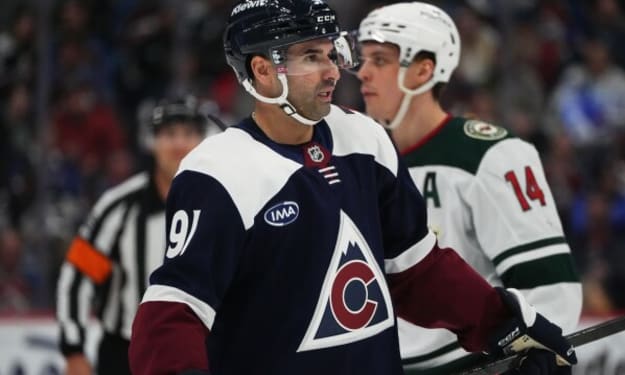
Welcome Back, Nazem Kadri
Some things just feel right, but more on that later. Coming off a big road win in Dallas, the Colorado Avalanche returned home and faced off against the other thorn in the division: the Minnesota Wild. This was big day game for the Avs, not just because of the division rivalry, but the fact that the Avs' deadline acquisitions would be playing at Ball Arena. Scott Wedgewood was in net against Jesper Wallstedt, and the game was off to an amazing start. Avs were shooting at will, bringing some early pressure towards Wallstedt.
By Clyde E. Dawkins3 days ago in Unbalanced



Comments (7)
What a wonderful article about an Alpinist who found joy in saving others. That mirror ascend path is spooky. I can't imagine how he accomplished that climb.
What a fascinating man, and he was a hero, saving lives in the mountains until he died. Thanks for informing us about his life <3
Oh wow, all those achievements and I've never even heard of him. Thank you for sharing about him with us!
I'd never heard of him but he sounds like a marvellous man.
Truly remarkable and these people were stronger than we could ever be , in spirit and will. Great article
What interesting and insightful piece on this man. Though I'd never heard of him before, I found his story quite inspiring and heartwarming. I love the quote you posted as well as the pictures of mountain climbing gear (or the lack thereof!). Such and interesting and admirable read, Lana. Thank you.
This is incredible. Thank you for sharing this, Lana!