
Senegal and Morocco Handed Heavy Fines and Bans Following Chaotic AFCON Final
CAF fines Senegal and Morocco over $1 million after AFCON final chaos, with coaches and players banned following controversial VAR scenes.

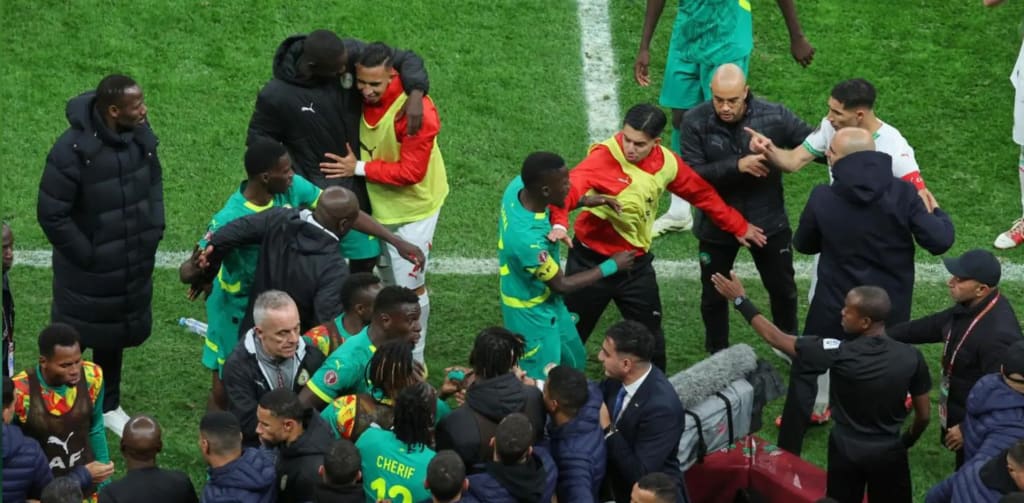
African football’s governing body has imposed sweeping sanctions on Senegal and Morocco following scenes of disorder that marred one of the most controversial Africa Cup of Nations finals in recent history. More than ten days after the dramatic showdown, the Confederation of African Football (CAF) confirmed fines exceeding one million dollars alongside multiple suspensions for players and coaching staff from both nations.
In a statement released on Wednesday, CAF detailed disciplinary measures stemming from what it described as widespread breaches of sporting conduct during and after the final. Senegal’s Football Federation received the heaviest punishment, with fines totaling $615,000 for the behavior of players and technical officials. CAF cited violations of its disciplinary code, specifically pointing to a failure to uphold principles of fair play, integrity, and loyalty to the game.
Senegal head coach Pape Thiaw was among those sanctioned most severely. CAF handed him a ban covering five of Senegal’s six qualifying matches for the 2027 Africa Cup of Nations and imposed an individual fine of $100,000. According to the governing body, Thiaw’s conduct during the final brought the game into disrepute and contributed to the volatile atmosphere surrounding the match.
Two Senegalese players, Iliman Ndiaye and Ismaila Sarr, were also punished for their actions toward match officials. Both players will miss the first two AFCON qualifying fixtures later this year after CAF ruled that their behavior toward the referee amounted to unsporting conduct.
The final itself descended into chaos after a late VAR intervention overturned a key moment. Senegal had a goal disallowed, and moments later Morocco were awarded a penalty following a video assistant referee review. In protest, Senegal’s players temporarily walked off the pitch, triggering confusion and unrest inside the stadium. Supporters attempted to breach the field of play, while confrontations reportedly broke out among journalists on the sidelines.
After a delay of approximately fifteen minutes, play resumed, only for Morocco to miss the controversial penalty. Senegal eventually prevailed in extra time to claim the AFCON title. In the aftermath, Morocco head coach Walid Regragui condemned the disorder, stating that the match had projected a shameful image of African football to the world.
CAF also imposed significant sanctions on Morocco and its football federation. Moroccan authorities were fined a total of $315,000 for what CAF described as unsporting and improper conduct involving players, coaching staff, supporters, and stadium officials.
The single largest portion of Morocco’s fine—$200,000—was issued over the behavior of stadium ball boys. During the match, several attempted to confiscate a towel being used by Senegal goalkeeper Edouard Mendy on a rain-soaked night in Rabat, apparently in an effort to distract him during play.
An additional $100,000 fine was levied after Moroccan players and technical staff were found to have invaded the VAR review area, obstructing the work of Congolese referee Jean-Jacques Ndala. CAF also fined Moroccan supporters $15,000 for using laser devices in an attempt to distract Senegalese players during key moments of the game.
Individual bans were also handed down to Moroccan players. Captain Achraf Hakimi received a two-match suspension, with one match suspended, while midfielder Ismael Saibari was banned for three matches. Both were found guilty of unsporting behavior during the final.
Morocco’s appeal to have the match result annulled was rejected outright. The Moroccan federation had argued that Senegal’s temporary walk-off justified canceling the outcome and awarding victory to the hosts, but CAF dismissed the claim after reviewing the incident.
Despite the controversy, both nations remain central figures in global football’s immediate future. Morocco is set to co-host the 2030 FIFA World Cup and will also stage the FIFA Women’s Under-17 World Cup annually for five consecutive years. Senegal, meanwhile, continues to build on its reputation as one of Africa’s most consistent international sides.
Looking ahead, both teams are preparing for the 2026 World Cup in the United States, Mexico, and Canada. Senegal has been drawn into Group I alongside France, Norway, and the winner of the intercontinental playoffs involving Bolivia, Suriname, or Iraq. However, the reigning African champions may have to compete in key matches without sections of their fan base, depending on further disciplinary decisions.
Morocco will compete in Group C, where they face Brazil, Scotland, and Haiti. The Atlas Lions will aim to build on their historic achievement at the 2022 World Cup in Qatar, where they became the first African nation to reach the semifinals.
While the AFCON final delivered unforgettable drama on the pitch, CAF’s decisive response underscores its intent to restore discipline, credibility, and respect across African football.
About the Creator
TheHonest Publishing
The Honest Publishing delivers fresh, reliable updates on the latest news, sharing insightful stories, trends, and news that keep readers informed and ahead.
Keep reading
More stories from TheHonest Publishing and writers in Unbalanced and other communities.
Will AI Replace Finance Professionals?
Artificial intelligence has rapidly transformed the finance industry, reshaping how data is analyzed, decisions are made, and services are delivered. From algorithmic trading to automated accounting systems, AI-driven tools are becoming more sophisticated and widely adopted. This rapid evolution has sparked a pressing question across the financial world: will AI replace finance professionals, or will it redefine their roles instead?
By TheHonest Publishing10 days ago in The Swamp
Wild Card Weekend Recap: What Happens Now?
I think I figured out why I love Wild Card Weekend so much. It's because it's the first playoff anything of the calendar year. The NFL season starts in the fall, and once upon a time, the champion was crowned either on or slightly before New Year's. The evolution of the NFL schedule has resulted in the playoffs starting just into the New Year, and currently, the final week of the season falls on the first weekend of the New Year, with Wild Card Weekend coming a week after that. So yes, chronologically, the NFL's Wild Card Weekend serves as the first playoff anything of the calendar year.
By Clyde E. Dawkins19 days ago in Unbalanced
A Look Back: Rey Mysterio's Road to WrestleMania 22
Without question, the Royal Rumble is my all-time favorite event. You would think I'd say WrestleMania, but the Rumble is where it's at. The Royal Rumble Match has all of the chaos of the NHL's Stanley Cup Playoffs, and it's all rolled up into an hour-long match. Since 2018, we now have two Royal Rumble Matches: a Men's match and a Women's match. Hard to believe that we are at Year Nine of the Women's Royal Rumble, when once upon a time, something like that was just a pipe dream.
By Clyde E. Dawkins3 days ago in Unbalanced
Instructions Included Challenge Winners
For the Instructions Included challenge, we asked writers to tell a story through instructions and to trust the form to carry what could not be said outright. Across the top entries, that trust paid off in many different ways.
By Vocal Curation Team4 days ago in Resources




Comments
There are no comments for this story
Be the first to respond and start the conversation.